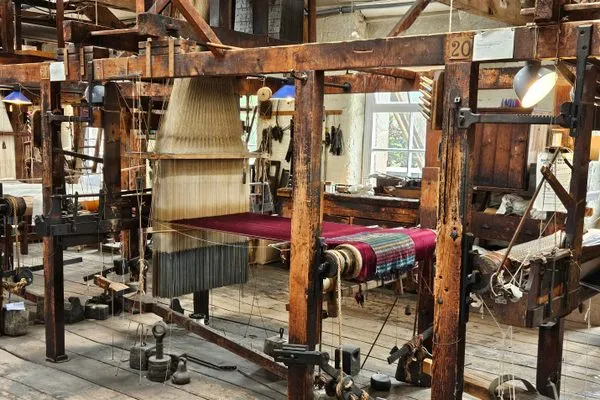
Macclesfield's textile industry once dressed Europe's wealthy. In the 1800s, the northwest English town hummed with silk mills producing hand-loomed luxury that traveled across continents. Then the industry collapsed. By the late twentieth century, most mills had closed their doors for good.
Paradise Mill was one of them. It stopped production in 1981 after operating continuously since 1862, its looms falling silent after more than a century of work. For decades, the building sat empty—a Victorian shell holding nothing but dust and the memory of what it had been.
Then someone decided to bring it back.
Today, Paradise Mill operates as part of the adjacent Silk Museum, but "museum" undersells what's actually happening here. The top floor holds 26 Jacquard looms restored to working condition and positioned exactly where they stood when the mill operated. Walk upstairs and you step into 1920, except the machines aren't frozen behind velvet ropes. They're being used.
We're a new kind of news feed.
Regular news is designed to drain you. We're a non-profit built to restore you. Every story we publish is scored for impact, progress, and hope.
Start Your News DetoxThis is the crucial part: people are learning to operate these looms again. They're relearning the skills that took generations to develop—the hand movements, the pattern-reading, the intuitive knowledge of how to coax silk into intricate designs. The looms themselves are historical artifacts, yes. But the skills are alive.
It's a particular kind of preservation that goes beyond nostalgia. The mill's designers' offices and managers' offices remain intact, showing the full chain of how raw silk became luxury textiles. You can trace the journey from material to finished product, from blueprint to loom to finished bolt. But you can also watch someone actually do it.
Macclesfield's industrial heyday is long gone—that's not changing. The global economy shifted, manufacturing moved elsewhere, and that's the reality of the past 70 years. But Paradise Mill suggests something worth holding onto: that the knowledge embedded in these machines and the hands that operated them doesn't have to vanish completely. Some skills, some techniques, some ways of making things beautifully—those can be kept alive, even in a world that's moved on.
The mill stands as proof that industrial history doesn't have to be either a dead monument or entirely forgotten.