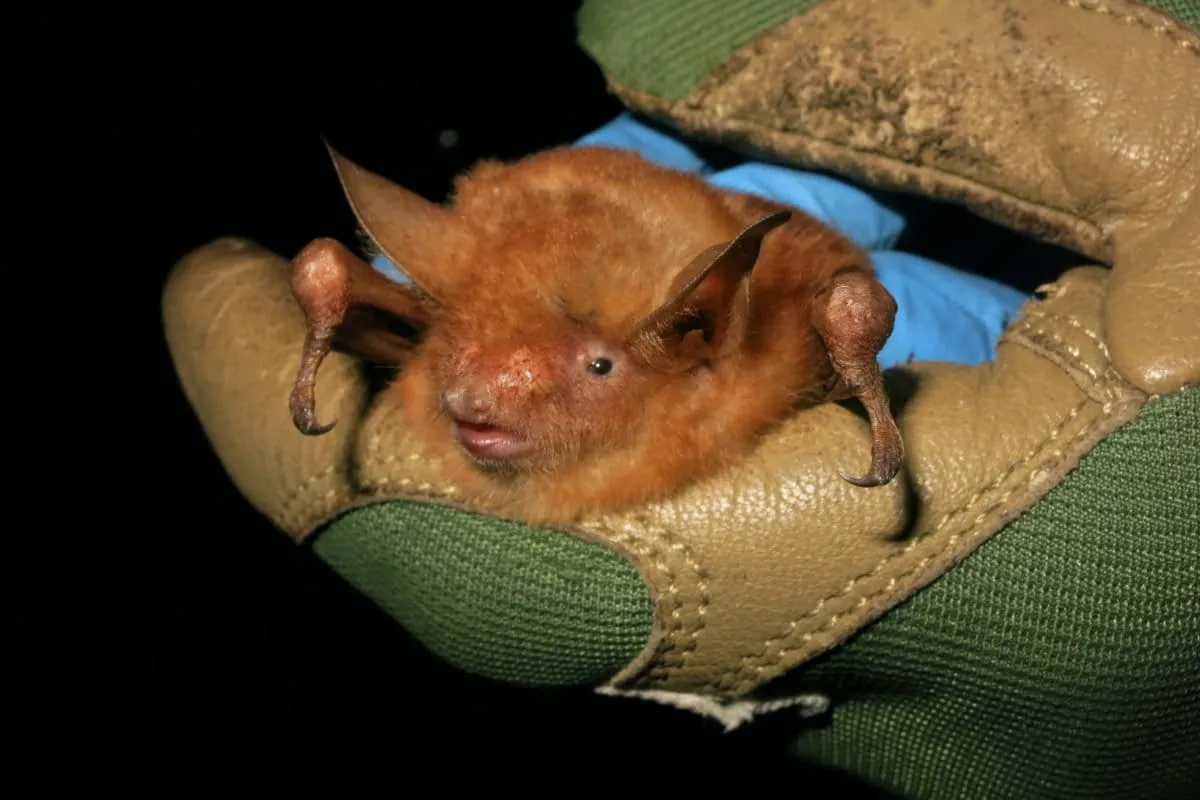
In 2018, researchers rappelling through abandoned mine shafts high in Guinea's Nimba Mountains found something unexpected: a bat with bright orange fur that science had never formally documented. The discovery of Myotis nimbaensis was thrilling for conservationists—and complicated for everyone else.
The bat emerged from a mystery. Local villagers around Nimba had reported sightings of an unusual orange-furred bat around 1,400 meters (4,600 feet) up the mountainside. When researchers from Bat Conservation International, Cameroon's University of Maroua, and the American Museum of Natural History explored the horizontal tunnels left behind from 1970s and '80s mining operations, they found the evidence: echolocation calls matching no known species, plus two trapped individuals—one male, one female—they could examine and release. By 2021, the species had a formal name and a published description.
The timing, though, made the discovery bittersweet. A U.S. mining company called Ivanhoe Atlantic is pursuing permits for a new open-pit iron ore mine in the same mountains—a UNESCO World Heritage Site already recognized for its extraordinary biodiversity. The newly identified bat doesn't just live in the region. It shelters in those abandoned mine tunnels, the very landscape an active mine would transform completely.
We're a new kind of news feed.
Regular news is designed to drain you. We're a non-profit built to restore you. Every story we publish is scored for impact, progress, and hope.
Start Your News DetoxWhat hangs in the balance
Open-pit mining reshapes terrain in ways that don't leave room for small, specialized species. The tunnels where Myotis nimbaensis roosts would likely be destroyed or rendered unusable. Beyond that: habitat fragmentation, water contamination, noise and light disruption—all documented threats to bat populations elsewhere. For a species known from only a handful of individuals in a single location, these aren't abstract risks.
Dr. Winifred Frick, Chief Scientist at Bat Conservation International, has been clear about what's needed: "We need to fully understand the distribution, ecology, and conservation status of Myotis nimbaensis before any mining activities can proceed." The Nimba Mountains harbor several other critically endangered species too. The ecosystem isn't just biodiverse—it's fragile, which is why it earned World Heritage protection in the first place.
Ivanhoe Atlantic says it's committed to environmental mitigation. Conservationists remain skeptical. They're not opposed to development in principle, but they argue the risks to this particular landscape are too high—and that alternative strategies prioritizing sustainable resource use deserve serious exploration.
The question now is whether a species discovered just a few years ago, still barely understood, will get the protection it needs before the machinery arrives.