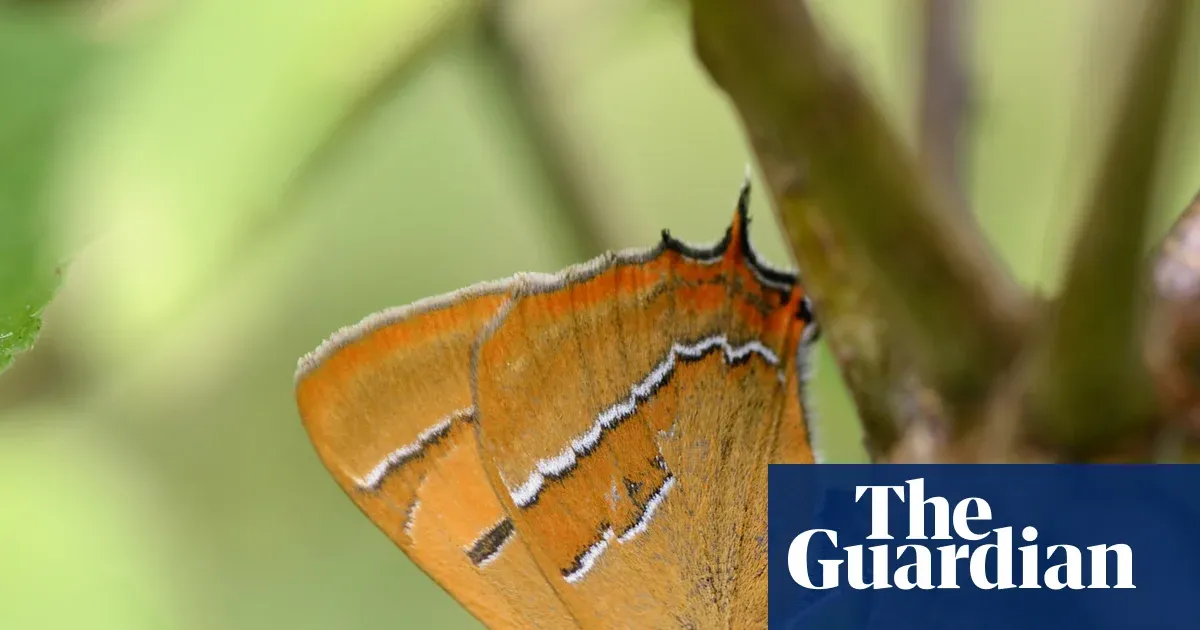
A small shift in how farmers manage their land has triggered something conservationists didn't expect to see again: a thriving population of brown hairstreak butterflies in southwest Wales.
The numbers tell the story. Volunteers counting eggs on blackthorn hedges found 276 on one stretch near Llandeilo, and 117 on another—both records, and a 50% jump from the year before. A decade ago, this butterfly was nearly gone from the Tywi valley. Now it's coming back.
The reason is almost mundane: people stopped cutting hedges every single autumn.
How a Simple Change Flipped the Trajectory
Brown hairstreak butterflies lay their eggs on blackthorn branches in late summer. When mechanical flails tore through hedgerows each fall—standard practice for decades—they destroyed thousands of eggs unknowingly. The caterpillars never got the chance to overwinter and emerge as adults in July.
We're a new kind of news feed.
Regular news is designed to drain you. We're a non-profit built to restore you. Every story we publish is scored for impact, progress, and hope.
Start Your News DetoxButterfly Conservation convinced local landowners to try something different: cut hedges in a rotating pattern, leaving sections untouched for up to three years. The shift sounds minor. The impact wasn't.
When a remnant population was spotted in 2021, the organization began annual egg counts and worked with the National Trust and local authorities to protect what remained and plant new blackthorn. Richard Smith, a volunteer with the South Wales branch, described it plainly: "after a decade of heartache, there is at last signs of an upturn."
This matters because brown hairstreak is what ecologists call an indicator species—a canary in the coal mine for hedgerow health. If the butterfly thrives, it signals that the balance is right for countless other species living in those same hedges: beetles, birds, small mammals, plants that depend on that structure.
The broader context makes the turnaround even more significant. The UK has lost roughly 40% of its hedgerows since the 1950s. Of what's left, less than half is in decent condition. Hedgerows are ecological infrastructure—corridors for wildlife, carbon storage, flood prevention—and they've been quietly disappearing for decades.
Dan Hoare, director of nature recovery for Butterfly Conservation, frames the opportunity simply: "We don't want to stop anyone managing their hedgerows, but if they're only trimmed once every two years, or even every three years, it could make an enormous difference."
The Welsh government's new Sustainable Farming Scheme actually requires avoiding annual hedge flailing, which means the conditions that allowed this butterfly to recover are now being written into policy. The brown hairstreak isn't just bouncing back in one valley anymore—the framework is shifting to make recovery possible across the region.
What started as a handful of volunteers counting eggs on a handful of hedges has become something bigger: proof that you don't need to rewild vast tracts or overturn entire systems. Sometimes the most effective conservation is just asking people to cut back on the cutting back.