Satellite data spanning two decades reveals something unprecedented: the world's oceans are rapidly filling with seaweed. Researchers at the University of South Florida analyzed 1.2 million satellite images between 2003 and 2022 using artificial intelligence to track floating algae, and what they found marks a turning point in how our oceans function.
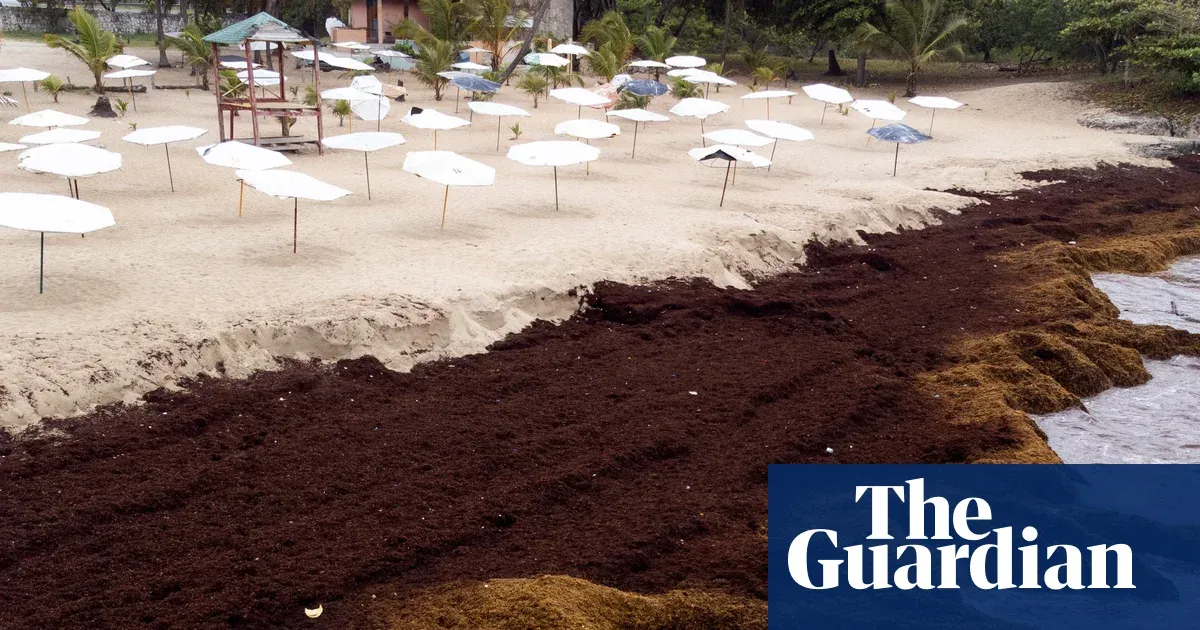
Seaweed blooms have expanded by 13.4% annually in tropical Atlantic and western Pacific waters, with the steepest increases happening after 2008. Before that year, major seaweed blooms were essentially absent from most of the world's oceans. Now they're visible from space—the Great Atlantic Sargassum Belt stretches from the Gulf of Mexico to the Congo's mouth, while rings of algae frame the Chatham Islands off New Zealand.
"On a global scale, we appear to be witnessing a regime shift from a macroalgae-poor ocean to a macroalgae-rich ocean," said Chuanmin Hu, the study's senior author. That's significant language. A regime shift means the ocean isn't just changing incrementally—it's crossing a threshold into a fundamentally different state.
We're a new kind of news feed.
Regular news is designed to drain you. We're a non-profit built to restore you. Every story we publish is scored for impact, progress, and hope.
Start Your News DetoxWhat's Driving the Blooms
Global heating is the primary culprit, but it's not acting alone. Agricultural runoff and other pollutants are enriching coastal waters with excess nutrients, creating conditions where seaweed thrives. The timing tells the story: most of the acceleration happened in the most recent decade, aligning with accelerated ocean warming since 2010.
What makes this shift particularly striking is what isn't happening. While seaweed is booming, phytoplankton—the microscopic algae that forms the base of ocean food webs—are growing at a much slower rate (just 1% annually). This suggests phytoplankton are more sensitive to temperature shifts and nutrient imbalances, meaning different parts of the ocean ecosystem are responding to stress in entirely different ways.
Why This Matters
The consequences ripple outward. Dense seaweed mats darken the waters below, altering light availability and changing the chemistry of the ocean itself. They affect carbon sequestration—the ocean's ability to absorb and store carbon dioxide. They disrupt the stability of the upper ocean layers where most marine life concentrates. And because seaweed absorbs and releases heat differently than open water, these blooms may even influence atmospheric conditions and climate feedback loops.
The researchers identified specific tipping points in 2008, 2011, and 2012 for different seaweed types in different regions, suggesting the ocean didn't drift gradually into this new state—it shifted. The study, published in Nature Communications, represents the first truly global picture of floating algae in our oceans, made possible by combining satellite technology with machine learning.
This isn't a problem that will reverse on its own. But understanding exactly what's happening—and when it started accelerating—gives scientists the baseline they need to monitor what comes next and explore whether this trajectory can be slowed.