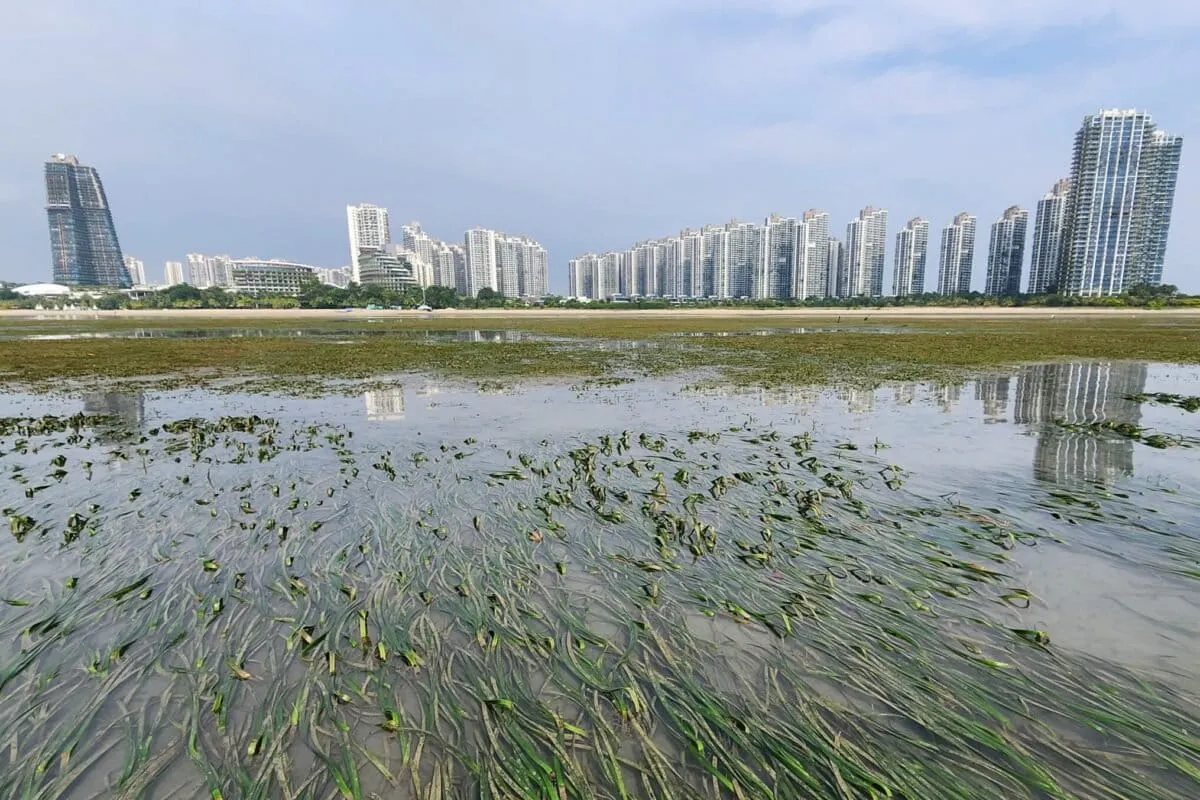
In the shallow waters off Johor Bahru, crabs and marine worms now move through a wafting seagrass meadow. A decade ago, this patch of ocean floor was barren.
In 2014, a massive land reclamation project called "Forest City" sent sediment plumes across the Merambong Shoal, one of Malaysia's most extensive seagrass beds. The dredging destroyed roughly 10 hectares (25 acres) of meadow in weeks. Seagrasses—flowering plants, not seaweeds—filter pollutants, cycle nutrients, lock away carbon, and shelter thousands of marine species. Losing them meant losing all of that.
The Department of Environment issued a stop-work order, but the damage was done. The developer, Country Garden Pacificview, brought in marine scientists from the University of Putra Malaysia to try reversing it.
We're a new kind of news feed.
Regular news is designed to drain you. We're a non-profit built to restore you. Every story we publish is scored for impact, progress, and hope.
Start Your News DetoxWhat worked: mixing species, not betting on one
Over ten years, researchers transplanted seedlings of four fast-growing seagrass species: Halophila ovalis, Halodule uninervis, Cymodocea rotundata, and Syringodium isoetifolium. They chose these based on what thrives in local conditions. The survival rate reached 66% in some plots—high for seagrass restoration, where many past projects failed entirely.
But the real breakthrough came from what happened next. As the transplanted meadow stabilized, other seagrass species returned on their own. Thalassia hemprichii and Enhalus acoroides recolonized the area without being planted. This wasn't part of the plan—it was the ecosystem healing itself.
"The multi-species approach seems to have created the right conditions for other seagrasses to recolonize the area on their own," said Japar Sidik, the lead researcher. "This shows the potential for self-sustaining recovery once the initial restoration work is done."
Each species occupies its own ecological niche. Together, they form a more complete and functional ecosystem than any single species could alone. This diversity made the meadow resilient enough to attract back species that hadn't been planted.
Why this matters now
Seagrass meadows are disappearing worldwide. Coastal development, pollution, and climate change are erasing them faster than they can regrow. Restoring them is crucial—they're carbon sinks, nurseries for fish, and buffers against coastal storms. But restoration is hard. Many attempts fail or collapse within a few years.
The Merambong Shoal project offers a working model. It shows that seagrass recovery isn't impossible with the right approach: choose species that fit the local environment, plant them in combination rather than alone, monitor carefully, and let the ecosystem do some of the work.
The UPM team is now sharing these findings with other projects across Malaysia and beyond. A decade of patient work in one shallow bay might reshape how coastal restoration happens across the region.