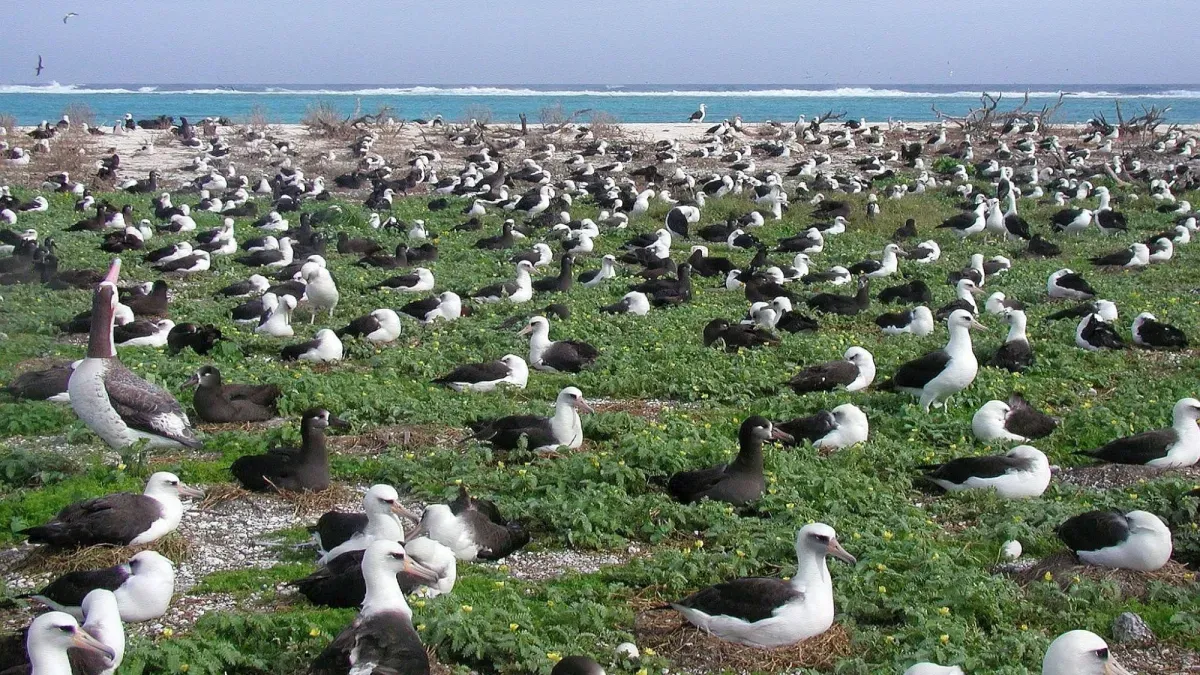
While snow piles up across North America, the Pacific island of Midway Atoll is hosting one of nature's most reliable annual gatherings. Right now, as many as 75,000 pairs of Laysan albatrosses—known as mōlī in Hawaiian—are returning to the same nesting grounds they've used for generations, reuniting with mates they've known for decades.
You can watch it all unfold live, 24/7, from anywhere with an internet connection. Friends of Midway Atoll runs the camera feed through memberships and donations, offering a window into a remote wildlife refuge on the northwestern edge of the Hawaiian Archipelago that most of us will never visit in person.
A Refuge Full of Returning Birds
Laysan albatrosses are creatures of habit. Each year they come back to nest on this same atoll, pair up with their longtime partners, and lay a single egg. If conditions hold, they'll stay through the nesting season, tending to their offspring. The camera lets you witness the quiet choreography of this process—the careful positioning of eggs in nests, the patient vigil of waiting parents.
We're a new kind of news feed.
Regular news is designed to drain you. We're a non-profit built to restore you. Every story we publish is scored for impact, progress, and hope.
Start Your News DetoxMidway Atoll is home to far more than just albatrosses. Depending on the time of day and season, you might spot black-footed albatrosses, endangered Laysan ducks, white terns, Pacific golden plovers, and ruddy turnstones. Red-tailed tropic birds occasionally perform what researchers call their "magnificent aerial mating dance"—a acrobatic courtship ritual that unfolds against the open sky.
As evening approaches on the atoll (around 11 p.m. on the East Coast), thousands of Bonin petrels emerge from underground burrows to tend their nests. It's a daily emergence so predictable you could set your watch by it.
The Bird Who Keeps Breaking Records
Among the albatrosses nesting on Midway right now is Wisdom, a 75-year-old Laysan albatross who holds the title of world's oldest known breeding bird. She was first banded and identified in 1956 by wildlife biologist Chandler Robbins—making her a living link to the mid-twentieth century. Over nearly seven decades, Wisdom has laid 50 to 60 eggs and raised as many as 30 chicks to fledging. In 2024, at an estimated age of 74, she became the oldest known wild bird to successfully lay an egg.
Wisdom's story is a quiet testament to resilience. She's survived seven decades in the ocean, returned faithfully to the same island year after year, and continues to contribute to her species' survival. Watching the live feed, you're not just observing nature—you're witnessing a creature whose life spans from the Eisenhower administration to now.
The nesting season unfolds slowly. There's no drama, no narration, just the patient reality of birds doing what they've done for millennia. If you're tired of winter, or tired of the usual nature documentary format, it's worth tuning in.