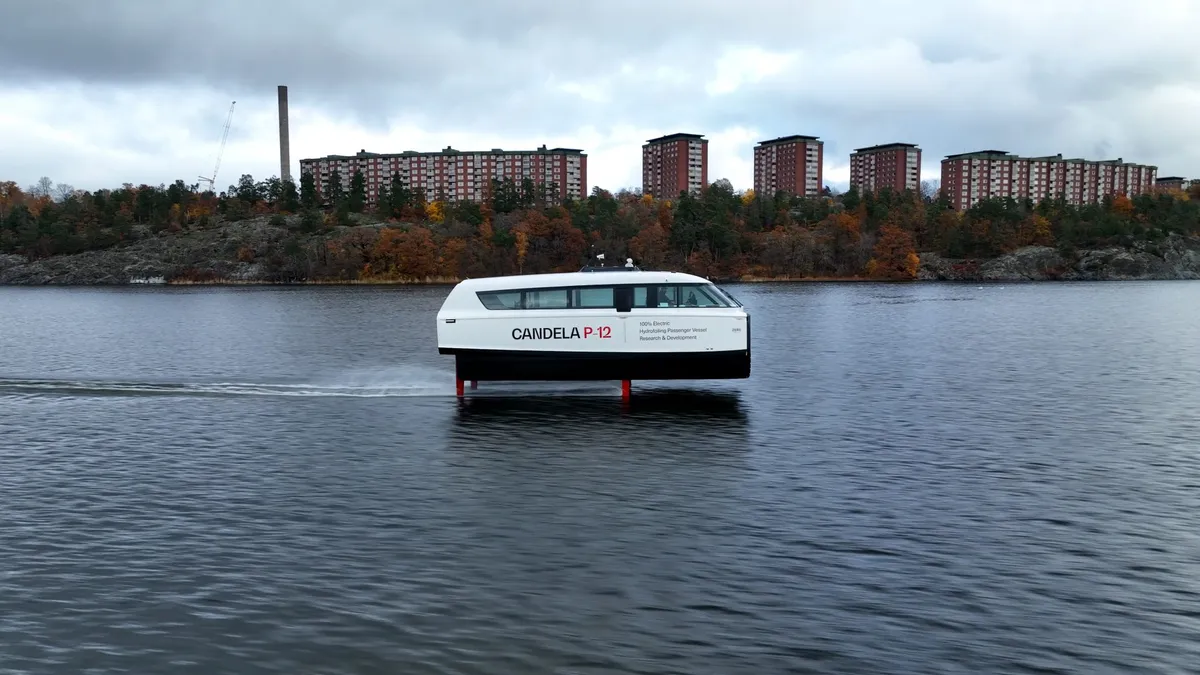
Stockholm is built across 14 islands, which means water isn't scenery—it's infrastructure. Last year, the city proved those waterways could become something else entirely: a model for cleaner, faster urban transport.
In late 2024, Stockholm introduced the Candela P-12, an electric ferry that literally lifts itself above the water as it accelerates. The Swedish Transport Administration just released results from the pilot, and they're striking. Travel times dropped from 55 minutes to roughly 30. Passenger numbers climbed 22.5 percent. Carbon emissions fell by 94 percent compared with the diesel ferries it replaced.
For a city where diesel ferries account for nearly half of public transport emissions, that's not incremental progress—it's a redirect.
We're a new kind of news feed.
Regular news is designed to drain you. We're a non-profit built to restore you. Every story we publish is scored for impact, progress, and hope.
Start Your News DetoxHow physics becomes faster commutes
Beneath the hull sit carbon fiber wings called hydrofoils. As the ferry speeds up, these wings generate lift, pushing the entire vessel above the water's surface. An onboard computer continuously adjusts the foil angles using sensors, keeping the craft stable mid-flight. Once airborne, drag plummets. The ferry now moves at around 25 knots—well above the usual 12-knot limit for ferries—and does it on a fraction of the energy.
The ride is also smoother than traditional ferries. Passengers notice the difference immediately.
But the environmental gains go deeper than emissions numbers. Because the ferry barely touches the water, it creates a wake comparable to a small dinghy with an outboard motor. That means less shoreline erosion, less ecological disruption. Noise levels are roughly equivalent to a car traveling at 28 miles per hour and barely audible from 80 feet away. A faster commute that's also quieter and gentler on the ecosystem.
What makes this work economically is equally important. Replacing two diesel ferries with six P-12 vessels could increase departure frequency from hourly to every 15 minutes while boosting passenger capacity by around 150 percent. Dockside charging requires only modest upgrades compared with traditional electric ferries. Operating costs drop due to reduced fuel consumption and maintenance. The Swedish Transport Administration estimates the socioeconomic benefit at roughly $13.1 million.
This is the kind of progress that doesn't require choosing between speed, comfort, and sustainability. It delivers all three.
Why this matters beyond Stockholm
Cities worldwide are watching. Berlin and Mumbai have announced plans to introduce similar vessels in 2026. The Maldives and Thailand are preparing their own deployments. The pattern is clear: when you solve a real problem—congestion, emissions, commute fatigue—with technology that's faster and cheaper than the alternative, adoption spreads.
What Stockholm has demonstrated is that the solution to urban congestion doesn't always mean building more roads or bridges. Sometimes it means reconsidering the water already there, and giving transport permission to rise above it. For waterfront cities facing climate targets and gridlock, that's a genuinely different path forward.
The Candela P-12 is now the world's fastest electric passenger ferry in service. More cities are about to find out what that means for their own morning commutes.