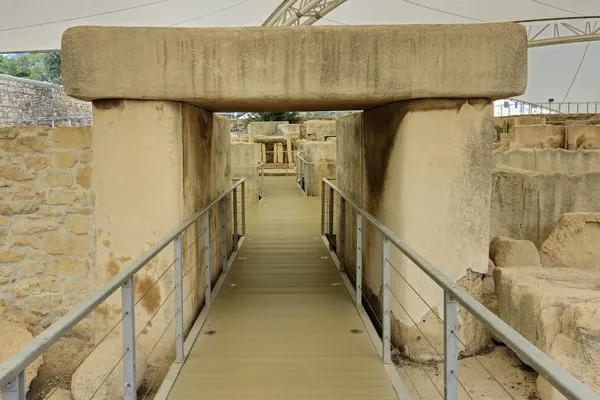
Most megalithic sites across Europe huddle in remote countryside, safer from the bulldozer and the strip mall. The Tarxien Temples in Malta broke that rule entirely — and somehow, they're still standing.
A farmer plowing his land in 1913 stumbled onto four interlinked stone structures sitting in what's now suburban Valletta, minutes from Malta's capital. By then, the neighborhood was already filling in around them. By every logic of urban development, these temples should have been paved over decades ago. Instead, they've become one of Europe's most significant Neolithic sites, now protected as a UNESCO World Heritage Site.
Older than the pyramids
The Tarxien complex was built between 3600 and 2500 BC — older than Egypt's pyramids, older than Stonehenge. The four temples feature elaborate bas-relief carvings of spirals and animals, suggesting they served as religious centers where animal sacrifices took place. Later, during the Bronze Age, the site was repurposed as a cremation cemetery, layering different chapters of human ritual onto the same ground.
We're a new kind of news feed.
Regular news is designed to drain you. We're a non-profit built to restore you. Every story we publish is scored for impact, progress, and hope.
Start Your News DetoxWhat makes their survival remarkable isn't just their age or their artistic value. It's that they've endured in the worst possible location for an ancient monument: smack in the middle of a developing nation's urban sprawl. During Malta's colonial period under British rule, military installations expanded around the nearby harbors. The pressure to develop, demolish, and modernize never stopped.
Yet the temples persisted. Local recognition came first, then formal protection. In 2015 — more than a century after their accidental discovery — UNESCO designated Ħal Tarxien as a World Heritage Site, cementing its place in the global story of Mediterranean prehistory.
Today, Heritage Malta manages the site, preserving both the physical stones and the knowledge they contain. The temples now stand as proof that ancient history doesn't need wilderness to survive. Sometimes all it takes is a farmer who notices something unusual, a community that values what came before, and enough institutional will to say no to the obvious choice.
The Tarxien Temples remind us that protection can happen even in unlikely places — and that what we choose to preserve says as much about us as what we choose to build.