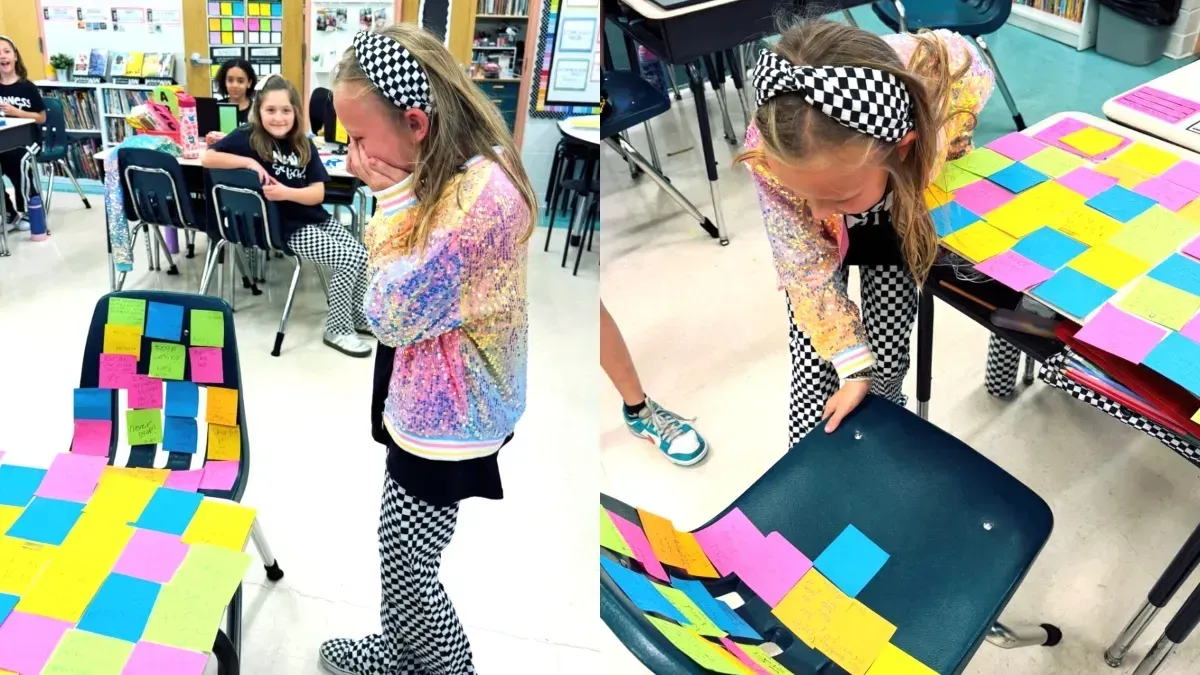
A student in Joanne Miller's classroom was struggling. Not with math or reading—with believing in herself. So her classmates did what Miller describes as completely their own idea: they turned her desk into a gallery of reasons to keep going.
While she was out of the room, they covered her chair and workspace with sticky notes. Not generic encouragement, but specific affirmations—reminders of her actual strengths, the things they'd noticed about her, the moments she'd shown up for them. When she came back and saw it, she ran to hug the student who'd started it all.
Miller, who documents her classroom on Instagram, called it one of her favorite teaching moments. But she was careful about what she was actually celebrating. "When students learn to champion each other, that's the real win," she wrote. "No state test can measure this."
We're a new kind of news feed.
Regular news is designed to drain you. We're a non-profit built to restore you. Every story we publish is scored for impact, progress, and hope.
Start Your News DetoxWhat the moment actually revealed
There's a temptation to see this as just a nice story—kids being kind, everyone feels good. But Miller was pointing at something more structural. This wasn't a random act of sweetness. It was evidence of a classroom where students had learned that noticing each other's struggles and responding matters. Where one person's low moment became a reason for everyone else to show up.
The comments on her post picked up on this too. One person noted that Miller herself had built this culture—she'd taught these students what support looks like. Another reflected on the ripple: what the gesture did for the struggling student in that moment, but also what it did for everyone else to see their kindness actually land, actually matter.
The sticky notes themselves became something the student kept—not as a one-time boost, but as evidence. A physical reminder that her classmates saw her worth when she couldn't quite see it herself.
It's the kind of classroom moment that doesn't show up in achievement metrics. No test measures whether students know how to lift each other. But Miller's point is clear: that's the part that actually sticks.