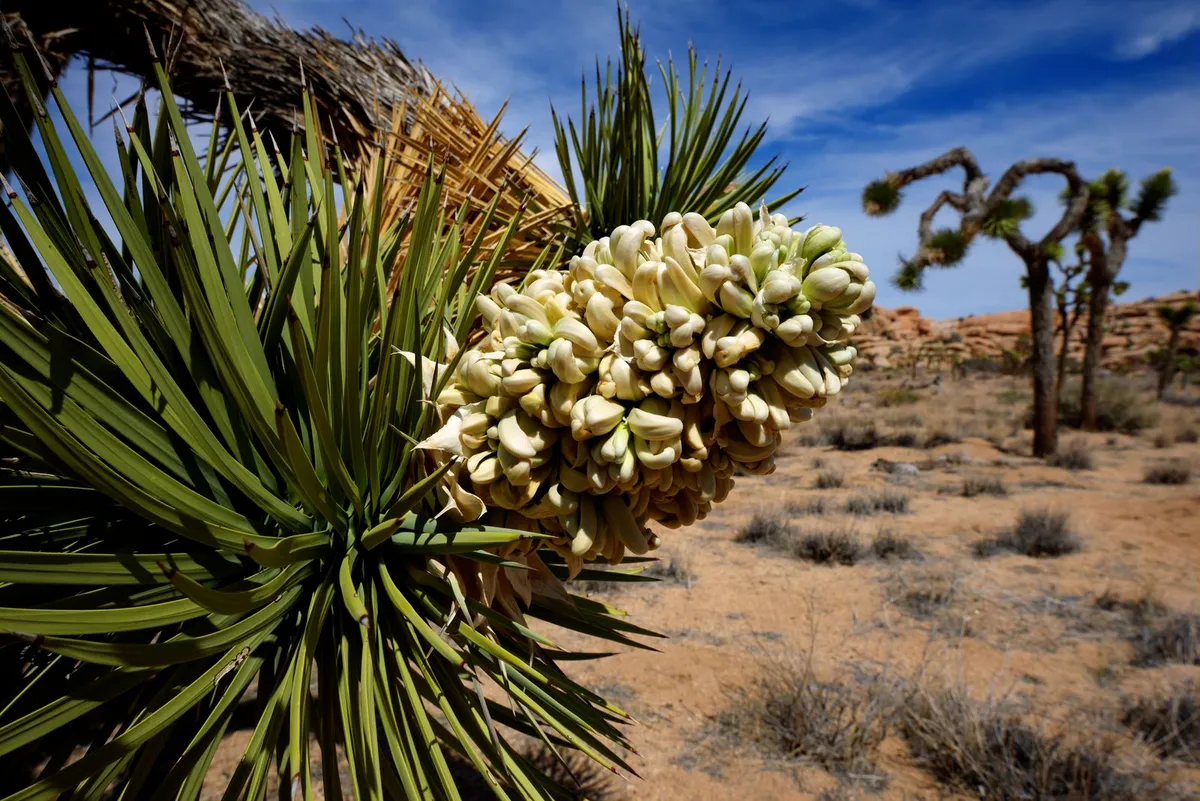
Joshua trees across the American Southwest are flowering in October and November instead of their usual late February timing—and scientists aren't sure what it means yet.
The iconic desert plants, found primarily in the Mojave Desert across California, Nevada, Arizona, and Utah, depend on a remarkably fragile partnership. Only yucca moths—insects the size of a grain of rice—can pollinate their white flowers. When the moths visit, the trees produce fleshy, light-green fruits filled with seeds that rodents and other desert creatures disperse across the landscape. This synchronized dance has worked for millennia. But this season, something shifted.
A Delicate Partnership Under Pressure
Joshua trees and yucca moths are locked in what scientists call "obligate mutualism"—each species has evolved to depend entirely on the other for survival. The timing is everything. Normally, flowers appear in late February, right when yucca moths emerge from the soil to begin their season. But if the flowers arrive months early while the soil is still cold, the moths may not emerge yet. No moths means no pollination. No pollination means no fruit, no seeds, and no new trees.
We're a new kind of news feed.
Regular news is designed to drain you. We're a non-profit built to restore you. Every story we publish is scored for impact, progress, and hope.
Start Your News DetoxThis matters because Joshua trees grow slowly and live around 150 years. They need to produce many seeds because most never make it—rodents, birds, and rabbits eat them before they mature, a process that takes 40 years or longer. Even a single disrupted breeding season could ripple across decades.
Something similar happened in fall 2018, but that early bloom was mostly confined to the southernmost Joshua trees. This time, early flowering is appearing throughout the desert. Jeremy Yoder, a biologist at California State University, Northridge, suspects intense late-season rains triggered the early blooms, but the data isn't complete yet.
Crowdsourcing the Answer
Scientists are asking people across the Southwest to photograph flowering or fruiting Joshua trees and upload images to iNaturalist, a citizen science platform. Ideally, observers will return to the same trees multiple times to track their progress through the season. This kind of distributed observation can reveal geographic patterns—whether early-flowering trees cluster in areas that received heavy rainfall, for example—that might explain what's happening.
"We want to see where the flowers are occurring, what the weather was like, and also if those flowers are resulting in any fruit," says Kirsten Zornado, an ecologist also at CSU Northridge.
The early blooms arrive as Joshua trees face mounting pressure from habitat loss and increasingly intense wildfires, both linked to climate change. Understanding this year's unusual flowering could help scientists predict how the species might respond to a warming, more volatile climate. The next few months of observations could provide crucial clues about whether Joshua trees and their moth partners can adapt when their carefully evolved timing falls out of sync.