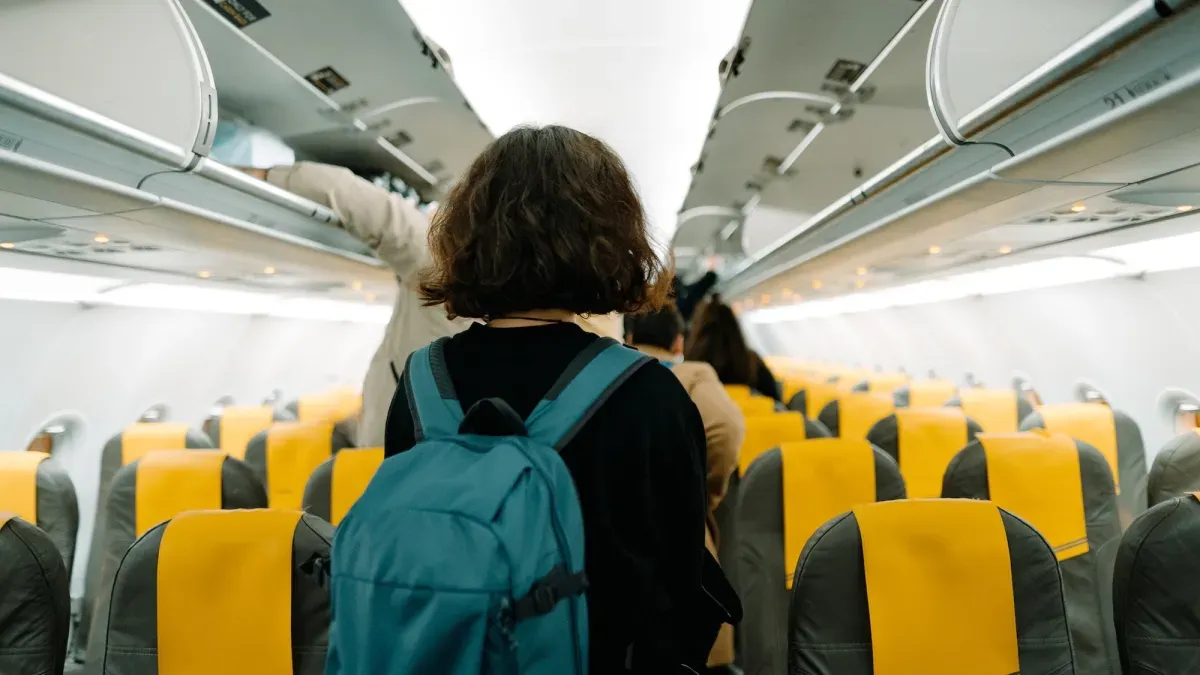
Air travel can be frustrating, especially when boarding a plane. What used to take about 15 minutes in the 1970s now often takes up to 40 minutes. This is due to many groups, zones, and priority boarding options.
A New Look at Boarding Methods
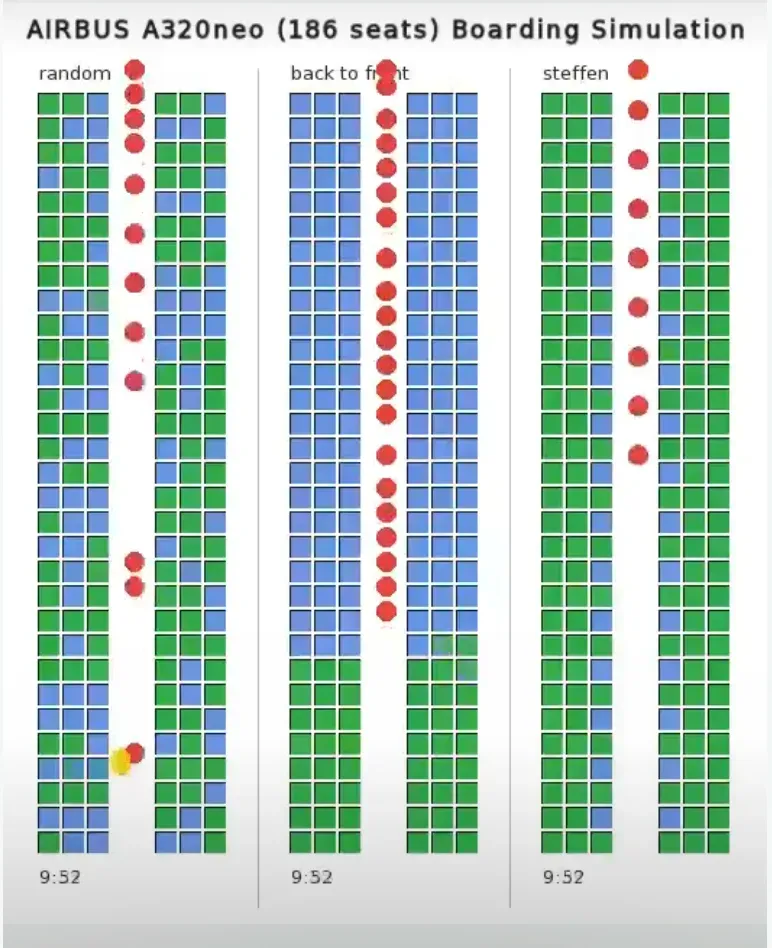
Adam Jacobs, a master's student at the University of Florida, created a computer simulation to study different boarding methods. He modeled a 186-seat Airbus A320neo. His simulation showed three common boarding styles: random, back-to-front, and the "Steffen method."
The simulation showed passengers as red dots moving to their seats. Empty seats were blue squares, turning green when occupied.
We're a new kind of news feed.
Regular news is designed to drain you. We're a non-profit built to restore you. Every story we publish is scored for impact, progress, and hope.
Start Your News DetoxThe Steffen method was the fastest, finishing in just 11 minutes and 16 seconds. This method prioritizes window seats first. Random boarding, similar to what Southwest Airlines used to do, took 17 minutes and 59 seconds.
Surprisingly, back-to-front boarding, which many people think is efficient, was much slower. It took 31 minutes and 15 seconds. Studies show that front-to-back boarding, common for most airlines, is even less efficient than back-to-front. Zone-based boarding helps reduce gate chaos but doesn't speed up boarding much.
Jacobs noted that random boarding works "surprisingly well." He suggested that if gate agents just told everyone to get on the plane, people might board faster.
Why Boarding Got Slower
The main reasons for slower boarding are the fight for overhead bin space and airlines trying to maximize profits. Boarding became more complicated around 2008 when airlines started charging for checked bags. Before this, checked bags were usually free.
This change encouraged passengers to bring more carry-on bags to avoid fees. However, there isn't enough overhead bin space for everyone's carry-ons. This led to passengers wanting to board earlier to secure space. Airlines then started charging for early boarding, creating the complex group and zone systems we see today. Passengers ended up paying another fee to avoid the checked-bag fee. This complexity made boarding times longer for everyone.

Massoud Bazargan, a professor at Embry-Riddle Aeronautical University, told CNN that airlines making money from bags "killed any efficiency to do faster boarding." Jacobs added that zones reduce gate congestion and allow airlines to sell priority boarding. He believes this revenue is more important to airlines than saving a few minutes of turnaround time.
The Steffen Method: A Potential Solution
The Steffen method directly addresses the overhead bag problem. Astrophysicist Jason Steffen developed this method in 2005 after experiencing delays at an airport. He used his computer modeling skills to find a more efficient way to board planes.
His simulations showed that much of the delay came from passengers blocking the aisle while stowing luggage. Steffen's method involves boarding passengers in a specific order: even-numbered window seats first, then odd-numbered window seats, and so on, with two passengers boarding at a time.
This method looks unusual but can cut boarding time by up to half in simulations compared to front-to-back boarding. It works by spacing out passengers, allowing them to stow luggage without blocking the aisle.
However, the Steffen method has drawbacks. It doesn't account for families or companions traveling together, meaning they wouldn't board at the same time. This could cause frustration. Also, human behavior doesn't always match tidy mathematical models. As one Instagram user commented, it's easier to model when you assume everyone travels alone and has the same physical ability. Another LinkedIn user noted that sorting people before boarding would be a "nightmare" and separating families would be "inhumane."
Other models have tried to improve on Steffen's method, but they all face the same challenge: airlines prioritize revenue. Charging for boarding has become a big business. With planes often full, travelers are more likely to pay extra to board early, even if it makes the overall experience worse for everyone.
Ultimately, the science of airplane boarding often takes a backseat to the financial decisions of airlines.