
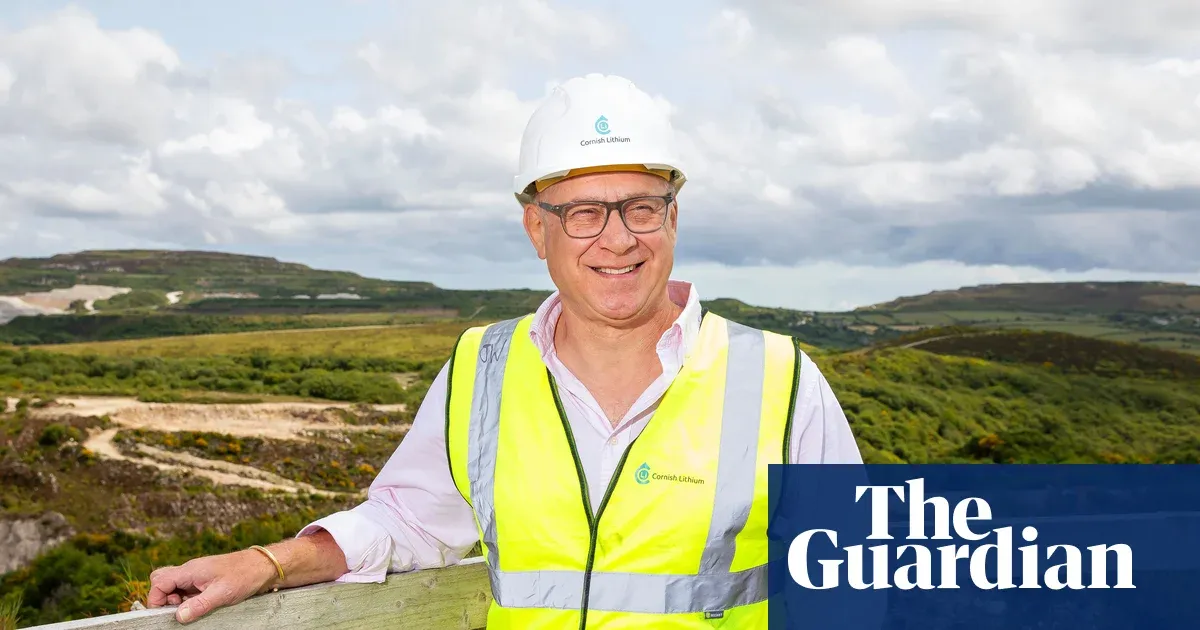
A vast crater gouged into the landscape near St Austell doesn't look like the future. It looks like abandonment — a scar left by decades of china clay mining. But Jeremy Wrathall, standing at the edge of Trelavour pit, sees something different: lithium.
Lithium is the element that makes modern batteries work. It's in your phone, your laptop, the electric cars that are supposed to replace petrol. Right now, the UK imports almost all of it. What Wrathall's company, Cornish Lithium, has discovered is that the same granite bedrock that made Cornwall rich in clay also contains significant deposits of lithium — and those old pits could be the easiest place on Earth to extract it.
Why Cornwall has lithium at all
The geology reads like deep time made visible. Around 275 million years ago, continental plates collided so violently that the Earth's crust melted. That molten material rose, cooled, and crystallized into granite. "There are lots of different types of granite that intruded over more than 10 million years," explains Frances Wall, professor of applied mineralogy at the Camborne School of Mines. "Within those minerals, some called mica contain lithium. If the conditions are right, you can extract it."
We're a new kind of news feed.
Regular news is designed to drain you. We're a non-profit built to restore you. Every story we publish is scored for impact, progress, and hope.
Start Your News DetoxWhat makes Cornwall extraordinary is that the lithium is already partially exposed. The china clay industry spent two centuries ripping open the granite, washing away the clay, and leaving the lithium-bearing rock behind. Those abandoned pits are now a resource waiting to be recovered.
Cornish Lithium is currently running feasibility studies and pilot projects to work out whether extraction at commercial scale is actually viable — and whether it can be done without creating new environmental problems while solving old economic ones. The company's pitch is straightforward: help the UK transition to renewable energy, reduce dependence on imports from countries like Chile and Australia, and give Cornwall something it's badly needed for decades — year-round jobs that don't depend on tourism.
The stakes are real. Global lithium demand is expected to grow tenfold by 2040. Europe currently produces almost none of it. A working lithium industry in Cornwall wouldn't solve that, but it would be a start — and it would do something harder: prove that you can turn industrial decline into industrial renewal.
The next phase will be watching whether pilot projects scale. Whether local communities see the promised jobs materialize. Whether the environmental safeguards actually hold. Those are the questions that separate genuine progress from hopeful speculation.