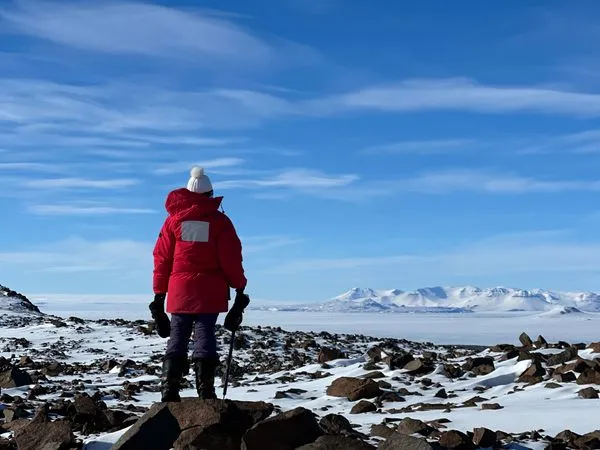
Daniela Hernandez arrived in Antarctica as someone she thought she knew. A science journalist with a PhD in neuroscience from Columbia, years covering health and extreme environments, confident and self-reliant. The kind of person with a plan.
Then the ice changed that.
Standing in the vast white expanse, surrounded by silence and scale, something cracked. Long stretches of time to think became long stretches of questioning — who she actually was, the life she'd built, the relationships she'd kept out of habit rather than honesty. Antarctica didn't offer answers. It offered space. And in that space, the mask she'd been wearing became impossible to ignore.
"When I went to Antarctica, I thought of myself as this confident, self-reliant person," she says. "And I found out that was mostly a mask."
We're a new kind of news feed.
Regular news is designed to drain you. We're a non-profit built to restore you. Every story we publish is scored for impact, progress, and hope.
Start Your News DetoxShe wasn't looking for transformation. If anything, the discovery came as a surprise — though she now sees surprise itself as "a really good learning tool." The continent worked like a mirror that refused to let her look away.
The Reckoning
Returning home was disorienting in a way she hadn't anticipated. The life waiting for her — the relationship, the routines, the conversations she'd learned to keep shallow — no longer fit. After her second trip to Antarctica, she made the kind of changes that sound simple on paper but feel seismic when you're living them: she ended a long-term relationship, started therapy for the first time, and opened deeper conversations with her family members she'd kept at arm's length.
She turned her life upside down. And slowly, deliberately, began rebuilding it with greater honesty.
"We seek happiness and comfort almost to a pathological degree," she reflects now. "But outside my comfort zone is where beautiful things can happen for me."
That reckoning has become the foundation of her forthcoming book, Quantum Lives: The New Science of Personal Transformation. Drawing on physics, neuroscience, and psychology, Hernandez explores how moments of rupture — those disorienting, uncomfortable moments when everything stops fitting — can become catalysts for genuine change. Not the change we plan for, but the change that finds us when we're finally still enough to notice it.