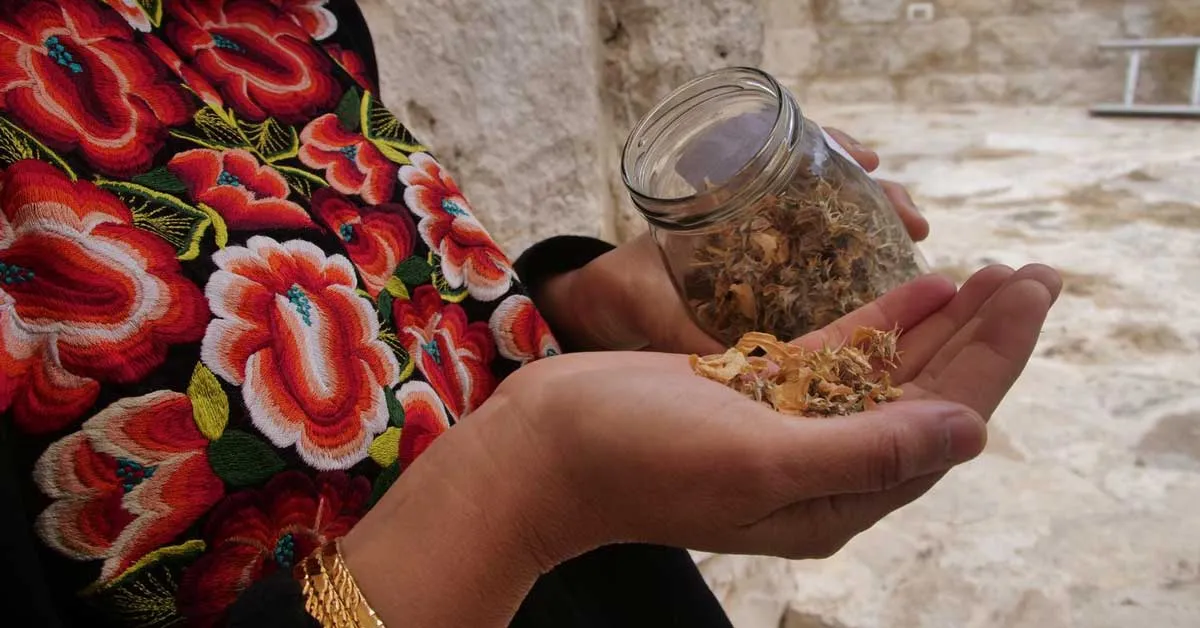
When Vivien Sansour left Palestine for the United States, she brought something that couldn't be confiscated or lost in transit: seeds. Not just any seeds, but varieties that have survived centuries in Palestinian soil—long-necked gourds, white cucumbers, Battiri eggplants—each one carrying the accumulated knowledge of generations of farmers.
In 2014, Sansour founded the Palestinian Heirloom Seed Library in Battir, a UNESCO World Heritage village, as a deliberate act of preservation. The library sits in Bethlehem while she works from America, part of the larger Palestinian diaspora. Local farmers can visit and retrieve seeds to plant on their own land, keeping the varieties alive in the place they've grown for centuries.
It's a form of resistance that works quietly. "These seeds that have been passed down to us over the centuries carry in their genes the stories and the spirits of the Palestinian Indigenous ancestors," Sansour writes. Beyond the cultural weight, there's a practical urgency: as climate patterns shift and agricultural diversity narrows globally, these adapted varieties represent real options for survival.
We're a new kind of news feed.
Regular news is designed to drain you. We're a non-profit built to restore you. Every story we publish is scored for impact, progress, and hope.
Start Your News DetoxThe work has rippled outward. Professor Riad Bahhur at Sacramento City College in California now grows the same heirloom varieties in his garden—a small plot in the American West that holds Palestinian heritage. When he tends those plants, he's not trying to recover what's been lost. "These ancestral practices cannot bring back the people who have been killed," he acknowledges. But they do something else: they prove the depth and continuity of Palestinian connection to the land. They're a form of testimony.
Other Palestinian immigrants have carried seeds with them too, planting them in new soil. Each garden becomes a node in a growing network—Sacramento, Bethlehem, diaspora communities across the globe—all maintaining the same varieties, the same knowledge. The seeds move where people move. They adapt where people adapt.
What started as one artist's effort to document and protect has become something larger: a living archive that refuses to be contained by borders or distance. The library continues to grow, and with it, the number of people who understand that keeping these seeds alive is keeping a story alive.