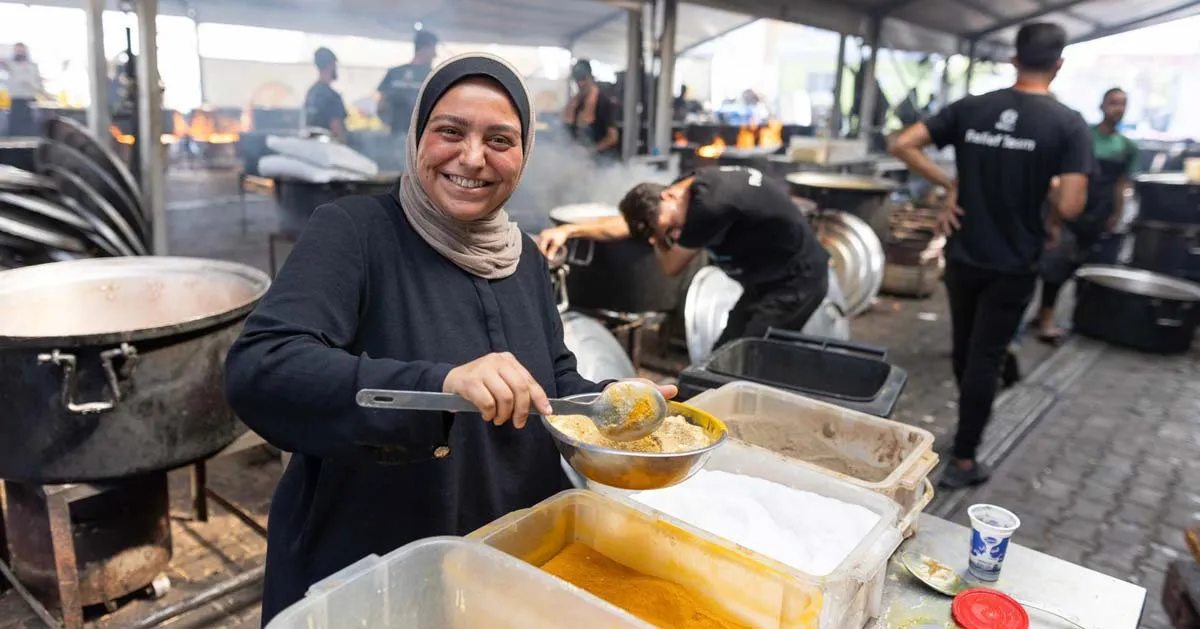
For Palestinians observing Ramadan, the month ahead means fasting from dawn to dusk—a spiritual practice that becomes a survival question when hunger is already a daily reality. World Central Kitchen has adapted its operations across Gaza to ensure that families can honor the fast without going without food.
Since the recent ceasefire agreements, the nonprofit has scaled up dramatically. They're now serving 1 million hot meals per day across Gaza, supported by six field kitchens run by Palestinian chefs and community volunteers. Over the past two years, they've distributed more than 272 million meals, 73 million loaves of bread, and 6.4 million gallons of water. The numbers matter less than what they represent: for the first time in months, close to half of Gaza's population can count on a reliable meal each day.
Yet the scale of need remains staggering. More than 75% of Gaza's population—1.6 million people—still face extreme acute food insecurity and critical malnutrition risks. Famine has been pushed back, as UN Secretary-General António Guterres noted in December, but the crisis hasn't ended.
We're a new kind of news feed.
Regular news is designed to drain you. We're a non-profit built to restore you. Every story we publish is scored for impact, progress, and hope.
Start Your News DetoxRamadan's Rhythm
During Ramadan, the rhythm of daily life shifts around food. Muslims fast between dawn and dusk, eating only during suhoor (pre-dawn hours) and iftar (after sunset). "In Gaza, where hunger is already a daily reality, those moments carry even greater weight," World Central Kitchen wrote. The organization has shifted its schedule to ensure hot meals are ready early in the morning and again in the evening when families gather to break their fast.
Beyond the field kitchens, World Central Kitchen is distributing 100,000 Ramadan food kits this year—enough for 7 million additional meals. Each kit contains halal, culturally appropriate staples: rice, lentils, freekeh, pasta, olive oil, chickpeas, tahini, tomato paste, tea, and coffee. The iftar boxes include dates, dried fruits, nuts, milk, juice, and traditional Ramadan sweets. The specificity matters. These aren't generic aid packages; they're assembled with the understanding that feeding people means respecting how they live.
Ramadan also traditionally emphasizes caring for the most vulnerable. World Central Kitchen's statement captures this tension: "The need does not pause during the month. In many cases, it intensifies." By ensuring families can observe Ramadan with both sustenance and dignity, the organization is doing something that sounds simple but is increasingly rare—meeting people where they are, spiritually and physically, without conditions.
As the month unfolds, World Central Kitchen will continue what it has been doing since 2023: cooking, delivering, and returning the next day to do it again.