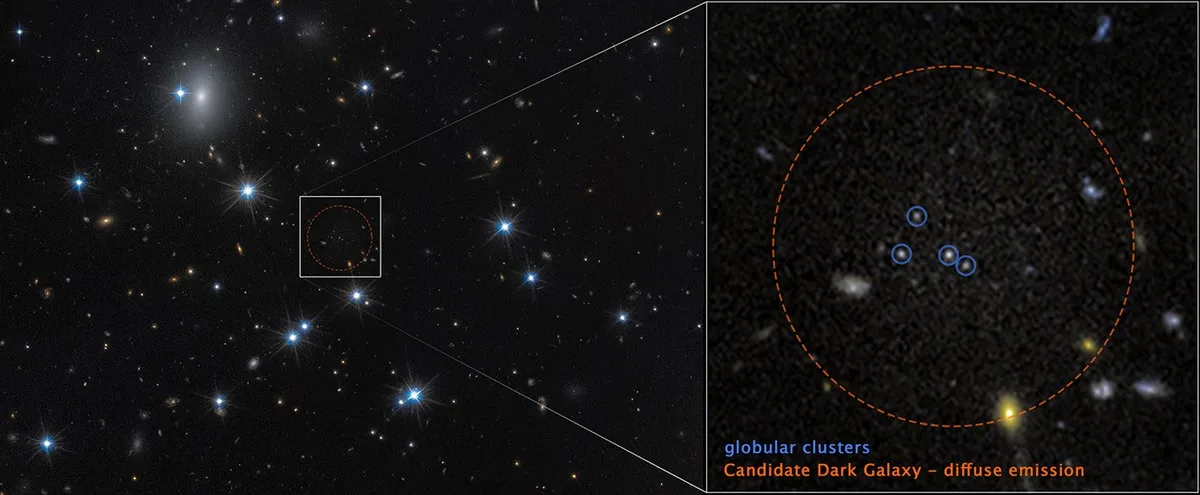
Somewhere 300 million light-years away, in a galaxy cluster called Perseus, there's a galaxy so faint that for years it hid in plain sight. Most galaxies blaze across the cosmos — their stars and light unmistakable even across incomprehensible distances. But CDG-2 is different. It's one of the darkest known galaxies ever detected, so dominated by dark matter that 99% of its mass is essentially invisible.
The discovery matters because it reveals something fundamental about how galaxies form and die. CDG-2 isn't dark because it's young or distant. It's dark because something stripped away most of its normal matter — the hydrogen gas needed to birth new stars. Gravitational interactions with neighboring galaxies inside the Perseus cluster likely tore away that fuel, leaving behind a ghostly remnant held together by dark matter.
Detecting such a galaxy should have been impossible. These low-surface-brightness objects are extraordinarily faint — imagine trying to spot a single candle from across a city. But David Li's team at the University of Toronto used a clever approach: they looked for the galaxy's globular clusters, dense balls of ancient stars that orbit galactic centers. Hubble's high-resolution imaging found four of these clusters huddled together, and when astronomers combined data from Hubble, the European Space Agency's Euclid observatory, and Hawaii's Subaru Telescope, they detected a faint, diffuse glow surrounding them. That glow was the galaxy itself.
We're a new kind of news feed.
Regular news is designed to drain you. We're a non-profit built to restore you. Every story we publish is scored for impact, progress, and hope.
Start Your News Detox"This is the first galaxy detected solely through its globular cluster population," Li said. The four clusters represent CDG-2's entire visible population — the only stars bright enough to find. The galaxy itself has the luminosity of about 6 million Sun-like stars, but those globular clusters account for just 16% of what we can actually see.
What makes this discovery significant is what it means for the future. As new space missions like NASA's Nancy Grace Roman Space Telescope and the ground-based Vera C. Rubin Observatory begin surveying the sky, astronomers are increasingly using machine learning and statistical methods to hunt for these invisible galaxies. CDG-2 proves the technique works. There are likely many more dark galaxies out there, waiting to be found by researchers willing to look beyond what shines brightest.