A team at New York University has observed something that shouldn't be possible: particles suspended in mid-air by sound waves, oscillating in a steady rhythm that breaks Newton's Third Law of Motion.
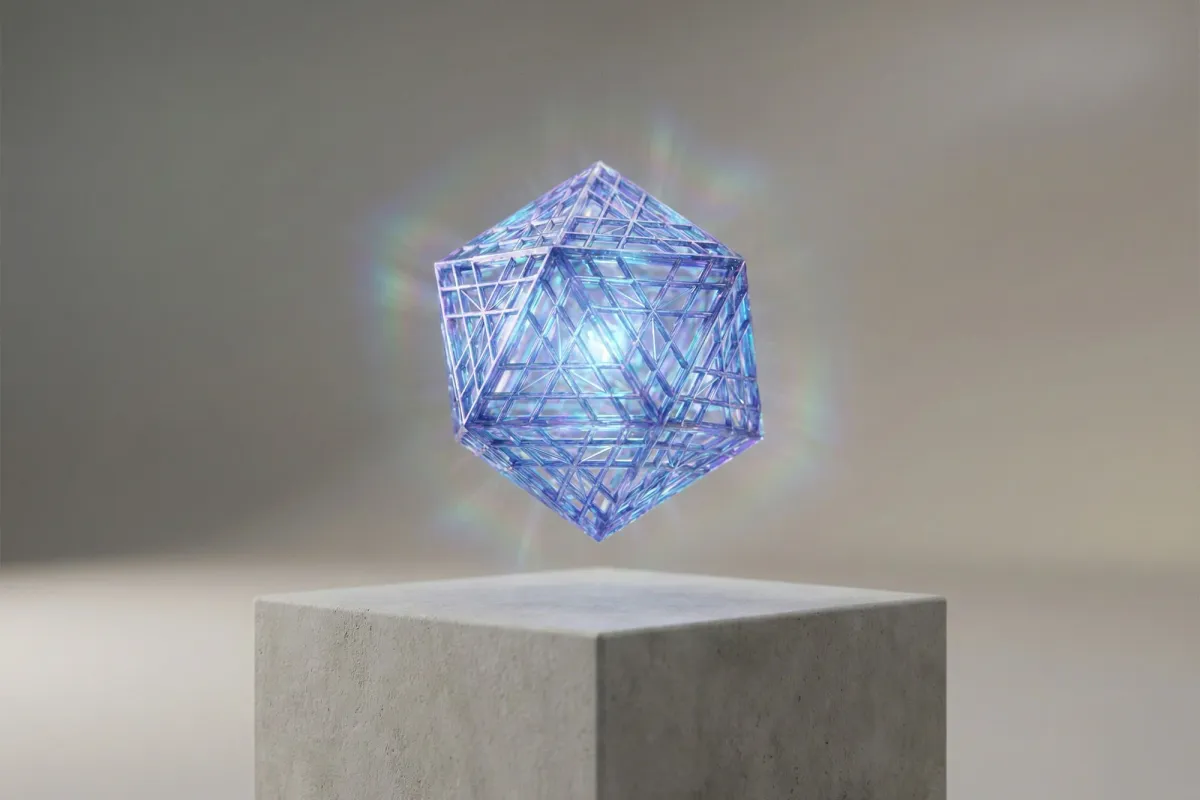
They call it an acoustic time crystal. It's made of styrofoam beads—the kind used for packing—held aloft by sound waves in what amounts to an invisible acoustic cushion. Once suspended, the beads begin interacting with each other by scattering sound waves back and forth. But here's where physics gets strange: the interactions aren't balanced. A larger bead influences a smaller one more strongly than the smaller bead influences it in return. This asymmetry means the beads can oscillate on their own, settling into a synchronized rhythm that repeats indefinitely.
"Think of two ferries of different sizes approaching a dock," explains Mia Morrell, a graduate student on the team. "Each one makes water waves that pushes the other one around—but to different degrees, depending on their size." In the NYU system, those unequal forces create motion that violates the classical rule that every action has an equal and opposite reaction.
We're a new kind of news feed.
Regular news is designed to drain you. We're a non-profit built to restore you. Every story we publish is scored for impact, progress, and hope.
Start Your News DetoxWhy This Matters
Time crystals were first proposed theoretically about a decade ago and confirmed experimentally shortly after. They're systems where particles repeat a steady back-and-forth motion—essentially "ticking" in a way that shouldn't be possible according to traditional physics. Since then, scientists have created and studied multiple forms, each opening new doors for potential applications.
This particular version is remarkable partly because it's visible and relatively simple to understand. You can watch the beads oscillate. "Time crystals are fascinating because they seem so exotic and complicated," says David Grier, the study's senior author and director of NYU's Center for Soft Matter Research. "Our system is remarkable because it's incredibly simple."
The implications stretch beyond physics laboratories. The nonreciprocal interactions at work here mirror patterns found in biological systems—circadian rhythms, digestive processes, and other biochemical timekeeping mechanisms that rely on similarly unbalanced interactions. Understanding how these forces work in a controlled acoustic setting could eventually illuminate how living systems maintain their own rhythms.
Researchers see stronger potential for applications in quantum computing and advanced data storage, though commercial uses remain years away. For now, this work is about understanding what's possible when you suspend particles in sound and let them find their own rhythm.