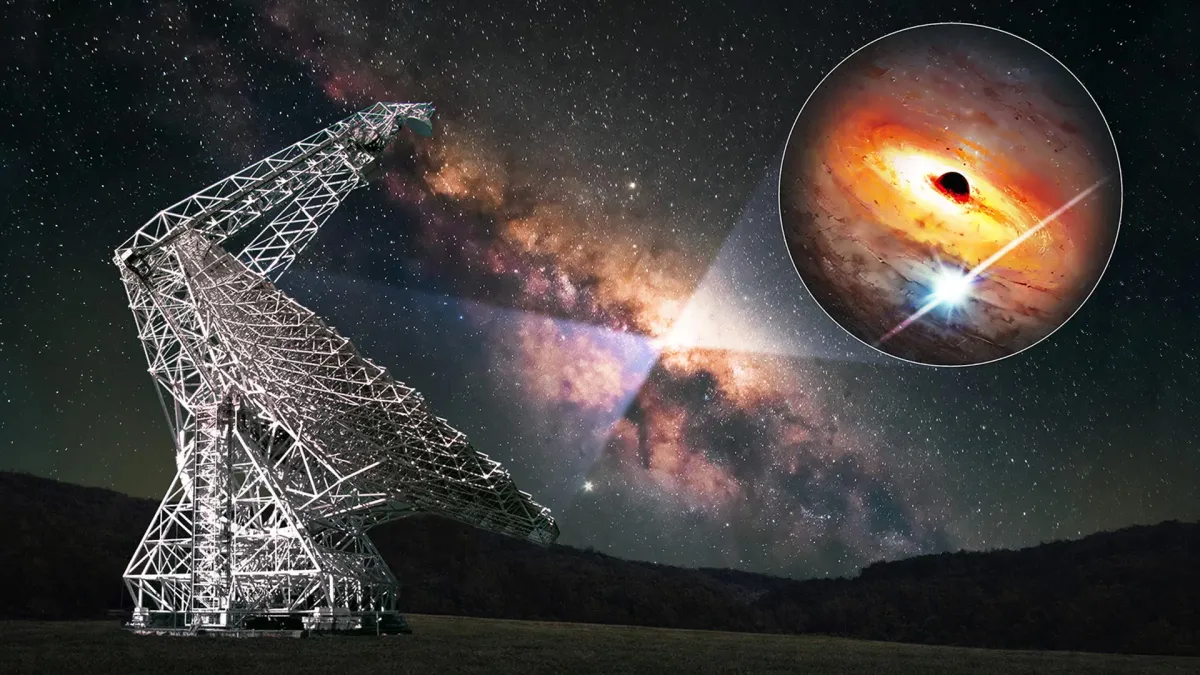
Scientists at Columbia University have spotted something that might let us test Einstein's most famous theory in the wildest laboratory imaginable: right next to a supermassive black hole.
The candidate is an 8.19-millisecond pulsar — a rapidly spinning neutron star — orbiting close to Sagittarius A*, the 4-million-solar-mass black hole anchoring our galaxy's center. If it's confirmed, this discovery opens a door to measuring spacetime distortion under conditions so extreme that most of physics gets pushed to its limits.
Here's why this matters. Pulsars are cosmic clocks. They're the burnt-out cores of massive stars, spinning so fast they emit beams of radio waves that sweep past Earth with almost metronomic precision. Near a black hole, gravity warps spacetime so severely that it bends those pulses slightly, delays them, changes their frequency. These tiny anomalies are exactly what Einstein's equations predict — and exactly what we've never been able to measure this precisely before.
We're a new kind of news feed.
Regular news is designed to drain you. We're a non-profit built to restore you. Every story we publish is scored for impact, progress, and hope.
Start Your News Detox"Any external influence on a pulsar, such as the gravitational pull of a massive object, would introduce anomalies in this steady arrival of pulses, which can be measured and modeled," says Slavko Bogdanov, a research scientist at Columbia's Astrophysics Laboratory.
The discovery, led by recent Columbia PhD graduate Karen I. Perez and published in The Astrophysical Journal, came through the Breakthrough Listen initiative, which searches for signals from beyond Earth. What's notable is that Breakthrough Listen is releasing all the survey data publicly. That means independent researchers worldwide can dig through the same observations, hunt for confirmation, or spot things the original team missed.
What Comes Next
Right now, the pulsar is still a candidate — it needs follow-up observations from other telescopes to confirm it's real. But the infrastructure is already there. Radio observatories across the globe can train their dishes on Sagittarius A* and look for those characteristic pulses.
If confirmed, this pulsar becomes a natural laboratory for testing General Relativity in a regime where quantum effects and gravity collide. It's the kind of discovery that doesn't announce itself with fanfare; it quietly hands physicists a tool they've been waiting for.