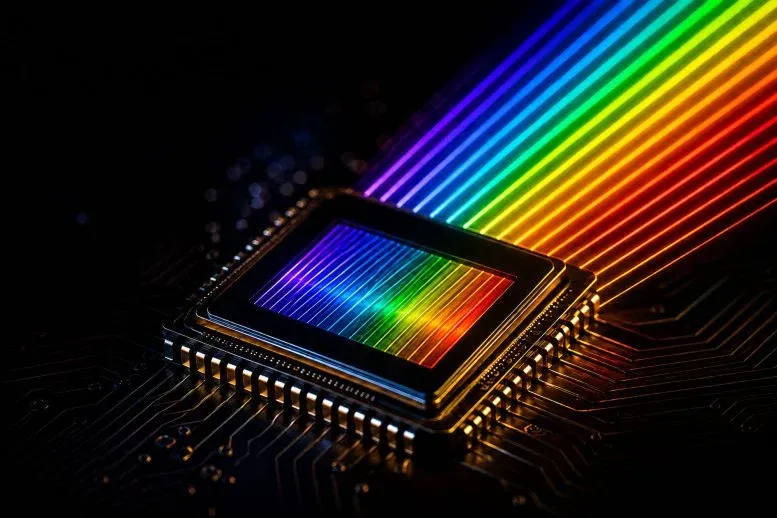
A new "rainbow on a chip" could change how we communicate and improve quantum technologies. This tiny chip, about the size of a grain of rice, creates a special spectrum of light. It can then turn this light into many high-frequency signals called millimeter waves.
Physicists at Loughborough University and their partners believe this method could lead to much faster 6G communications. It could also make timing more precise for advanced quantum systems.
Boosting 6G and Beyond
Millimeter waves are key for future communication because they offer a lot more bandwidth. This means they can carry much more data. The challenge has been making these waves stable and precise enough for advanced uses.
We're a new kind of news feed.
Regular news is designed to drain you. We're a non-profit built to restore you. Every story we publish is scored for impact, progress, and hope.
Start Your News DetoxDr. Luke Peters from Loughborough University explained that the world needs more data, faster. Millimeter waves could provide the capacity for this. He noted they could help create faster 6G networks.
The potential goes beyond just communication. These frequencies could also be used in radar systems. They might also help scientists study materials and make very precise measurements of the universe.
How the "Rainbow" Chip Works
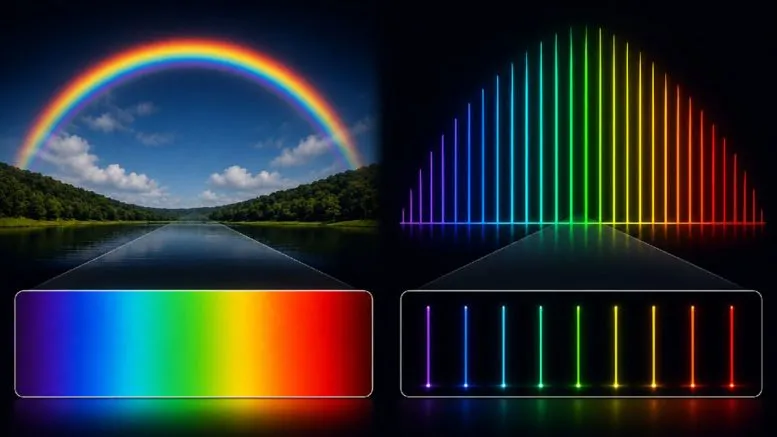
The researchers create millimeter waves using a microcomb. This is a set of light frequencies that looks like a rainbow but is invisible to the human eye. A special antenna then converts these light frequencies into millimeter waves.
Previous work showed that microcombs could make one precise millimeter wave frequency. To send more data, many frequencies are needed at once. This requires a very stable and clear microcomb.
The Loughborough team published their findings in Nature Communications. They showed a system that makes a stable, high-quality microcomb. This microcomb's light frequencies could then be turned into several precisely spaced millimeter-wave frequencies at the same time.
The key difference is how the microcomb is made. Traditional systems shine laser light into a tiny structure on a chip called a microresonator. This structure traps the light.
The Loughborough system adds a much larger loop of optical fiber to this chip-based microresonator. Laser light travels through both parts repeatedly. This helps the light states become stable and stay that way.
Dr. Peters said they created a very precise and stable "rainbow on a chip." The loop keeps feeding light back through the chip. This allows the light states to build up efficiently and remain stable even if the system is disturbed. He added that it's very robust, staying stable even when people jump near it.
Precision and Future Steps
The researchers also found they could adjust individual frequencies within the microcomb. This means some could be made stronger and others weaker. Importantly, the precision of the microcomb stayed intact even after being converted into millimeter waves.
Dr. Peters explained that controlling individual frequencies gives them more power over the signals. Different uses will need different combinations of frequencies. He also highlighted that the precision of the microcomb carries over to the millimeter waves. This provides a set of highly controlled signals, which is vital for applications needing accuracy.
This level of precision is also valuable for timing. Accurate timing is at the heart of new quantum technologies.
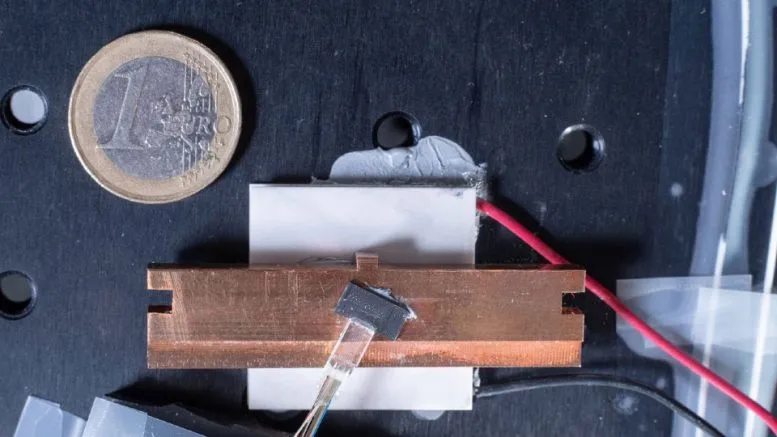
The next step is to make the technology smaller. While the main chip is tiny, the full setup currently fills a tabletop. Future versions could use less power and be much smaller, possibly fitting into a shoebox. The team is also looking into using this technology on satellites.
Researchers are also testing how accurate the microcomb can be. They are working with the National Physical Laboratory to compare the system with precision clocks. This could lead to uses in timing, navigation, and positioning.
Dr. Antonio Cutrona, who led the stability measurements, is excited about the microcomb's precision. He hopes this study will help bring the accuracy of atomic clocks into smaller technologies for timing, navigation, and position.
Deep Dive & References
Millimetre-wave comb generated by an optical microcomb - Nature Communications, 2026