

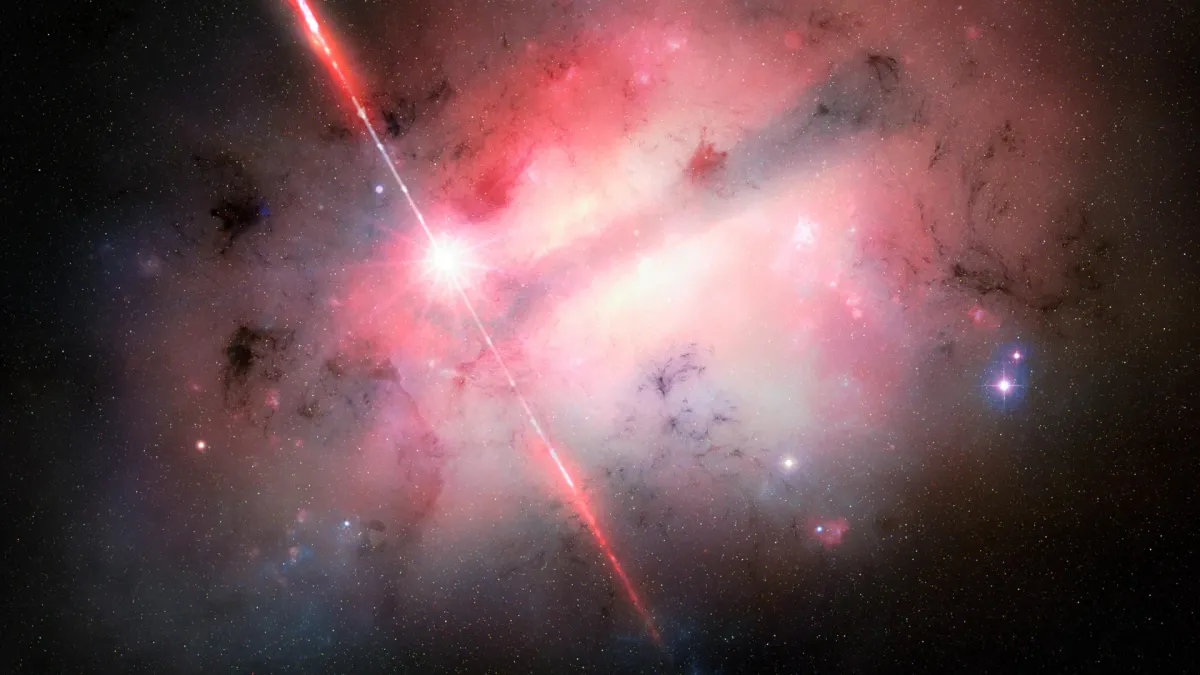
Imagine a firework that just… kept going. For seven hours. That's essentially what astronomers just witnessed, thanks to the James Webb Space Telescope and a whole host of other observatories. Dubbed GRB 250702B, this cosmic explosion absolutely shattered the record for the longest-duration gamma-ray burst ever seen, lasting an astonishing seven hours when most of its kind vanish in less than a minute.
Because apparently, the universe decided the old rules were getting a bit dull. These gamma-ray bursts are usually the universe's ultimate mic drop: a massive star collapses into a black hole, unleashing a quick, blinding flash of high-energy radiation. But GRB 250702B? It was doing its own thing, even showing X-ray activity a full day before the main event. It's like the universe's most dramatic slow burn.
The Mystery Deepens with Black Hole Theories
Naturally, scientists are a bit stumped. Rutgers astrophysicist Huei Sears, who's helping unravel this celestial enigma, pointed out the sheer weirdness of its duration. Observatories from China's Einstein Probe to the National Science Foundation's Very Large Array all pitched in, collecting data across the electromagnetic spectrum because no single telescope could capture the whole show. It was that intense.
We're a new kind of news feed.
Regular news is designed to drain you. We're a non-profit built to restore you. Every story we publish is scored for impact, progress, and hope.
Start Your News DetoxSo, what happened? The leading theories are as wild as the event itself. Was it just an exceptionally powerful gamma-ray burst? Or perhaps a tidal disruption event, where a black hole, thousands of times the mass of our Sun, rips apart a star that got too close? And then there's the truly sci-fi option: a smaller black hole merging with a stripped helium star and consuming it from the inside out. Which, if you think about it, is both impressive and slightly terrifying.
NASA even put together an animation suggesting one scenario: a black hole three times the mass of the Sun merging with another star. Eliza Neights, an astronomer at NASA Goddard, simply stated that this outburst is unlike anything seen in the last 50 years. Let that sink in.
A Distant Galaxy and Lingering Questions
The Hubble Space Telescope initially spotted an unusual galaxy at the explosion's origin, looking like two galaxies merging or one split by a dark dust band. Webb later confirmed this galaxy is roughly 8 billion light-years away. That means this record-breaking explosion happened long before our own planet even formed. Talk about ancient history.
Sears and her team used Webb's NIRCam instrument to get a better look at the host galaxy months after the event. What they saw was one massive galaxy with a complex dust lane, making it hard to tell if anything's left of the explosion. It's all very faint.
While the current evidence leans towards GRB 250702B being a gamma-ray burst rather than a tidal disruption event, the jury is definitely still out. As Sears noted, we haven't seen many tidal disruption events of this type, so understanding their typical development is still a work in progress. Many studies are offering different, sometimes conflicting, explanations. It's still early in understanding what truly happened, but one thing is clear: this rare, important event is a unique chance to study how stars and black holes evolve. Or, perhaps, to discover something entirely new and unexpected. Because that's where we are now.





