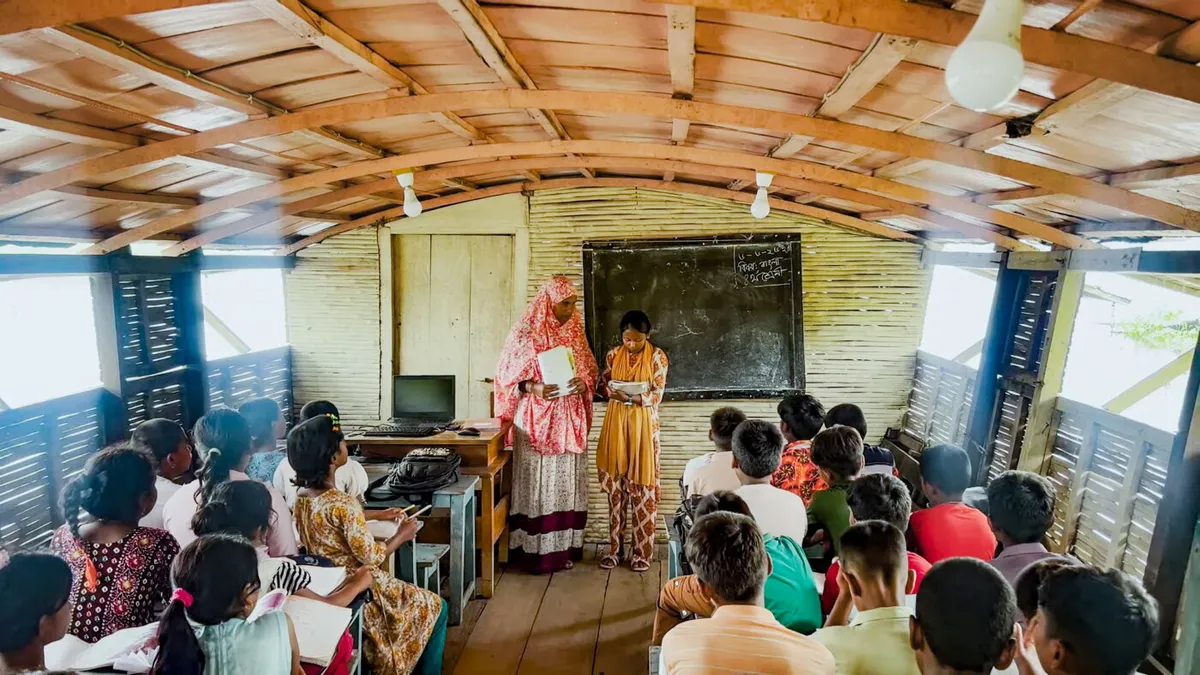
Eight years ago, a beige boat bobbing in tall grass along Bangladesh's Atrai River was a classroom. Inside, 29 third graders were getting an education, something seasonal floods and muddy roads often made impossible. Now, in 2026, with climate change making those disruptions even more widespread, this local solution has become a global blueprint.
Turns out, if the kids can't get to school, you bring the school to the kids. And if that school happens to float, well, all the better. These aren't just quaint little vessels; they're a masterclass in keeping essential services running when the environment throws everything it has at you. And the world is starting to notice.
Education on the Ebb and Flow
Take 12-year-old Mahiya Khatun. This summer, she was reciting Bangla poetry on one of these boat schools. The best part? The school picks her up and drops her off right at her house. Traditional schools are often too far, especially when the landscape turns into a mud-soaked obstacle course during monsoon season. Fourth-grader Himel Hasan agrees, preferring the boat school to the distant government alternative, enjoying lessons with his five friends.
We're a new kind of news feed.
Regular news is designed to drain you. We're a non-profit built to restore you. Every story we publish is scored for impact, progress, and hope.
Start Your News DetoxMosammat Hosne Ara Khatun has been teaching on these boats for a decade, calling it a "noble job" serving underprivileged students. Even Suman Mia, the boat driver who never got to study, dreams of his children attending these schools and landing good jobs. It's a full-circle moment, really.
Many of these students have gone on to genuinely impressive things. Rabbi Hossain, who attended from 2005 to 2010, is now studying engineering at Dhaka University. He credits the boat school for his start, remembering learning computers there way back in '05. His classmate, Nahid Hossain, is now a soldier in the Bangladesh Army, calling the boat school an "emotional place" that provided his foundational education. He firmly believes he wouldn't have gotten where he is without it.
Nahid explains that conventional schools often shut down during floods. The roads become impassable, the school grounds submerged. But the floating school? It just kept going, docking at various points to gather students from hard-to-reach areas, even through storms and heavy rain. Because apparently that's where we are now: schools that defy the weather.
Then there's Surovi Khatun, now an undergraduate studying English. She started her schooling on a boat from 2012 to 2016. She points to the dedicated English teachers on the boat as crucial to her success. Her one wish? That the floating schools offered education beyond grade five. Primary education on the boats is free, including textbooks. But higher secondary education means fees for tuition and materials, which many families simply can't afford, sometimes leading to early marriage for girls.
Beyond academics, the boat schools also taught Surovi and her mother tailoring. Now, they not only make their own clothes but also earn extra income sewing for neighbors. Which, if you think about it, is both impressive and a very practical life skill.
The Model That Floats Globally
The initiative is run by Shidhulai Swanirvar Sangstha, a local nonprofit that snagged the UNESCO Confucius Literacy Prize in 2025. UNESCO's representative to Bangladesh, Susan Vize, notes the country's literacy rate has shot from a dismal 17.6% in 1971 to around 76% today. Groups like Shidhulai are vital for reaching rural communities and women, where literacy rates still lag.
Mohammed Rezwan, the group's founder, isn't stopping there. He's designing a larger boat — a floating community hub that could offer classes, healthcare, and even shelter for up to 150 people during floods. And he's hoping to create a global network for this floating school model. Turns out, other flood-prone countries like Cambodia, Vietnam, India, and Brazil are already taking notes. Because sometimes, the best way forward is to literally go with the flow.