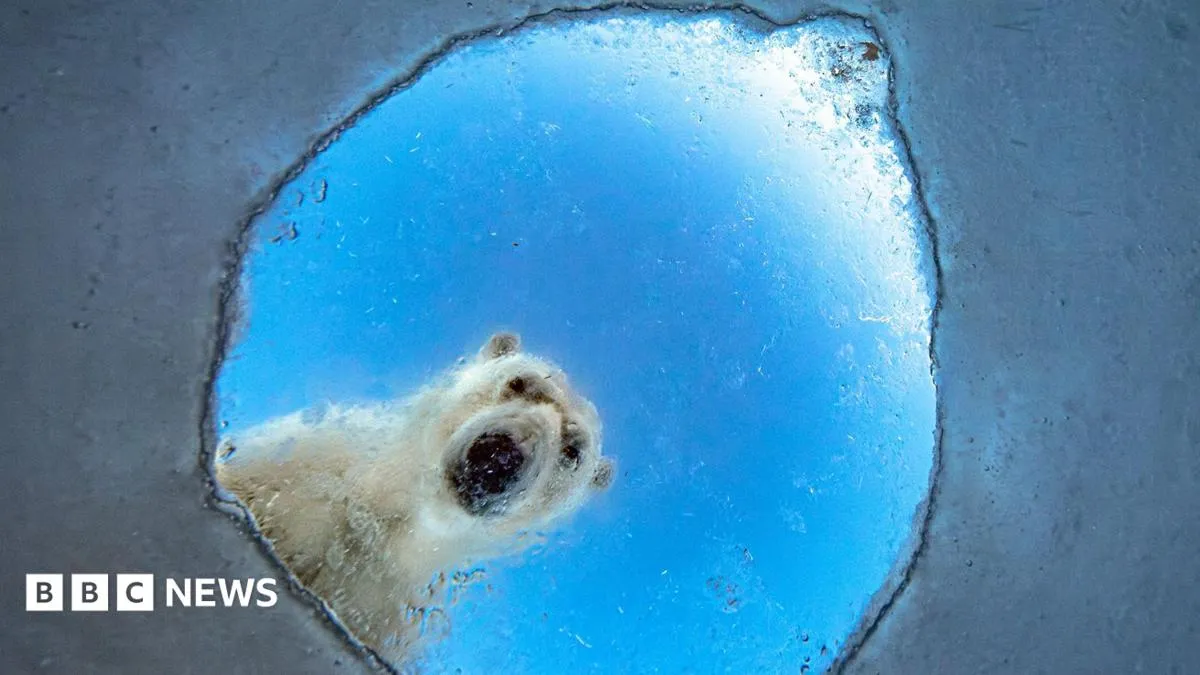
Ever wonder what a polar bear looks like from the perspective of its dinner? Norwegian photographer Audun Rikardsen now knows, and it's surprisingly intense. His shot, "Icy Window," captures a polar bear peering through a seal's breathing hole, an image so captivating it earned a highly commended nod in the "Animal Portraits" category of the Wildlife Photographer of the Year competition. Let that satisfying number sink in: 2026. Yes, we're looking that far ahead.
Rikardsen, clearly a man dedicated to his craft (or maybe just a glutton for punishment), set up an underwater camera beneath a breathing hole and simply waited. For eight hours. At 4 AM, the bear showed up. He then had to wait another eight hours for her to leave so he could retrieve his gear. The result? A photo so good, he "screamed" with happiness. Which, if you think about it, is both impressive and slightly terrifying for anyone within earshot.
This isn't Rikardsen's first rodeo; he's won two other categories in this competition before. The overall winners for 2026 will be unveiled on October 13th, with an exhibition kicking off at London's Natural History Museum a few days later.
We're a new kind of news feed.
Regular news is designed to drain you. We're a non-profit built to restore you. Every story we publish is scored for impact, progress, and hope.
Start Your News DetoxThe World's Most Intriguing Postcards
While we wait for the grand prize, a slew of other highly commended images have been released, each a tiny, perfect window into the natural (and sometimes unnatural) world:
-
The Art of Flying: Jack Crockford, a UK teen, caught swifts mid-flight in Bushy Park, London. These birds spend almost their entire lives airborne, making a mid-air portrait a true feat.
-
Urban Wanderer: Sora Miyazawa, a Japanese student, found an Eastern Japanese toad on a Tokyo street after a rainstorm. Proof that even in the concrete jungle, nature finds a way – often right before it hops into a bush.
-
Lifted to the Surface: Vegard Byrkjeland Aasen from Norway captured an adult orca carrying its dead calf. A heart-wrenching image, revealing a behavior that a 2026 study suggests is far more common than previously thought. Because grief, apparently, isn't just for land-dwellers.
-
Biting Back: Andrea and Maceo Grammatico from France snapped a photo of a highly venomous fer-de-lance viper. It was only later, reviewing the shots, they noticed a mosquito calmly perched on its head. Talk about audacity.
-
Wings of Darkness: Andy Parkinson from the UK photographed a black vulture over a dead caiman in Brazil. He suspects the caiman met its end via boat, but a jaguar later showed up to claim the carcass, because the circle of life waits for no one.
-
Eye of the Storm: Dewald Tromp from South Africa was photographing a Namaqua chameleon in the Namib Desert when a sandstorm hit. The chameleon, unfazed, is a desert specialist that can literally drink moisture from the air. Your move, Brita.
-
Flock of Gold: Bence Máté from Hungary witnessed tens of thousands of red-billed queleas drinking in Kenya. Their wings created such a rush of air, it looked like a golden cloud. These are, by the way, the most abundant wild bird on Earth. Let that sink in.
-
Mutual Friends: Ernest Porter from South Africa captured a red-billed oxpecker hitching a ride on a white rhino's head. These birds eat insects off rhinos and act as their early warning system. In Swahili, they're literally called "the rhino's guard." Try getting that kind of service from your Uber driver.
-
Up a Tree without a Squirrel: Allegra Hutton from the USA caught a young leopard in Botswana chasing a squirrel up a tree. The squirrel, being smarter than the average cat, simply climbed higher and escaped. A stark reminder that fewer than half of young leopards even survive to independence.
-
Split-Second Escape: Jens Cullmann from Germany froze the moment an African bullfrog lunged for a butterfly and missed. After weeks of watching these frogs eat everything that moved, it's nice to see the butterfly get a win.
-
Hidden Dragon: Gil Wizen from Israel/Canada found a tiny lichen dragon katydid in Ecuador so camouflaged it’s practically a magic trick. Its spiny armor probably helps, too.
-
Calm Amid the Storm: Shane Gross from Canada captured a school of bigeye trevally at sunrise as a storm rolled in. The split-level image shows chaos above, serenity below, in a newly minted Marine Protected Area. Because even fish need a safe space.
-
Pooltime Pastime: Loren Elliott from the USA caught a black bear taking a dip in a garden pool in Monrovia, California. This is less about the bear's excellent taste in real estate and more about how much wildlife and human homes now overlap. Get used to it.
-
Ocean Protector: Ralph Pace from the USA photographed a sea hare in an eelgrass meadow in Monterey Bay. He calls it a "gentle giant safeguarding the last green meadows of the sea." These creatures graze on red algae, helping restore vital eelgrass. So, basically, tiny ocean gardeners.
-
The Show Goes On: Pietro Rojas from Guatemala documented a muzzled brown bear riding a motorcycle in a circus in Doha, Qatar. A stark, uncomfortable image that highlights the absurdity and cruelty of wild animals in captivity. Over 50 countries have banned or restricted such acts, and this photo is a pretty good argument for the rest to catch up.
These images aren't just pretty pictures; they're tiny, often profound, stories. And proof that the world, even in its wilder corners, is still finding new ways to surprise us.