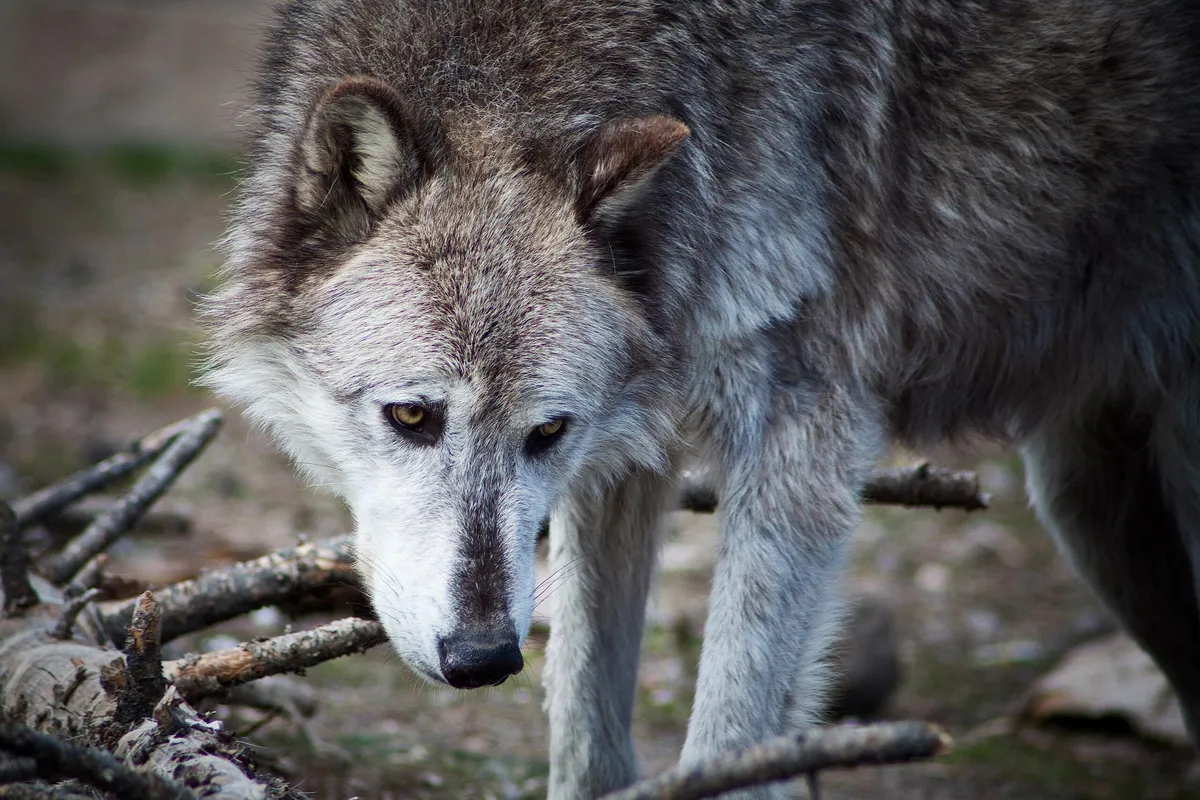
The story of wolves returning to Yellowstone and transforming the entire ecosystem has become almost legendary in conservation circles. But new research suggests the actual changes were far more subtle than the popular narrative suggests.
A peer-reviewed study published this month challenges the earlier claims of a dramatic "trophic cascade"—the idea that reintroducing wolves triggered a domino effect that revived willows, stabilized riverbanks, and reshaped the whole landscape. The researchers didn't set out to diminish wolves' importance. Instead, they found that the methods used to measure these effects had some serious blind spots.
Where the earlier research went wrong
The original studies relied on a model designed to estimate how much willow had grown by measuring the height and shape of plants. But that model assumed willows grew in regular, predictable ways. In Yellowstone, the willows had been heavily browsed and grazed for decades, leaving them twisted and irregular—exactly the conditions where the model breaks down and makes growth appear larger than it actually was.
We're a new kind of news feed.
Regular news is designed to drain you. We're a non-profit built to restore you. Every story we publish is scored for impact, progress, and hope.
Start Your News DetoxThere were other issues too. When researchers compared willow plots between 2001 and 2020, many of the specific locations didn't match up perfectly, mixing real ecological change with sampling bias. Some comparisons with trophic cascades in other ecosystems assumed nature had reached a stable equilibrium, but Yellowstone is still recovering—it's a system in flux, not at rest.
Photography played a role as well. Selective images of thriving willows, combined with the exclusion of other factors like human hunting, made the case for wolf-driven transformation seem stronger than the data actually supported.
"Once these problems are accounted for, there is no evidence that predator recovery caused a large or system-wide increase in willow growth," said Dr. David Cooper, emeritus senior research scientist at Colorado State University. "The data instead support a more modest and spatially variable response influenced by hydrology, browsing, and local site conditions."
What the evidence actually shows
This isn't a story about wolves being unimportant. The lead author, Dr. Daniel MacNulty at Utah State University, was clear on that point: "Predator effects in Yellowstone are real, but context-dependent—and strong claims require strong evidence."
The study reconciles two conflicting interpretations of the same dataset. One team concluded that carnivore recovery produced a strong trophic cascade. Another team, who had spent two decades collecting the field data, found only weak cascade effects. The new analysis suggests the second group was closer to the truth.
What this really shows is that ecological systems don't work like dominoes in a neat line. Wolves matter. They're changing Yellowstone. But the changes are happening unevenly, in some places more than others, shaped by local conditions—water availability, how much browsing pressure remains, what's happening on the ground in each specific area. The ecosystem is responding, just not in the simple, sweeping way that made for a compelling story.