Europe's space program has a problem: while the US and China build rockets designed to fly again and again, Europe's most powerful launcher, Ariane 6, gets used once and discarded. That gap is about to narrow, thanks to a material that repairs itself when heated.
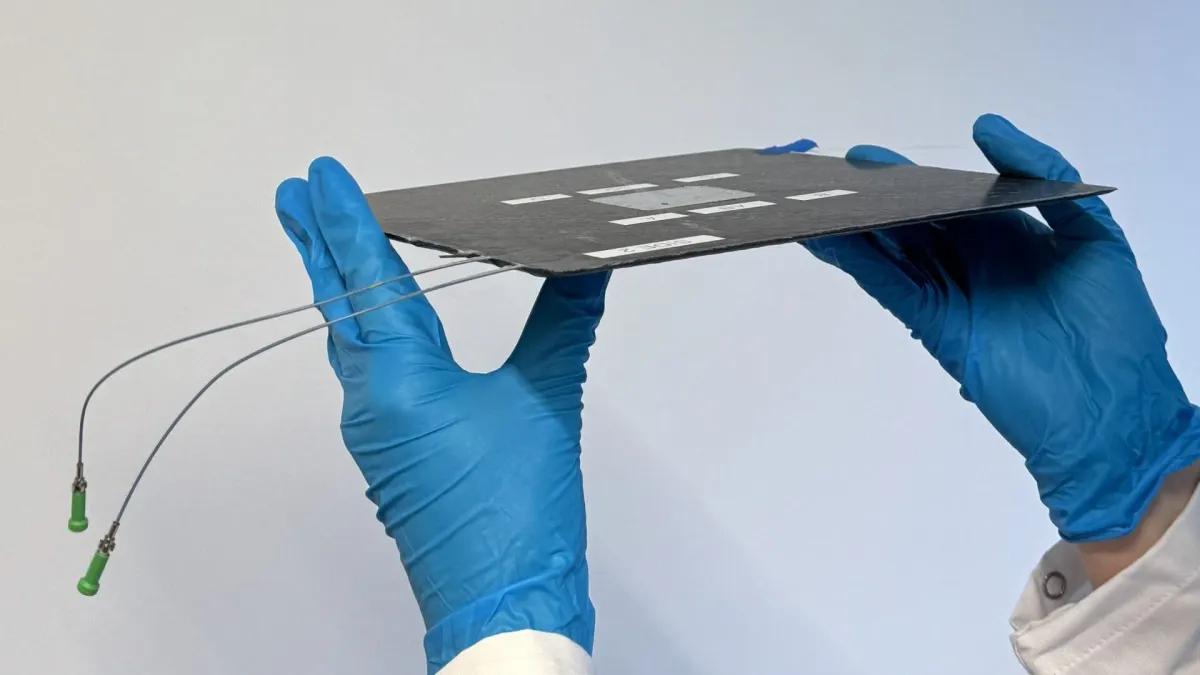
Swiss company CompPair has partnered with the European Space Agency to develop a composite material that heals damage autonomously in space. The HealTech material works through a deceptively simple mechanism: embedded fiber-optic sensors detect cracks or stress damage, trigger a heating system, and warm the material to 100–140°C (212–284°F). At that temperature, a healing agent embedded in the resin flows into the damaged area and seals it. The spacecraft repairs itself without human intervention.
This matters because reusable spacecraft are fundamentally different animals from expendable ones. A rocket that lands and launches again faces repeated stress—vibration, thermal cycling, micro-impacts from debris. Traditional composite materials, which are lightweight and strong, crack under this punishment. Small damage compounds over time. CompPair's self-healing approach means a spacecraft could detect and repair damage in real-time, extending its operational life and reducing the need for costly ground maintenance between flights.
We're a new kind of news feed.
Regular news is designed to drain you. We're a non-profit built to restore you. Every story we publish is scored for impact, progress, and hope.
Start Your News DetoxWhy This Changes the Economics
The real advantage isn't the material itself—it's what it enables. Reusable spacecraft require materials that can handle repeated use without degradation. Currently, that's expensive and labor-intensive. A spacecraft that can autonomously repair minor damage means fewer grounding periods, fewer replacement parts needed, and potentially lower launch costs. For Europe, which has been outspent in the reusable rocket race, this is a foothold.
The ESA's Project Cassandra (Composite Autonomous Sensing AnD RepAir) has already moved beyond theory. CompPair tested the material on samples ranging from postage-stamp size (2×10 cm) to 40×40 cm panels, running thermal shock tests to simulate the extreme conditions inside cryogenic fuel tanks. The next phase scales up to a full-sized tank prototype. If those tests succeed, the technology could be integrated into European spacecraft within the next five to ten years.
What's particularly striking is the autonomy element. This isn't a material that needs a technician to inspect and repair it. It's a material that monitors itself and fixes itself. That shift—from reactive maintenance to autonomous resilience—could cascade through spacecraft design. Future launchers might be simpler, lighter, and more reliable because they don't need the same level of built-in redundancy.
Europe has strong engineering traditions but has ceded leadership in reusable space technology to SpaceX and China's emerging programs. CompPair's innovation won't close that gap overnight, but it addresses a genuine technical challenge that the US and China are also working to solve. The question now is execution: whether this lab breakthrough becomes a flight-qualified system. The timeline is aggressive but realistic.