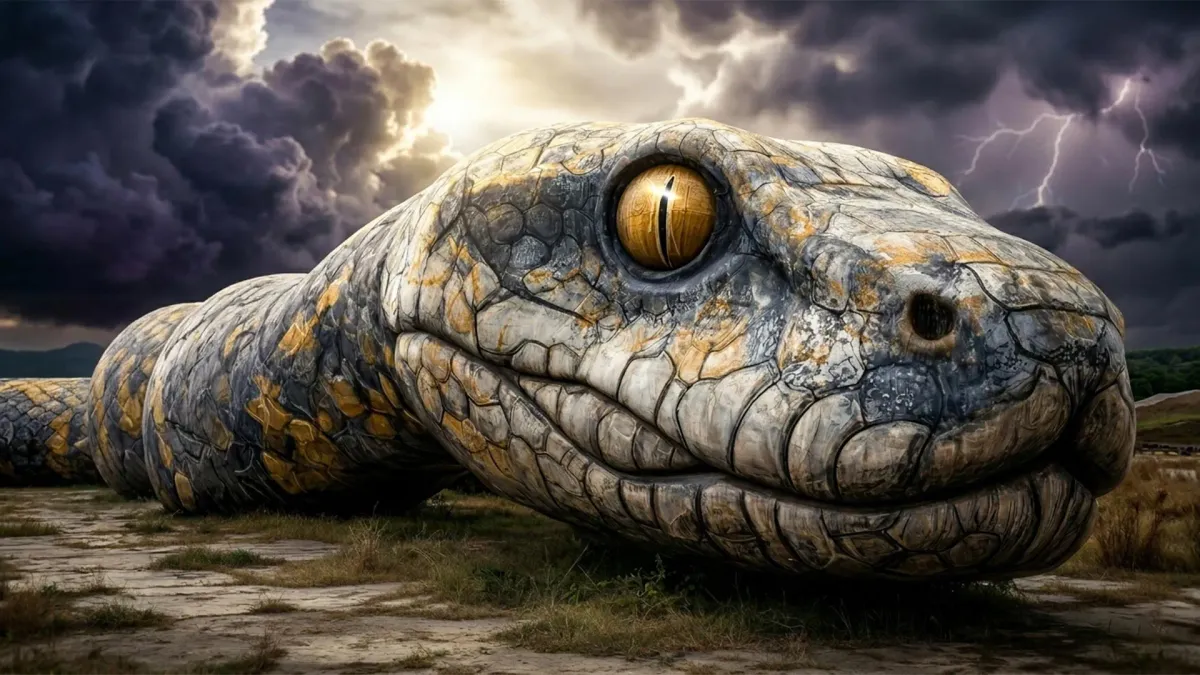
Imagine a snake so long it could stretch across a bowling alley and still have room to spare. Now imagine that snake lived 47 million years ago in India. Scientists just unveiled Vasuki indicus, a newly discovered ancient snake species that might just be one of the biggest to ever coil its way across the planet.
Clocking in at an estimated 36 to 49 feet, this colossal reptile was basically a prehistoric school bus with scales. It belonged to an extinct family called madtsoiidae, but researchers say Vasuki came from a unique group that started right there in India. Because, apparently, India was busy growing giant snakes back then.
Debajit Datta and Sunil Bajpai were the lucky souls who got to describe this discovery. They found its fossilized remains in the Panandhro Lignite Mine in Kutch, Gujarat State. We're talking 27 well-preserved vertebrae, some still connected, suggesting this wasn't some adolescent growth spurt — this was a fully grown, terrifyingly large snake.
We're a new kind of news feed.
Regular news is designed to drain you. We're a non-profit built to restore you. Every story we publish is scored for impact, progress, and hope.
Start Your News DetoxBigger Than Your Average Python
Each vertebra measures between 1.48 and 2.47 inches long and a whopping 2.46 to 4.39 inches wide. Let that satisfyingly specific number sink in. These aren't just bones; they're blueprints for a thick, cylindrical body that probably didn't do much in the way of quick sprints. Like modern anacondas, Vasuki likely moved slowly, preferring the ambush method of hunting. Because when you're 50 feet long, who needs to run?
These measurements put Vasuki indicus squarely in the same league as Titanoboa, previously considered the largest snake ever found. So, it's a tight race for the title of 'biggest nope rope ever.'
What's even more fascinating is that this madtsoiidae family of snakes lived for nearly 100 million years, popping up everywhere from Africa to Europe to India. The study suggests Vasuki might be part of a group of giant madtsoiids that originated in India, eventually spreading to southern Europe and Africa during the Eocene period. Basically, they were the original globetrotters, just, you know, much, much larger and with fangs.
So, next time you're complaining about a garden snake, just remember Vasuki indicus. It puts things in perspective.