For years, astronomers have been staring at the early universe, scratching their heads over tiny, super distant objects they affectionately call "little red dots." These aren't just any dots; they're some of the most mysterious things out there, and they've been keeping secrets.
Then, NASA's Chandra X-ray Observatory spotted an "X-ray dot" – a cosmic outlier that might just be the Rosetta Stone for hundreds, if not thousands, of these enigmatic little red siblings. Suddenly, the universe's most elusive connect-the-dots game might have a solution.
The Curious Case of the Little Red Dots
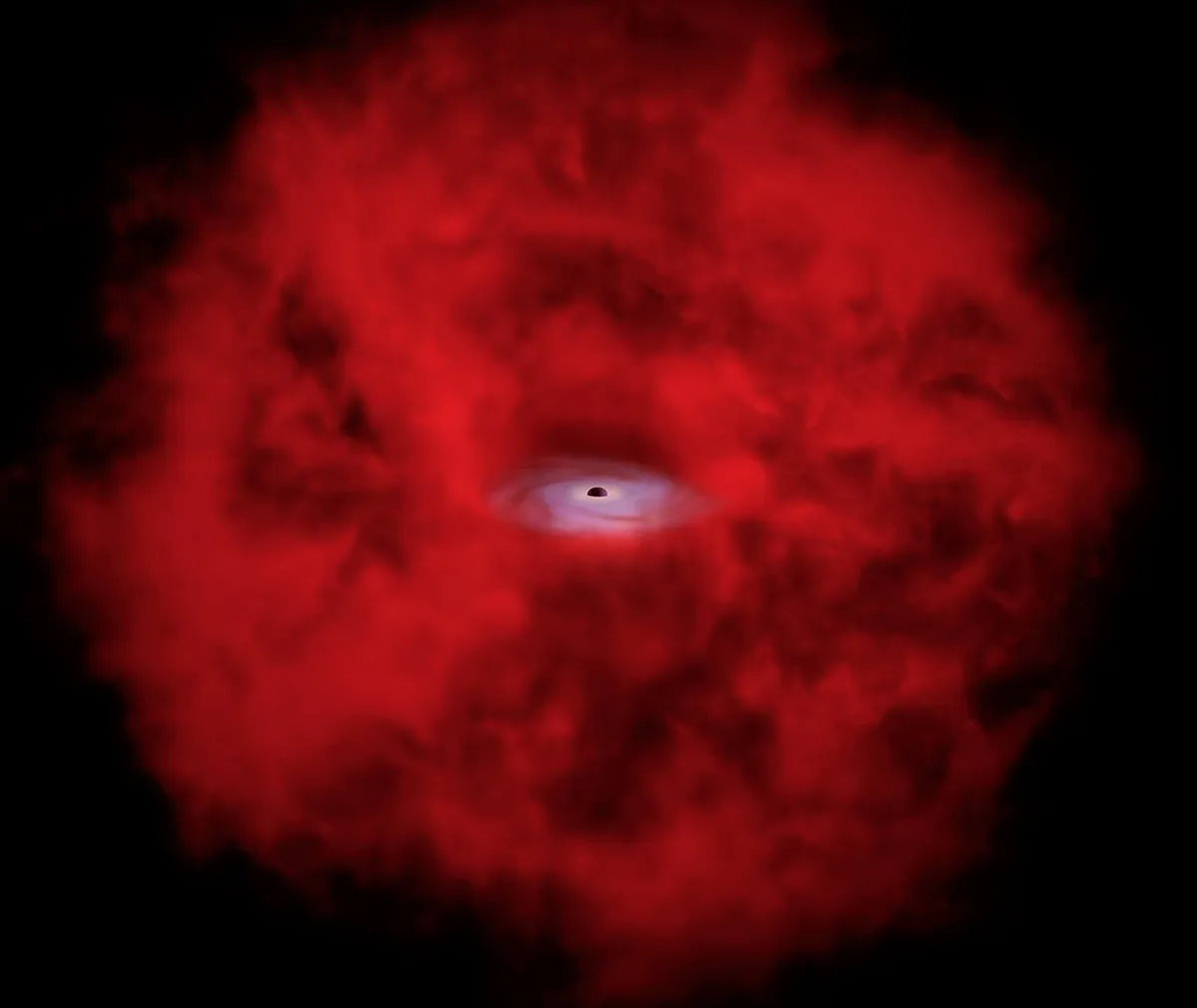
Ever since the James Webb Space Telescope started beaming back its incredible images, astronomers have been spotting these small, red objects. They're about 12 billion light-years away (or even further, which is a number that makes your brain slightly tingle) and they're just... there. The prevailing theory is that they're supermassive black holes, but with a twist: they're cloaked in such dense gas and dust that they block most of the light, including the X-rays usually used to find them.
We're a new kind of news feed.
Regular news is designed to drain you. We're a non-profit built to restore you. Every story we publish is scored for impact, progress, and hope.
Start Your News DetoxImagine a black hole trying to be incognito. That's these guys. This hidden nature earned them the nickname "black hole stars" because they don't quite behave like your typical, brightly glowing black holes that proudly display their ultraviolet and X-ray emissions. They're the shy, mysterious types of the cosmos.
The X-ray Dot That Broke the Mold
Now, enter 3DHST-AEGIS-12014, the X-ray dot that's about 11.8 billion light-years away. It's small, it's red, it's incredibly far away – all the hallmarks of a little red dot. Except for one crucial detail: it glows in X-ray light. This makes it the cosmic equivalent of a wallflower suddenly busting out a solo on the dance floor.
Raphael Hviding, the lead author from the Max Planck Institute for Astronomy, put it perfectly: this single X-ray object might just "connect all of the dots." The team found it by cross-referencing Webb's new, glorious data with Chandra's older, deep-survey observations. Because sometimes, the answer has been there all along, just waiting for the right perspective.
Anna de Graaff, a co-author, noted that finding a little red dot that does emit X-rays is like finding the one person in a witness protection program who accidentally used their real name. It's a huge clue.
The Great Reveal (and Rotation)
The leading theory is that this X-ray dot is a transitional phase. Think of it as a black hole star starting to shed its gaseous cloak. As it devours the surrounding gas, holes appear in the cosmic curtain, allowing those tell-tale X-rays to finally escape. Eventually, the gas is all gone, and the black hole star, in its original form, vanishes.

Chandra's data even hints that the X-ray dot's brightness changes, which supports this idea. As the gas cloud spins, thicker and thinner patches would move across the black hole, causing the X-ray emissions to flicker – like a cosmic disco ball, but with significantly more gravity.
If confirmed, this X-ray dot would be the first of its kind, offering a peek into the very heart of a little red dot. It's strong evidence that these shy cosmic giants are, indeed, supermassive black holes in disguise. Another theory suggests it's just a regular black hole hidden by unusual dust, but honestly, where's the fun in that?
Andy Goulding from Princeton University pointed out that this X-ray dot was chilling in Chandra's data for over a decade. It only became significant when Webb arrived on the scene, proving once again that sometimes, all you need is a fresh pair of eyes (or, you know, a giant space telescope) to solve a mystery.