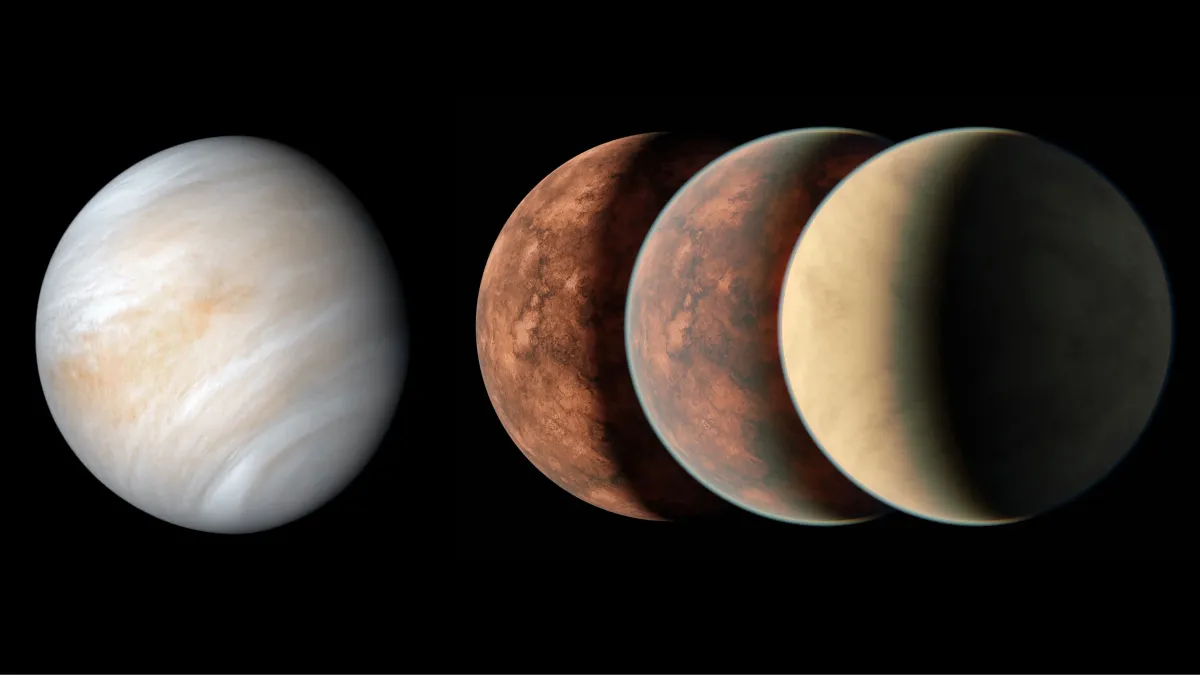
You know that goldilocks zone, the sweet spot around a star where temperatures are just right for liquid water? Turns out, that's not nearly enough. A new study suggests that most planets previously thought to be prime real estate for alien life are actually parched, desolate rocks.
Researchers at the University of Washington found that an Earth-sized planet needs a surprising amount of water — at least 20% to 50% of our own planet's ocean volume — just to stay in the game. Because apparently, even planets need proper hydration.
The Carbon Cycle: More Than Just a Science Class Memory
Astronomers have spotted over 6,000 exoplanets, with billions more lurking out there, many comfortably nestled in their stars' habitable zones. But being in the right neighborhood is only step one. A planet also needs stable climate control, which, on Earth, is a delicate dance between water, geology, and atmosphere.
We're a new kind of news feed.
Regular news is designed to drain you. We're a non-profit built to restore you. Every story we publish is scored for impact, progress, and hope.
Start Your News DetoxHaskelle White-Gianella, a lead author and doctoral student, put it simply: when you're sifting through thousands of potential life-harboring worlds with limited resources, you need a good filter. And the new filter? Water, or rather, the lack thereof.
Water is crucial, yes, but it’s not an automatic habitability ticket. The study, published in Planetary Science Journal, dug into planets with minimal water to understand their life-supporting potential. White-Gianella noted that many arid planets are indeed in the habitable zone, but their actual habitability was a big question mark.
The secret sauce is the geologic carbon cycle. This water-driven system shuffles carbon between a planet's atmosphere and its interior over millions of years, acting like a planetary thermostat. On Earth, volcanoes burp out carbon dioxide. Rainwater dissolves it. The rain reacts with rocks, carrying carbon into the ocean, where it settles. Plate tectonics then drag this carbon-rich crust back beneath continents, eventually recycling it through mountain formation. It's a slow, steady, very wet process.
But if a planet doesn't have enough water for rainfall, this elegant cycle grinds to a halt. Carbon removal slows to a crawl, while volcanic belches continue. Carbon dioxide builds up, trapping heat. Any remaining water evaporates, and the planet spirals into an oven-like state, too hot for life. Which, if you think about it, is both impressive and slightly terrifying.
White-Gianella's conclusion? Arid planets in habitable zones are pretty much out of the running for life. Let that sink in.
Venus: The Ultimate Dry Run
Scientists can pick up hints of surface water from afar, but directly observing rocky exoplanets is tricky. So, the team turned to advanced computer simulations to model how water (or the lack of it) behaves on these desert worlds.
Earlier models of the carbon cycle focused on cooler, wetter planets, often missing factors like wind. White-Gianella refined these models to better represent dry environments, tweaking estimates for evaporation and precipitation. Essentially, they built a better desert simulator.
Joshua Krissansen-Totton, a senior author, explained that these sophisticated models sprang from efforts to understand Earth's own long-term temperature regulation. And what they found suggests that even planets that start with some surface water can lose it over time, slipping from potentially habitable to decidedly not as the carbon cycle goes haywire.
Our own solar system has a stark example: Venus. Similar in size to Earth and likely formed around the same time, it may have once harbored similar amounts of water. Today? Its surface is hot enough to melt lead, and as White-Gianella vividly put it, standing there would feel like being crushed by ten blue whales. Scientists have long puzzled over why Earth and Venus went such dramatically different ways. White-Gianella and Krissansen-Totton propose that Venus, being closer to the sun, might have simply started with slightly less water than Earth. That seemingly small difference could have thrown its carbon cycle off balance, leading to a runaway greenhouse effect, a planetary sauna, and the total loss of any potential for life.
Future missions to Venus aim to unravel its past, and whether life ever got a foothold. The findings could also shed light on those distant exoplanets we can only glimpse. White-Gianella noted that while landing on an exoplanet isn't happening in our lifetime, Venus is the best "exoplanet analog" right next door. Data from upcoming missions, they hope, will help confirm their models. Krissansen-Totton added that this research has implications for a lot of potentially habitable places in the universe. Which means a lot of thirsty planets are about to get crossed off the list.