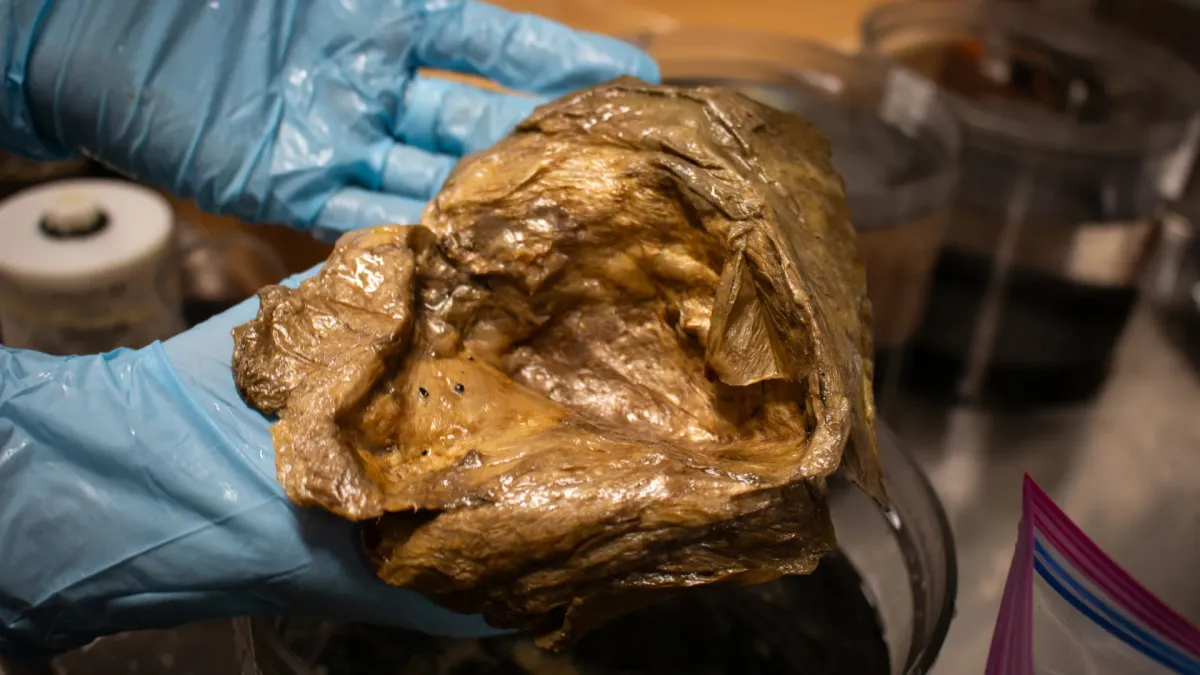
For two years, a mysterious "golden orb" sat at the bottom of the Gulf of Alaska, baffling scientists. Was it an alien egg? Some new, undiscovered creature? A deep-sea disco ball? Nope. After a whole lot of deep-sea sleuthing, microscopic analysis, and DNA sequencing, the verdict is in: it was the remains of a giant deep-sea anemone. Specifically, its attachment point. Let that sink in.
The Golden Discovery
The whole saga began in 2023 when the remotely operated vehicle Deep Discoverer was poking around more than two miles beneath the surface. Suddenly, there it was: a perfectly rounded, golden object with a tiny opening, clinging to a rock. The team had never seen anything quite like it. Naturally, the internet went wild with theories, because apparently that's where we are now. Was it an egg case? A sponge? Some kind of deep-sea escape pod? The possibilities were endless, and the curiosity was intense. So, with the precision of a surgeon performing a delicate operation, the team used a suction sampler to collect the orb and sent it off to the Smithsonian National Museum of Natural History (NMNH) for the full scientific treatment.
Unraveling the Mystery, One Cell at a Time
Solving the case of the golden orb wasn't a quick Netflix binge. It took years of meticulous work, combining multiple scientific disciplines. Allen Collins, a zoologist at NOAA Fisheries, described it as a complex puzzle requiring expertise in everything from morphology (how things look) to genetics, deep-sea biology, and even computational analysis. Because, you know, a golden blob isn't just going to give up its secrets easily.
We're a new kind of news feed.
Regular news is designed to drain you. We're a non-profit built to restore you. Every story we publish is scored for impact, progress, and hope.
Start Your News DetoxInitial studies by researchers from NOAA Fisheries and the Smithsonian revealed fibrous layers packed with stinging cells called cnidocytes. This immediately pointed to cnidarians—the group that includes corals and anemones. Further investigation by scientist Abigail Reft narrowed it down to spirocysts, which are exclusively found in the Hexacorallia subgroup of cnidarians. They even compared it to a similar object found in 2021 and found matching cellular structures. It was like a deep-sea cold case getting warmer.
The DNA Drops the Mic
Early DNA tests were a bit muddled, likely due to genetic material from other tiny organisms hitching a ride. So, the team went all-in with whole-genome sequencing. This deeper dive into the genetic code confirmed animal DNA was present and, more importantly, showed a strong match to the giant deep-sea anemone, Relicanthus daphneae. Mitochondrial genome sequencing from both the orb and a known specimen of the anemone were practically identical. Case closed.
So, the mysterious golden orb wasn't an alien egg or a forgotten treasure. It was the base of a giant deep-sea anemone, the part that anchors it to the seafloor. Which, if you think about it, is both impressive and slightly terrifying. Imagine finding what you think is a space pod, only to discover it's the equivalent of a barnacle's foot. Still, it solves a captivating mystery and reminds us just how much we still don't know about the deep ocean. Apparently, even anemones have their secrets.