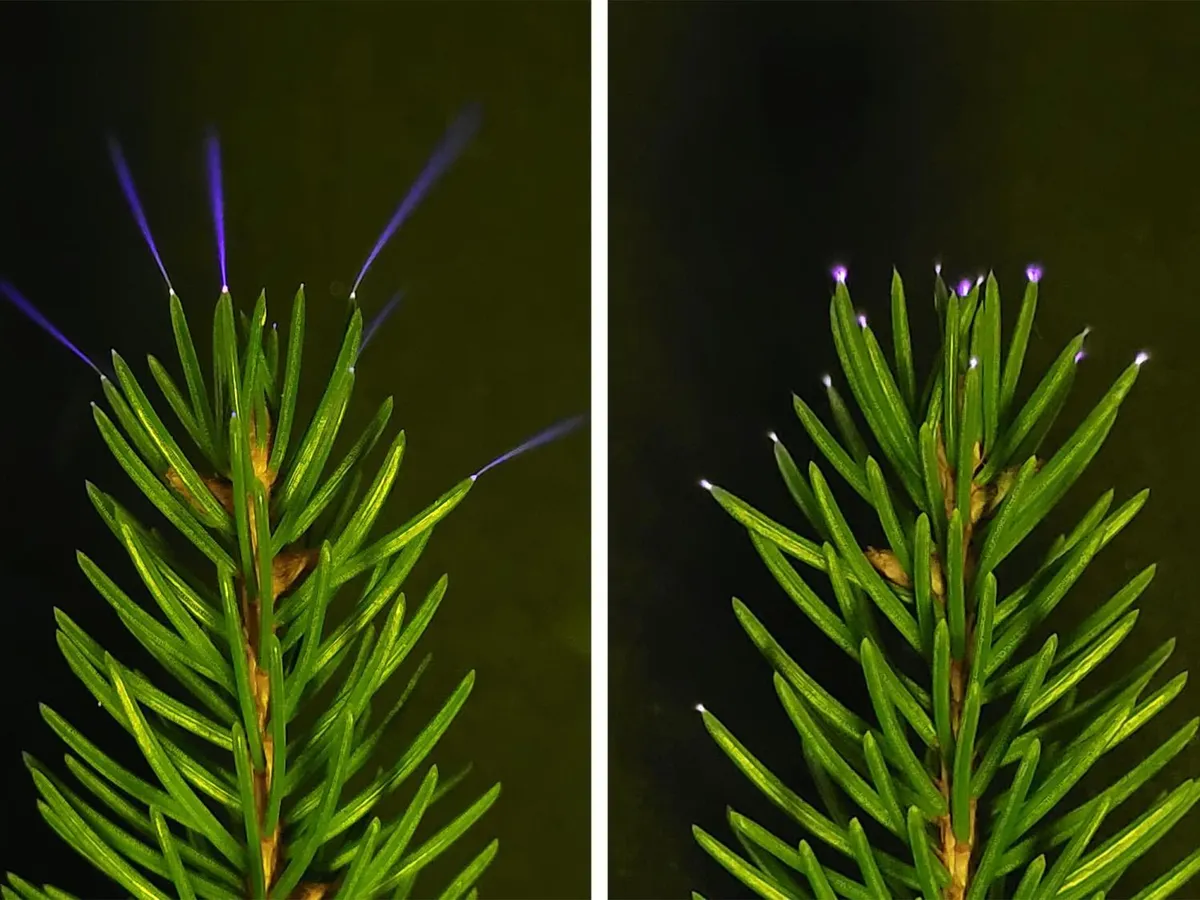
For over 70 years, scientists have suspected that trees put on a secret light show during thunderstorms. Not just the dramatic, branch-snapping kind, but a subtle, nearly invisible glow from their very tips. Now, after decades of theorizing, researchers have finally caught trees in the act, proving these tiny electrical flashes — called corona discharges — are very much a real, natural phenomenon.
Imagine your phone, but instead of just sitting there, it occasionally emits a faint, cleansing glow when the weather gets wild. That's essentially what trees are doing, and it turns out, it might be helping clean the air.
The Great Tree-Glow Hunt
The chase for these elusive flashes began in June 2024. A team from Penn State, armed with a modified Toyota Sienna van and a rooftop weather instrument, embarked on an East Coast road trip. Their mission: track Florida's notoriously dramatic summer thunderstorms and find proof of these corona discharges in the wild. Up until now, these tiny electrical pulses, which cause treetops to glow faintly in ultraviolet (UV) light, had only ever been seen in controlled lab settings.
We're a new kind of news feed.
Regular news is designed to drain you. We're a non-profit built to restore you. Every story we publish is scored for impact, progress, and hope.
Start Your News DetoxAfter three weeks of frustratingly brief and scattered storms in Florida, luck finally struck on their return journey. West of Interstate 95, near the University of North Carolina at Pembroke, a massive, two-hour storm rolled in. The team pointed their specialized telescope system, complete with a UV-sensitive camera, at a sweetgum tree about 100 feet away. They then detected the tell-tale corona discharges.
Later, a nearby loblolly pine joined the glowing party as the storm faded. These were the first confirmed observations of corona discharges in nature, a discovery published in Geophysical Research Letters.
"This just goes to show that there’s still discovery science being done," noted lead author Patrick McFarland. "For more than half a century, scientists have theorized that corona exists, but this proves it." Because apparently, some mysteries just need a road trip and a very patient sweetgum tree.
How Trees Get Their Glow On
So, how does a tree become a natural lightbulb? It's all about electrical imbalances during a thunderstorm. Storm clouds build up negative charges, which, like a cosmic magnet, pull positive charges up from the ground. These positive charges surge through trees, gathering at the tips of leaves. At these minuscule points, the electric field becomes so intense it creates a faint glow in both visible and UV light.
But here's where it gets really interesting: this UV light then breaks apart water vapor, forming something called hydroxyl. If you've never heard of hydroxyl, here's your fun fact of the day: it's the atmosphere's primary oxidizer, essentially a natural scrub brush for the air. It reacts with pollutants from human activity (like methane) and chemicals emitted by trees themselves, transforming them into forms that can be removed from the atmosphere.
Earlier research by the team hinted that these corona discharges could be a significant source of these air-cleansing compounds in forests. Which, if you think about it, is both impressive and slightly terrifying. Trees are out here doing atmospheric chemistry while we're just trying to find an umbrella.
In North Carolina, the team recorded 859 corona events on the sweetgum tree and 93 on the loblolly pine. Individual events ranged from quick flashes to several seconds of sustained glow. They also observed similar activity during four other thunderstorms and on four other tree species. "It’s nearly invisible to the naked eye," McFarland explained, "But our instruments show swaths of scintillating corona glowing as thunderstorms pass overhead."
Now, the big questions remain: are these electrical events harming the trees, or do they offer some kind of benefit? And how do these widespread, glowing trees impact the health of our forests and the very air we breathe? Scientists are now teaming up with tree ecologists to find out. Because when it comes to nature, there's always a hidden light show happening just out of sight, proving the world is a lot more electrically charged than we usually give it credit for.