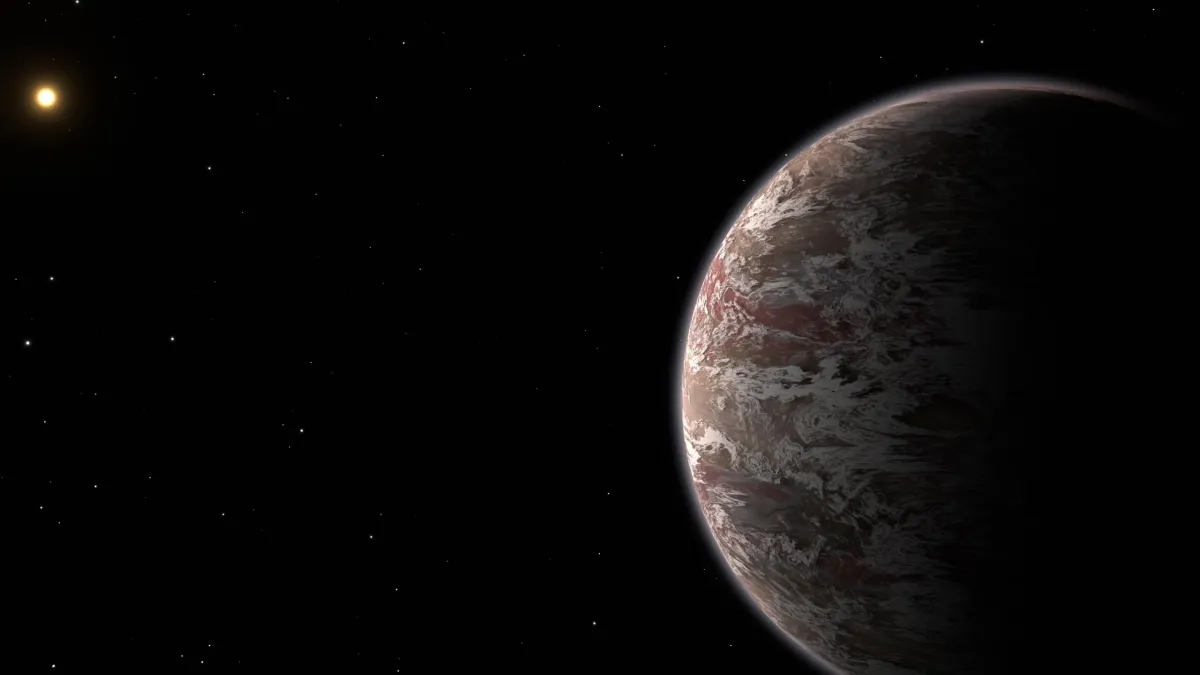
Turns out, even the most advanced space telescopes can deliver a cosmic curveball. The James Webb Space Telescope (JWST) just peered at a distant, Jupiter-esque planet and found something completely unexpected: water-ice clouds swirling in its atmosphere. This isn't just a pretty picture; it's a giant, frosty wrench thrown into how scientists model planets beyond our solar system.
The gas giant in question is Epsilon Indi Ab, and the team, led by Elisabeth Matthews at the Max Planck Institute for Astronomy, basically confirmed that these alien worlds are far more complex than our current theories suggest. Which, if you think about it, is both impressive and slightly terrifying.
A Cold, Cloudy Surprise
Most gas giants we've spotted so far are scorching hot because the easiest way to find them is when they transit (pass in front of) their star. That usually means they're orbiting very close. But Epsilon Indi Ab is different. It's chilling out much farther from its star — about four times the distance Jupiter is from our Sun. Its star is also a bit smaller and cooler, keeping things relatively frosty.
We're a new kind of news feed.
Regular news is designed to drain you. We're a non-profit built to restore you. Every story we publish is scored for impact, progress, and hope.
Start Your News DetoxAstronomers aimed JWST's MIRI instrument directly at Epsilon Indi Ab, using a special coronagraph to block out the star's blinding light. What they found was a planet about 7.6 times more massive than Jupiter, but roughly the same diameter. Its surface temperature hovers between a brisk -70 and +20 degrees Celsius. Still warmer than Jupiter's bone-chilling -133 degrees Celsius, but that's because it's still radiating heat from its formation. Give it a few billion years, it'll be colder than our own gas giant.
Scientists expected to see plenty of ammonia gas in its atmosphere, just like on Jupiter. But the JWST observations showed less ammonia than predicted. The most likely culprit? Thick, uneven water-ice clouds, much like the cirrus clouds high in Earth's atmosphere. An utterly unexpected finding.
This isn't just a "huh, neat" moment. It means the computer models scientists use to understand exoplanet atmospheres, many of which don't even include clouds because they're so tricky to simulate, need a serious upgrade. As co-author James Mang put it, it's "a great problem to have," showing just how far JWST has pushed our capabilities. We're now detecting things that were once impossible, forcing us to rethink our cosmic assumptions.
So, while we're still a ways off from finding definitive signs of life on Earth-like worlds, every icy cloud and atmospheric puzzle piece brings us closer. And frankly, it's a lot more fun when the universe keeps surprising us.