
New research shows that plants under stress release ultrasonic sounds. These sounds travel through the air and might carry information about the plant's condition.
Plants Make Sounds When Stressed
Scientists have found that many plants make faint, ultrasonic clicks when they are distressed. It's not a sound humans can hear.
A new study in the journal Cell found that stressed plants release bursts of ultrasonic sound. These sounds are like faint pops or clicks, similar to snapping bubble wrap. Tomato and tobacco plants made these signals when they were dehydrated or physically damaged.
We're a new kind of news feed.
Regular news is designed to drain you. We're a non-profit built to restore you. Every story we publish is scored for impact, progress, and hope.
Start Your News DetoxThe sounds are as loud as a normal conversation, about 60 to 65 decibels. However, they are at frequencies far beyond what human ears can pick up. This means our world might be full of plant noises that we never notice.
Lilach Hadany, an evolutionary biologist at Tel Aviv University and a lead author, explained that even in a quiet field, there are sounds we don't hear. These sounds carry information. She noted that animals can hear these sounds, suggesting a lot of acoustic interaction might be happening.
Scientists had previously found ultrasonic vibrations in plants. But this study is the first to show these sounds travel through the air. This makes them more important for other living things nearby. Hadany added that plants constantly interact with insects and animals, many of which use sound to communicate. So, it would be strange if plants didn't use sound at all.
https://scitechdaily.com/images/Plant-Sounds.mp3
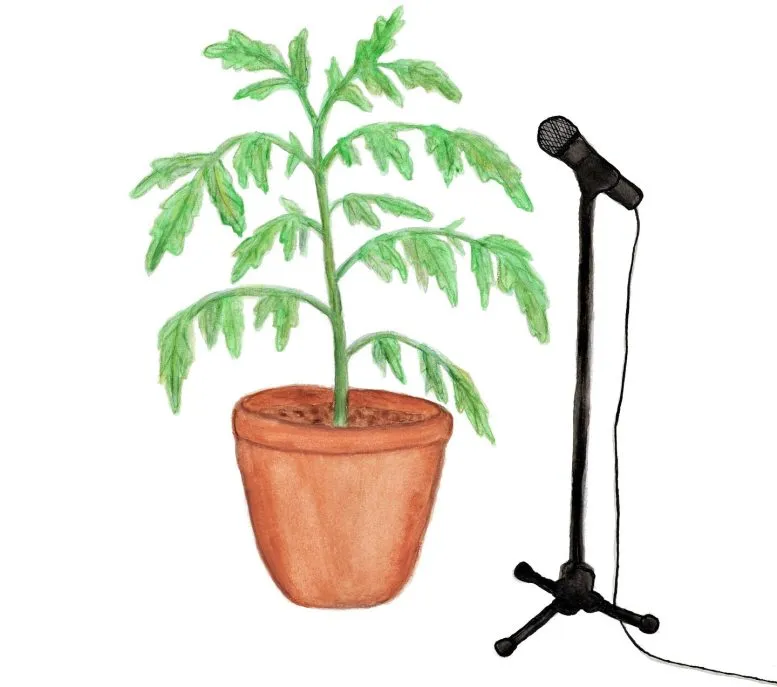
To study this, researchers recorded healthy and stressed tomato and tobacco plants using microphones. They did experiments in a soundproof room and later in a greenhouse with background noise. Plants were stressed by not getting water for several days or by having their stems cut. The team then used a machine learning program to tell the difference between healthy, dehydrated, and cut plants.
Different Sounds for Different Stress
The results showed that stressed plants made many more sounds than healthy ones. These noises sounded like clicks or pops. A single stressed plant made about 30 to 50 sounds per hour at irregular times. Healthy plants were mostly quiet. Hadany said that tomatoes are very quiet when they are not stressed.
Plants that needed water started making sounds before showing visible signs of drying out. The number of sounds was highest after about five days without water. Then, the sounds decreased as the plants became completely dry. The type of sound also changed depending on what was stressing the plant. The machine learning system could successfully tell the difference between dehydration and physical damage. It could even identify if the sounds came from tomato or tobacco plants.
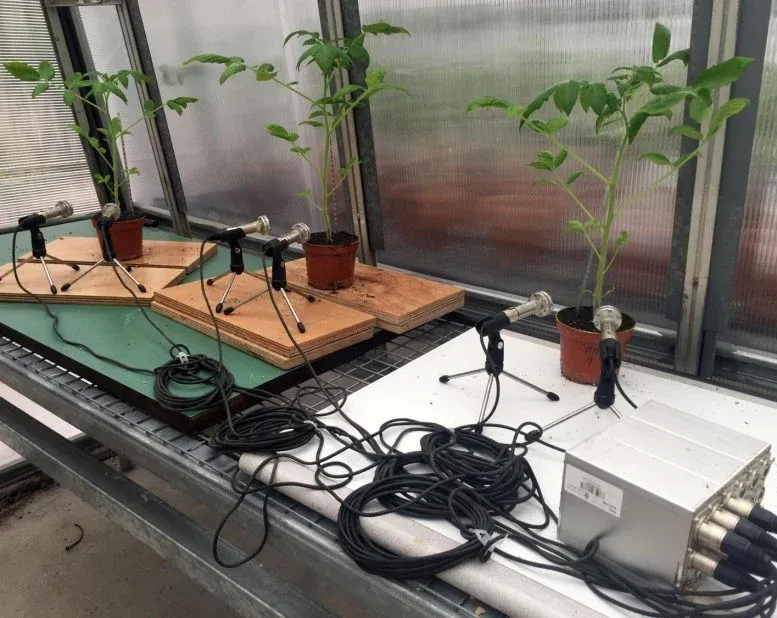
The study focused on tomato and tobacco plants because they are easy to grow in controlled settings. However, the researchers also tested other plants. Hadany noted that many plants, like corn, wheat, grape, and cactus, make sounds when stressed.
The exact reason for these sounds is still unknown. Researchers think they might come from cavitation. This is when air bubbles form and burst inside the plant's water-carrying system.
What Do These Sounds Mean?
It's not clear if plants make these sounds on purpose to communicate. However, these sounds could have important effects on nature and evolution. Hadany suggested that other living things might have learned to hear and react to these sounds. For example, a moth looking for a place to lay eggs or an animal wanting to eat a plant could use these sounds to help them decide.
Other plants might also detect and respond to these signals. Earlier studies show that plants react to sound and vibration. Hadany and her team found that plants increase sugar in their nectar when they "hear" pollinators. Other research shows that sound can change how plant genes work. Hadany believes that if other plants get information about stress before it happens, they could prepare themselves.
These findings could be useful in farming. Monitoring plant sounds might help farmers check how much water their crops need. This could make irrigation more efficient.
Yossi Yovel, a neuro-ecologist at Tel Aviv University and co-senior author, said that a lot of ultrasound exists. Every time a microphone is used, many things make sounds that humans can't hear. The fact that plants make these sounds opens new possibilities for communication, listening in, and using these sounds.
Hadany concluded by asking, "So now that we know that plants do emit sounds, the next question is, 'who might be listening?'" She added that they are currently studying how other organisms, both animals and plants, react to these sounds. They are also trying to identify and understand these sounds in natural environments.
Deep Dive & References
Sounds emitted by plants under stress are airborne and informative - Cell, 2023