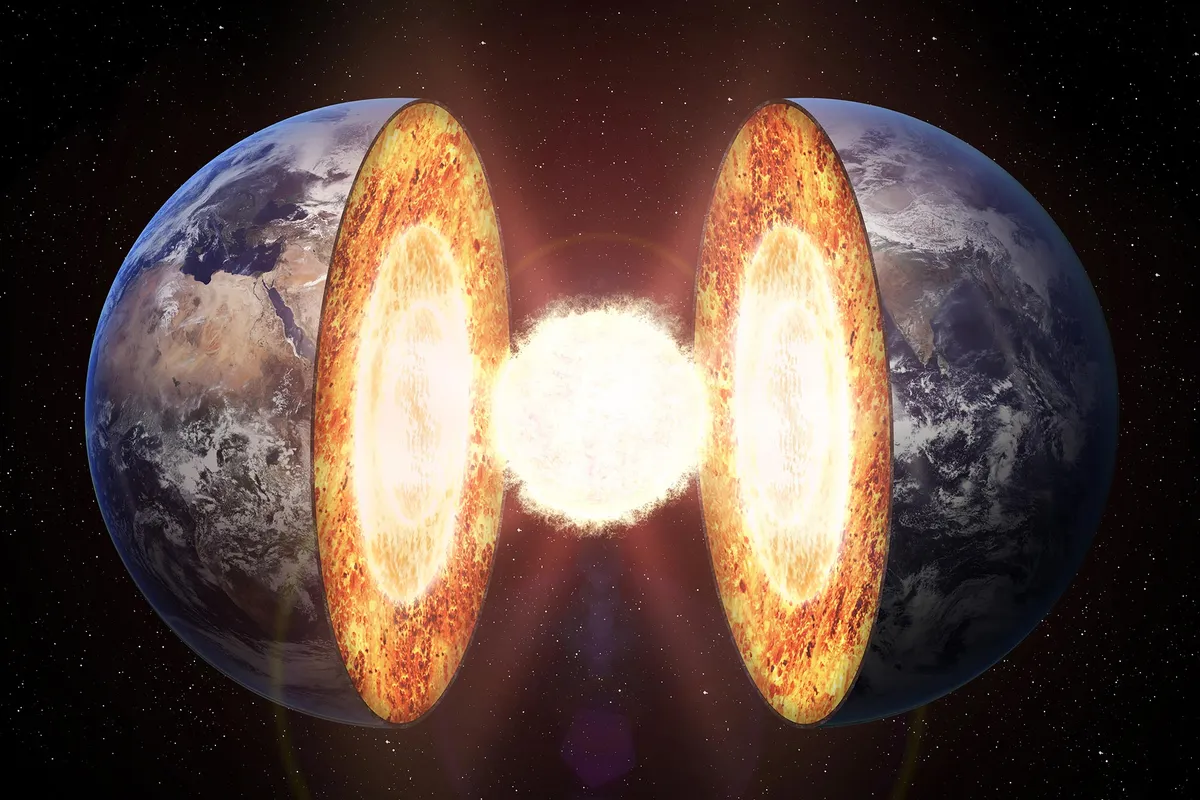
Just when you thought you had Earth figured out, scientists have gone and found a secret layer hiding deep inside our planet's core. Yes, the one you learned about in school? Apparently, it's more of a Russian nesting doll situation. This isn't just a fun fact; it could rewrite the textbooks and finally explain some of Earth's biggest ancient mysteries.
For decades, the idea of an "innermost inner core" has been floating around scientific circles. It's a bit like a conspiracy theory that finally got enough evidence to go mainstream. Joanne Stephenson, a PhD researcher at The Australian National University (ANU), noted that the data was just never clear enough to confirm it. Until now.
Peeking into the Planet's Guts
To understand this, let's remember our planet's layers: crust, mantle, outer core, and inner core. This new discovery suggests there's a distinct zone within that solid inner core — a dense, scorching ball of iron and nickel, hotter than 5,000 degrees Celsius (9,000 degrees Fahrenheit). We can't exactly pop down for a visit, so how do you probe something so inaccessible? Earthquakes, naturally.
We're a new kind of news feed.
Regular news is designed to drain you. We're a non-profit built to restore you. Every story we publish is scored for impact, progress, and hope.
Start Your News DetoxScientists use seismic waves from quakes like a planetary ultrasound. These waves zip through different materials at varying speeds, giving researchers clues about what they're encountering. The ANU team sifted through decades of this seismic data, not just averaging it out, but looking for subtle shifts. And they found one, about 650 kilometers (400 miles) from Earth's exact center. It's a boundary, a demarcation line indicating something entirely different.
What did the waves reveal? Anisotropy, which is fancy talk for seismic waves traveling at different speeds depending on their direction. Most models show waves moving faster along the north-south axis. But in this newly identified central region, that pattern flips. The slowest speeds happen at a 54-degree angle from the rotation axis, suggesting the iron crystals inside are aligned in a totally unique way. Which, if you think about it, is both impressive and slightly terrifying.
Stephenson believes this shift could be a sign of "two separate cooling events in Earth’s history," hinting at "an unknown, dramatic event" that shaped our world billions of years ago.
The Confirmation
If one study finds a secret layer, that's interesting. If another study, using a completely different method, finds the exact same secret layer, well, that's when you start calling the textbook publishers. In 2023, a separate group of researchers bounced rare earthquake signals through Earth multiple times — some up to five times — gathering unprecedented detail.
And guess what? They also found a central region, roughly 650 kilometers (400 miles) across, where seismic waves showed the same directional weirdness, with the slowest speeds at about 50 degrees from Earth's rotation axis. The rest of the inner core, by comparison, seemed rather uniform.
This double-whammy discovery could finally explain why some past experiments just didn't quite fit the existing models of Earth's interior. It seems our planet has been holding out on us, keeping a significant piece of its formation story under wraps. As Stephenson put it, "It’s very exciting—and might mean we have to re-write the textbooks!" Let's hope they leave room for future discoveries; Earth seems to have a flair for the dramatic.