Neutrinos are among the most mysterious particles in physics. They rarely interact with other matter, have almost no mass, and carry no electrical charge. These traits make them incredibly hard to study.
Detecting them requires special facilities. These are often found in deep caves, thick Antarctic ice, or on the ocean floor.
The Most Energetic Neutrino
One leading neutrino detector is KM3NeT, the Cubic Kilometer Neutrino Telescope. It sits on the Mediterranean seafloor. In February 2023, it found the most energetic neutrino ever seen.
We're a new kind of news feed.
Regular news is designed to drain you. We're a non-profit built to restore you. Every story we publish is scored for impact, progress, and hope.
Start Your News DetoxThis neutrino, named KM3-230213A, had an estimated energy of 220 PeV. That's 220 million billion electron volts. Since its detection, physicists have been trying to figure out where it came from.
Neutrinos come from the universe's most energetic events. These include supernovae, gamma-ray bursts, and kilonovae. Only these powerful events can give particles such high energies. But tracing KM3-230213A back to one of these has been a major challenge.
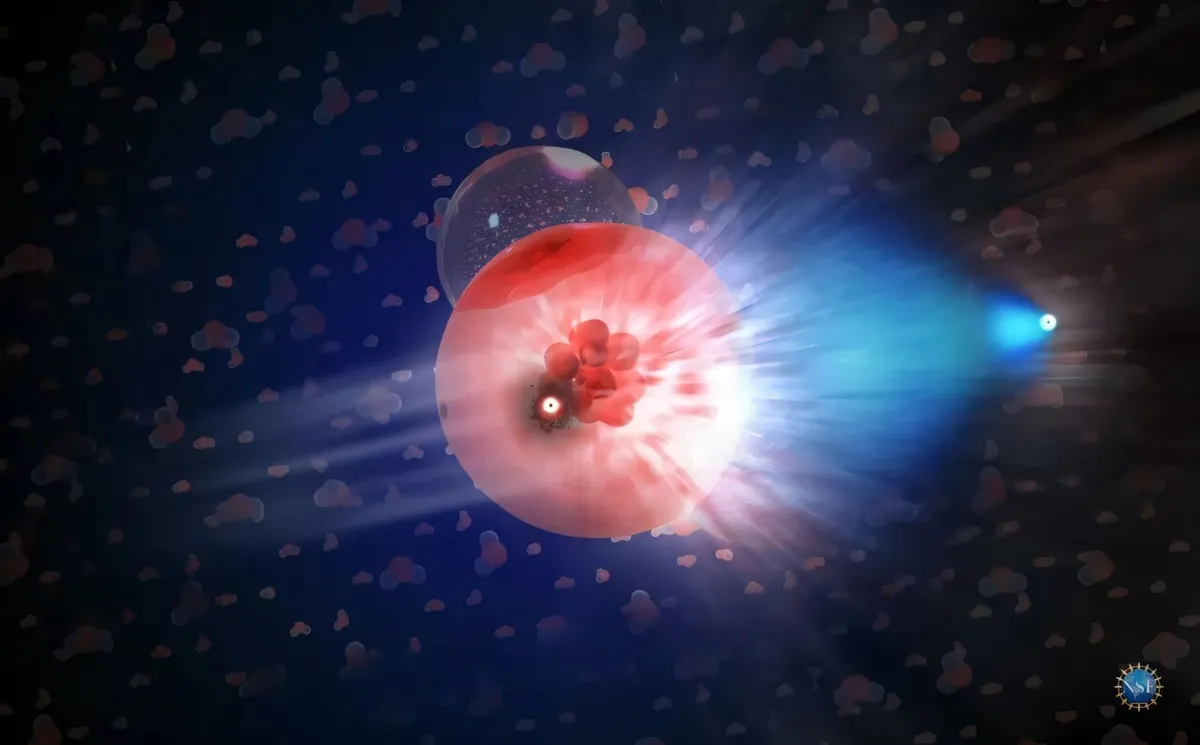
Detectors don't actually see neutrinos directly. Instead, they spot secondary particles or Cherenkov radiation. This radiation appears when a neutrino rarely interacts with other matter. For KM3-230213A, researchers detected a muon.
After careful study, researchers from KM3NeT published their findings in Nature. The paper is titled "Observation of an ultra-high-energy cosmic neutrino with KM3NeT."
The authors explained that detecting cosmic neutrinos with energies above a teraelectronvolt (TeV) helps explore astrophysical events. Neutrinos are not affected by magnetic fields and are rarely absorbed by interstellar matter. This means their direction points to their cosmic origin, possibly from the universe's farthest reaches.
High-energy neutrinos have specific sources. They form when ultra-fast cosmic-ray protons or nuclei hit matter or photons. Observing these neutrinos is like seeing the signature of the process itself.
Rosa Coniglione, KM3NeT deputy-spokesperson at the time, noted that neutrinos are special cosmic messengers. They bring unique information about the most energetic phenomena and help us explore the universe's farthest parts.
A Primordial Origin?
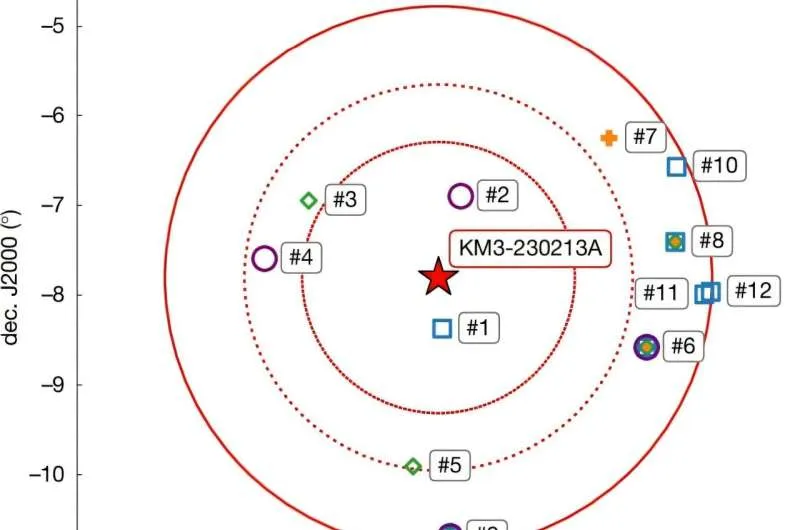
Researchers traced the neutrino back to its origin, but not precisely. Their work pointed to four possible source types: galactic, local universe, transient, and extragalactic.
The energy of KM3-230213A was much higher than any other neutrino detected before. This suggests two main possibilities. Either it came from a different cosmic object than less energetic neutrinos, or it is a cosmogenic neutrino.
Cosmogenic neutrinos are mostly theoretical. They are created when ultra-high-energy cosmic rays (protons or heavier nuclei moving near light-speed) collide with photons from the cosmic microwave background. This background radiation is a leftover from the Big Bang. Such impacts create a cascade of particles, including ultra-high-energy neutrinos like KM3-230213A.
Cosmogenic neutrinos are exciting for several reasons. They can point directly to their sources, such as active galactic nuclei, gamma-ray bursts, or even galaxy mergers. Since they formed throughout the universe's history, they can help us study the early universe. Also, they are far more energetic than anything we can create in particle accelerators. Studying them could reveal new physics beyond the Standard Model.
So, was KM3-230213A a cosmogenic neutrino? Its energy falls within the range physicists expect for cosmogenic neutrinos.
The researchers stated that this explanation is a "viable alternative hypothesis." The neutrino's extremely high energy is key. They wrote that it might have come from a different cosmic accelerator than lower-energy neutrinos. Or, it could be the first detection of a cosmogenic neutrino. This would mean it resulted from ultra-high-energy cosmic rays interacting with background photons in the universe.
For now, there is no clear conclusion. Understanding these high-energy neutrinos will depend on future observatories and upgrades to current ones. KM3NeT is expanding with more detectors. This will help it find more neutrinos and pinpoint their cosmic sources more accurately.
Deep Dive & References
Observation of an ultra-high-energy cosmic neutrino with KM3NeT - Nature, 2025