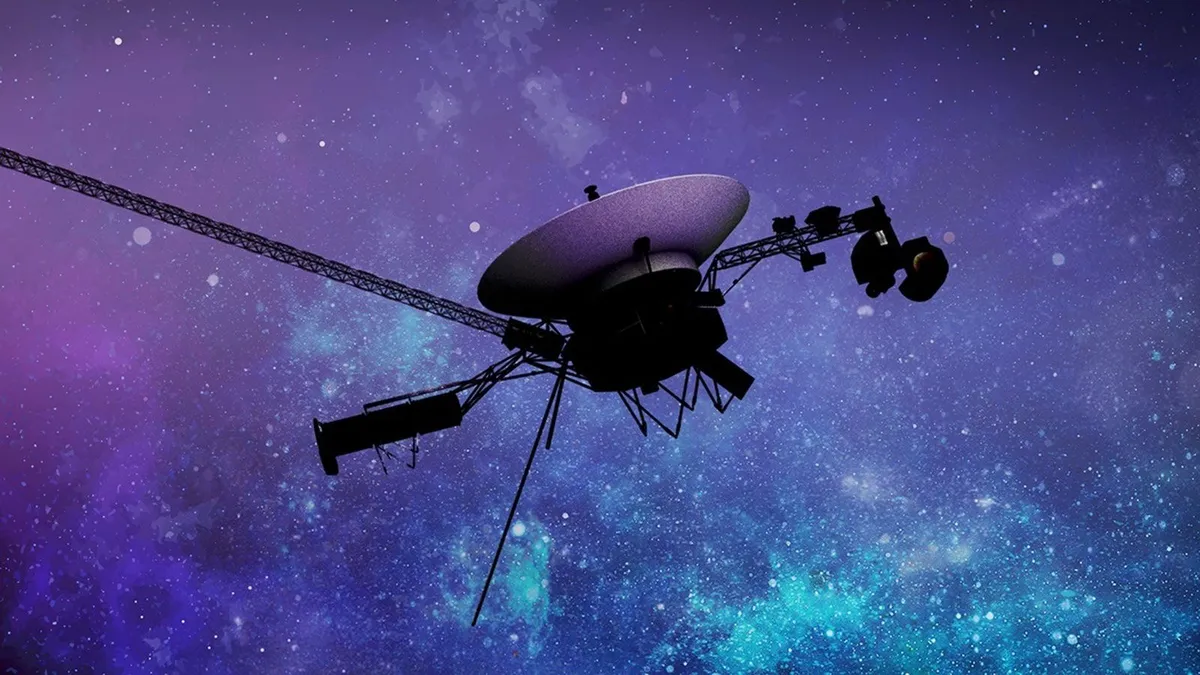
In 1977, NASA launched two spacecraft, Voyager 1 and Voyager 2. Their initial mission was to study Jupiter and Saturn. Today, they are still collecting data in interstellar space, traveling toward the edge of our solar system.
Voyager 1 is now about 15.8 billion miles from Earth. This makes it the farthest human-made object. To keep the probe working, NASA turned off one of its scientific instruments on April 17.
Keeping Voyager 1 Going
Former Voyager project manager John Casani noted that the spacecraft were not designed to last 30 or 40 years. Instead, they were built not to fail.
We're a new kind of news feed.
Regular news is designed to drain you. We're a non-profit built to restore you. Every story we publish is scored for impact, progress, and hope.
Start Your News DetoxBoth Voyagers get power from a generator that converts heat from decaying plutonium into electricity. They lose about four watts of power each year. Their power levels are now very low. The team must turn off heaters and instruments to save energy and prevent the spacecraft from getting too cold.
Voyager 1 has especially low power. In February, its power levels dropped sharply. A further drop could trigger an automatic shutdown system. This would require a long and risky recovery process by NASA scientists.
To prevent this, engineers at NASA’s Jet Propulsion Laboratory (JPL) turned off Voyager 1’s Low-energy Charged Particles experiment (LECP). This instrument measures ions, electrons, and cosmic rays from the solar system and galaxy. Data from the LECP helped scientists understand the interstellar medium. This is the gas, dust, and radiation at the edges of the solar system and between star systems.
Mission engineers have shut down Voyager 1's Low-energy Charged Particles experiment. NASA / JPL-Caltech
The Voyager spacecraft are the only probes that have taken these measurements. Voyager 1 reached interstellar space in 2012, and Voyager 2 followed in 2018. Voyager 2's LECP was turned off in March 2025.
Kareem Badaruddin, Voyager mission manager at JPL, said that shutting down an instrument is not ideal. However, it is the best option available. Voyager 1 still has two working science instruments: one for plasma waves and one for magnetic fields. Both are still performing well.
Both Voyager probes started with ten instruments. Before this latest shutdown, seven had already been turned off on each. NASA scientists had a plan for which instruments to power down. Voyager 1’s LECP was next. Commands took about 23 hours to reach the probe, and the shutdown took about 3 hours and 15 minutes.
A Chance for Revival
The particle-measuring device might not be off forever. The team is working on a larger energy-saving plan for both probes, called “the Big Bang.” This plan involves turning off several devices at once and switching to lower-power options.
Voyager 1 might get the Big Bang treatment as early as July. If successful, scientists might be able to reactivate its LECP. NASA even left part of the instrument running to increase the chances of turning it back on.
These efforts aim to keep both Voyager probes on their journey. Suzanne Dodd, program manager for Voyager at JPL, shared her personal goal in 2019. She hopes to see a spacecraft celebrate its 50th anniversary from launch.
Deep Dive & References
NASA Shuts Off Instrument on Voyager 1 to Keep Spacecraft Operating - NASA, 2026 Still Kickin' Since the 70s: NASA's Voyager Mission Keeps Exploring - NASA, 2024