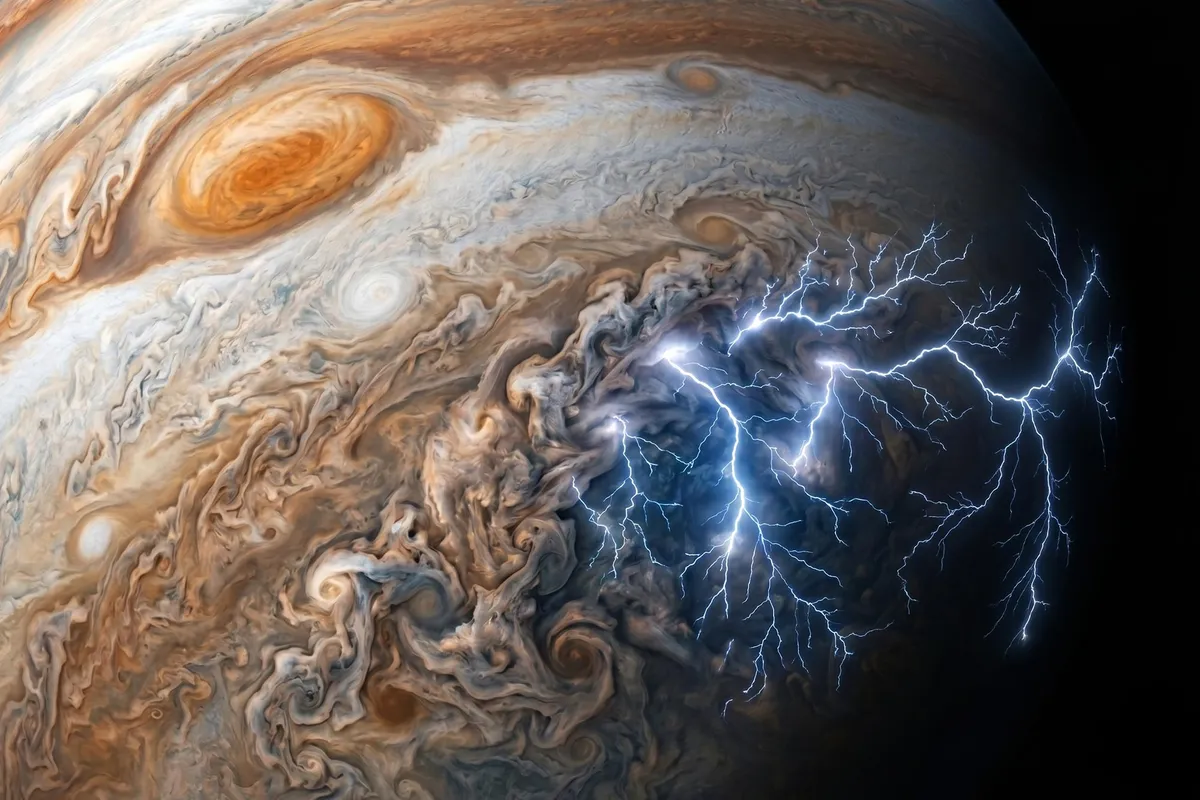
Scientists studying data from NASA's Juno spacecraft have found that lightning on Jupiter can be much more powerful than on Earth. This discovery offers new insights into the planet's extreme storms.
Jupiter's Powerful Storms
Jupiter, the solar system's largest planet, has huge storms that can last for centuries. A new study from the University of California, Berkeley, shows these storms produce incredibly strong lightning. Some flashes might be up to 100 times stronger than lightning on Earth, possibly even more.
These findings come from NASA's Juno spacecraft, which has been orbiting Jupiter since 2016. Juno uses a microwave radiometer to detect radio signals from lightning. This is similar to how lightning causes interference on Earth.
We're a new kind of news feed.
Regular news is designed to drain you. We're a non-profit built to restore you. Every story we publish is scored for impact, progress, and hope.
Start Your News DetoxWhy Study Lightning on Other Planets?
Studying storms on other planets helps scientists better understand weather on Earth, where many things are still unknown. Michael Wong, a planetary scientist at UC Berkeley and lead author of the study, explained this. His research was published in AGU Advances.
Wong noted that much is still unknown about lightning on Earth. In the last decade, scientists have found new types of "transient luminous events" (TLEs) linked to thunderstorms. These include sprites, jets, halos, and ELVEs, which are millisecond electrical events above large storms.
On Jupiter, lightning helps explain convection, the process that moves heat through the atmosphere. Wong said that convection works differently on Earth and Jupiter. Jupiter's atmosphere is mostly hydrogen, making moist air heavier and harder to lift.
On Earth, air is mostly nitrogen, which is heavier than water. This makes moist air more buoyant and easier to lift. But on Jupiter, moist air is heavier than the surrounding atmosphere. This means storms need much more energy to rise. When they reach higher altitudes, they release that energy more violently, causing strong winds and intense cloud-to-cloud lightning.
Almost every spacecraft that has flown past Jupiter has seen lightning, especially on the planet's dark side where flashes stand out. Earlier missions only detected the brightest flashes, which led to the idea that Jupiter's lightning was much stronger than Earth's.
This idea changed when Juno's sensitive star-tracking camera found many weaker flashes, similar to those on Earth. However, observations on the night side can be misleading. Thick clouds might hide some light, making flashes seem weaker than they are, Wong explained.
Juno's microwave radiometer provides a more reliable measurement because its signals can pass through clouds. Even though the instrument wasn't made specifically for lightning studies, it can detect microwave emissions from nearby storms.
One big challenge is that many storms often happen at the same time across Jupiter's wide atmospheric bands. This makes it hard to link a lightning signal to a specific storm. Without knowing the exact source, scientists can't accurately calculate the strength of each flash. Wong compared it to hearing popping sounds at a parade without knowing if they are from nearby popcorn or distant firecrackers.
Stealth Superstorms
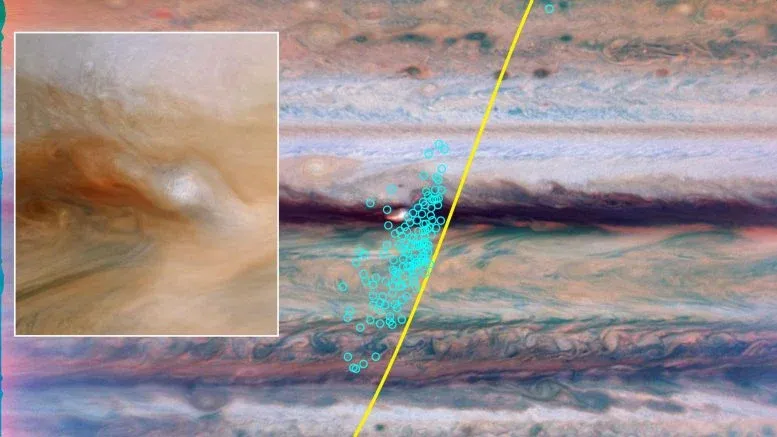
In 2021 and 2022, storm activity in Jupiter's North Equatorial Belt temporarily decreased. This allowed Wong and his team to isolate individual storms. They tracked these storms more precisely using data from the Hubble Space Telescope, Juno's camera, and amateur astronomers. He called these events "stealth" superstorms.
These storms lasted for months and changed the surrounding cloud patterns, much like larger superstorms. However, their cloud tops did not rise as high.
Wong said that because they had a precise location, they could directly measure the power of the lightning.
During this time, Juno made 12 passes over isolated storms. In four cases, it got close enough to detect microwave signals from lightning. The spacecraft recorded an average of three flashes per second. In one pass, it detected 206 separate pulses. Out of 613 total pulses, Wong estimated that lightning strength ranged from similar to Earth's to more than 100 times stronger.
He noted that there is some uncertainty in these comparisons because the measurements were taken at different radio wavelengths. One study suggests Jupiter's lightning could be up to a million times more powerful than lightning on Earth.
Understanding Lightning Energy
Converting microwave signals into total lightning energy is complex, said co-author Ivana Kolmašová, a space physicist at Charles University in Prague. Lightning produces energy in many forms, including radio, light, heat, sound, and chemical reactions.
On Earth, a single lightning bolt releases about 1 gigajoule (1 billion joules). This is enough to power 200 average homes for an hour. Wong estimates that a lightning bolt on Jupiter could release between 500 and 10,000 times more energy.
The process behind Jupiter's lightning is likely similar to Earth's. Rising water vapor condenses into droplets and ice crystals that become electrically charged, creating large voltage differences. On Earth, this often leads to hail. On Jupiter, the ice particles include both water and ammonia. One idea is that they combine to form "mushballs" that fall like slushy hail.
Ongoing Mysteries
Even with these findings, many questions remain. Stronger lightning suggests higher voltages, but the exact processes on Jupiter are still unclear.
Wong said that the details are exciting. Researchers can ask if the key difference is hydrogen versus nitrogen atmospheres, or if Jupiter's storms are taller, leading to greater distances. Jupiter's storms are more than 100 kilometers tall, compared to 10 kilometers on Earth.
He added that it could also be that more energy is available because moist convection on Jupiter requires a bigger buildup of heat before a storm can generate lightning. This is an active area of research.
Deep Dive & References
Radio Pulse Power Distribution of Lightning in Jupiter’s 2021–2022 Stealth Superstorms - AGU Advances, 2026