Imagine the universe's very first moments: pure, unadulterated chaos. Now, picture tiny ripples in that chaos, not just echoing, but creating something fundamental. New research suggests that ancient gravitational waves, those faint spacetime shivers, might have actually transformed into the elusive dark matter that shapes our galaxies today. Because apparently, even the fabric of reality can be a particle factory.
This isn't just a wild theory; it's a new set of calculations from Professor Joachim Kopp of Johannes Gutenberg University Mainz and Dr. Azadeh Maleknejad from Swansea University. Published in Physical Review Letters, their work points to a previously unexplored process where 'stochastic' gravitational waves could give rise to dark matter. Which, if you think about it, is both impressive and slightly terrifying.
This study dives headfirst into one of particle physics' biggest head-scratchers: what is all this other stuff? Everything we can see — you, me, the stars, that cat currently judging you — makes up a measly four percent of the universe. The rest? Mostly dark energy, and a hefty 23% chunk of dark matter. It's the invisible scaffolding holding galaxies together, yet we still have no idea what it's made of.
We're a new kind of news feed.
Regular news is designed to drain you. We're a non-profit built to restore you. Every story we publish is scored for impact, progress, and hope.
Start Your News DetoxThe Unseen Architects: Waves Becoming Particles
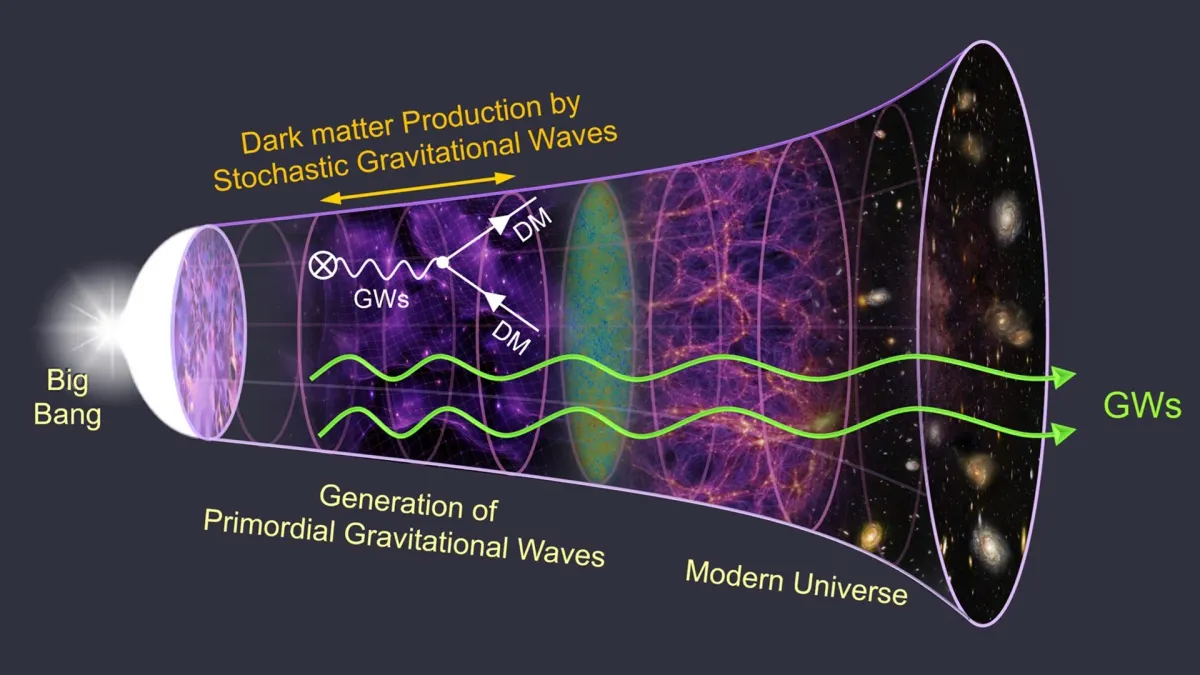
Gravitational waves are usually the dramatic kind, born from black holes doing a cosmic tango or neutron stars smashing together. But these aren't those. Stochastic gravitational waves are weaker, a background hum from processes that don't involve massive objects. They're ancient, dating back to the Big Bang's earliest phases, perhaps from the universe cooling down or primordial magnetic fields doing their thing.
"We investigate the possibility of gravitational waves — which are believed to have been ubiquitous in the early universe — being partially converted into dark matter particles," Kopp explained. "This leads to a new mechanism of dark matter production that has not been researched before."
Basically, these early universe ripples could have birthed fermions — a broad class of particles that includes electrons and protons. The theory is these fermions started with little to no mass, then bulked up, evolving into the dark matter particles we're still trying to shake hands with today.
So, the next time you hear about gravitational waves, remember they might not just be cosmic echoes. They could be the universe's original sculptors, turning faint shivers into the unseen matter that quite literally holds everything together. And here we thought the Big Bang was just a really loud bang.