Intermittent fasting has been linked to a longer life, but new research points to an unexpected reason for its benefits. Scientists at UT Southwestern Medical Center found that the key factor isn't the fasting itself. Instead, it's how the body adjusts its metabolism when food is reintroduced.
This discovery came from studies on Caenorhabditis elegans, a type of roundworm often used in labs. The findings could help improve human health.
The Refeeding Phase is Key
Peter Douglas, Ph.D., who led the study, explained that their findings shift focus to the "refeeding phase." He is an Associate Professor of Molecular Biology at UT Southwestern. Douglas noted that the health benefits of intermittent fasting depend on how the body's metabolic system resets after fasting.
We're a new kind of news feed.
Regular news is designed to drain you. We're a non-profit built to restore you. Every story we publish is scored for impact, progress, and hope.
Start Your News DetoxLexus Tatge, Ph.D., a former member of the Douglas Lab, co-led the study.
During fasting, cells quickly use up glucose. Then, they start breaking down stored fats for energy. This process, called catabolism, is controlled by a protein named NHR-49. When glucose is low, NHR-49 activates and starts breaking down fats. When food returns, NHR-49 turns off, allowing cells to stop breaking down fats and rebuild energy stores.
Earlier work by Dr. Douglas and his team in 2022 showed that NHR-49 also monitors fat levels in cells. It helps prevent starvation when fat reserves are low.
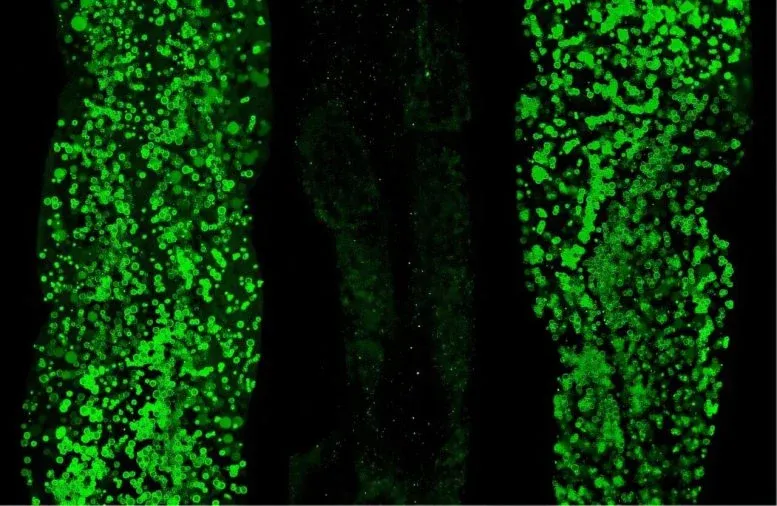
To see if NHR-49 was behind the life-extending effects of fasting, researchers removed the gene for this protein in C. elegans. They then fasted the worms for 24 hours. Surprisingly, removing NHR-49 did not reduce the lifespan benefit. The fasted worms still lived about 41% longer and showed more youthful behavior, similar to worms with normal NHR-49.
How Metabolism Extends Life
The researchers then looked at what happens after fasting, when NHR-49 usually turns off.
Vincent Tagliabracci, Ph.D., an Associate Professor of Molecular Biology at UTSW, led experiments to understand how NHR-49 is turned off. His team, including postdoctoral researcher Victor Lopez, Ph.D., found that an enzyme called protein kinase CK1 alpha 1 (KIN-19) modifies NHR-49. This modification is called phosphorylation.
Douglas and his team changed this system so NHR-49 stayed active even after feeding resumed. When NHR-49 remained active, fat breakdown continued, and the life-extending effects of fasting disappeared.
These findings suggest that properly turning off NHR-49 after fasting is crucial for extending lifespan through calorie restriction. Adjusting this process might offer a way to get the benefits of fasting without strict diets.
Dr. Douglas noted that their findings connect lipid metabolism and aging research. He believes that by targeting aging, which is the biggest risk factor for human disease, they can move towards preventive medicine that improves quality of life.
Deep Dive & References
Silencing lipid catabolism determines longevity in response to fasting - Nature Communications, 2026