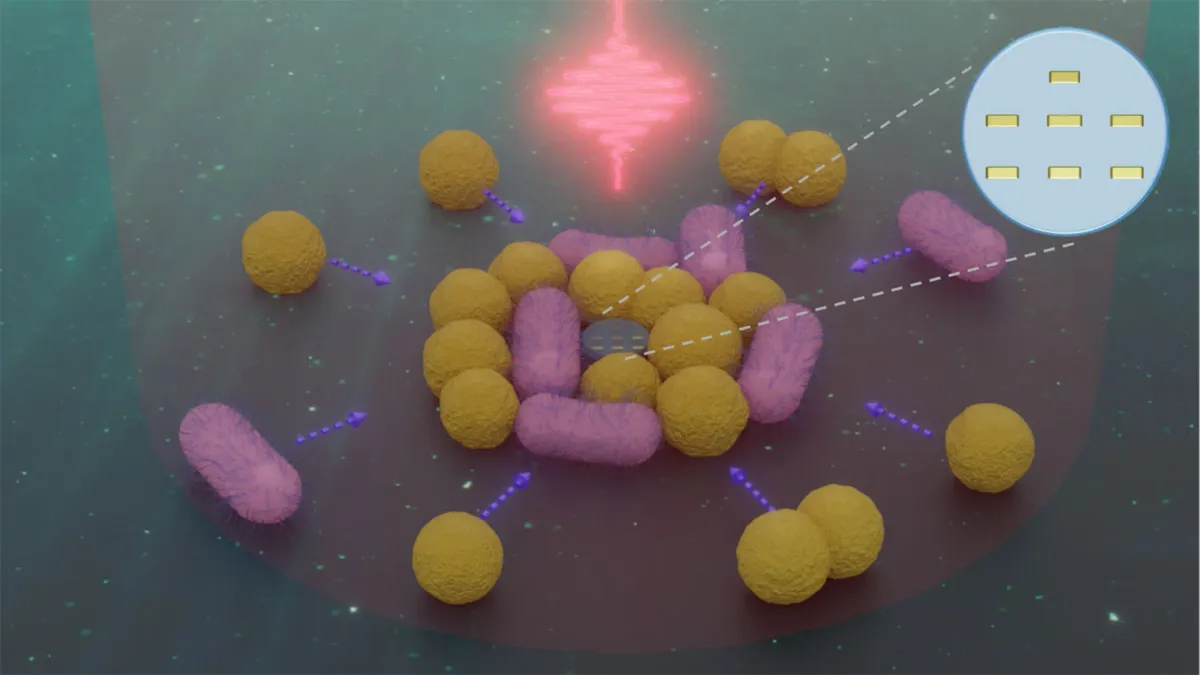
Imagine a tiny, invisible Roomba for your bloodstream, except it’s 50 times smaller than a human hair and runs on light. Scientists at Julius-Maximilians-Universität Würzburg (JMU) just got us a whole lot closer to that reality with nanorobots that can precisely grab and move microscopic materials — like, say, a single bacterium.
For ages, the microscopic world has been a bit like trying to pick up a grain of sand with boxing gloves. Things are just too tiny and slippery, especially when they're floating in liquid. But these new nanorobots? They’re essentially microscopic bouncers, capable of collecting and relocating bacteria with unnerving precision.
How to Power Something You Can't See
The real trick to building anything this small is figuring out how to make it move. You can't exactly plug it into a wall socket. The JMU team, led by Professor Bert Hecht, found a solution so elegant it’s almost poetic: they use the recoil from individual photons.
We're a new kind of news feed.
Regular news is designed to drain you. We're a non-profit built to restore you. Every story we publish is scored for impact, progress, and hope.
Start Your News DetoxThink of it like this: these microdrones have up to four tiny antennas. When light hits these antennas, they absorb it and then ping! — send a photon off in a specific direction. Each photon that gets shot out creates a tiny push, like the kickback from firing a miniature gun. Because these microdrones are lighter than a whisper, even that minuscule force can send them zipping along at surprisingly high speeds.
Their latest iteration? Even smaller, less than one micrometer across, and now, they’re better at steering. The secret sauce is in tiny antenna wires inside the robot that naturally align with the light’s polarization. By changing the light, you change the robot's direction. The movement still comes from those little photon kicks, but now it’s a guided kick.
Catching Germs with Light
“We built a light-driven nanorobot that can find and collect bacteria,” explained Jin Qin, the lead experimental scientist. “By making the design simpler, we made these robots small enough to work directly in the world of microbes, almost like tiny cleaning devices.”
Tiny cleaning devices that can make sharp 90-degree turns, scan large areas, and then pick up, move, and release entire groups of bacteria. This means they can “clean” microscopic zones in a lab, gathering unwanted microbes and depositing them elsewhere. Which, if you think about it, is both impressive and slightly terrifying.
“This shows how light can not only help us see the microscopic world but also actively change it,” added Bert Hecht. “The idea of tiny robotic cleaners might sound futuristic, but we are showing the science that makes it possible.”
Even with a microscopic blob of bacteria in tow, these nanorobots remain fully maneuverable, albeit a little slower. It’s a pretty compelling argument for their future in everything from microbiology and medical research to precision manufacturing at scales we can barely comprehend. Someone get these things a tiny dustpan and grime commercial. It would be adorable, and probably solve a lot of problems.