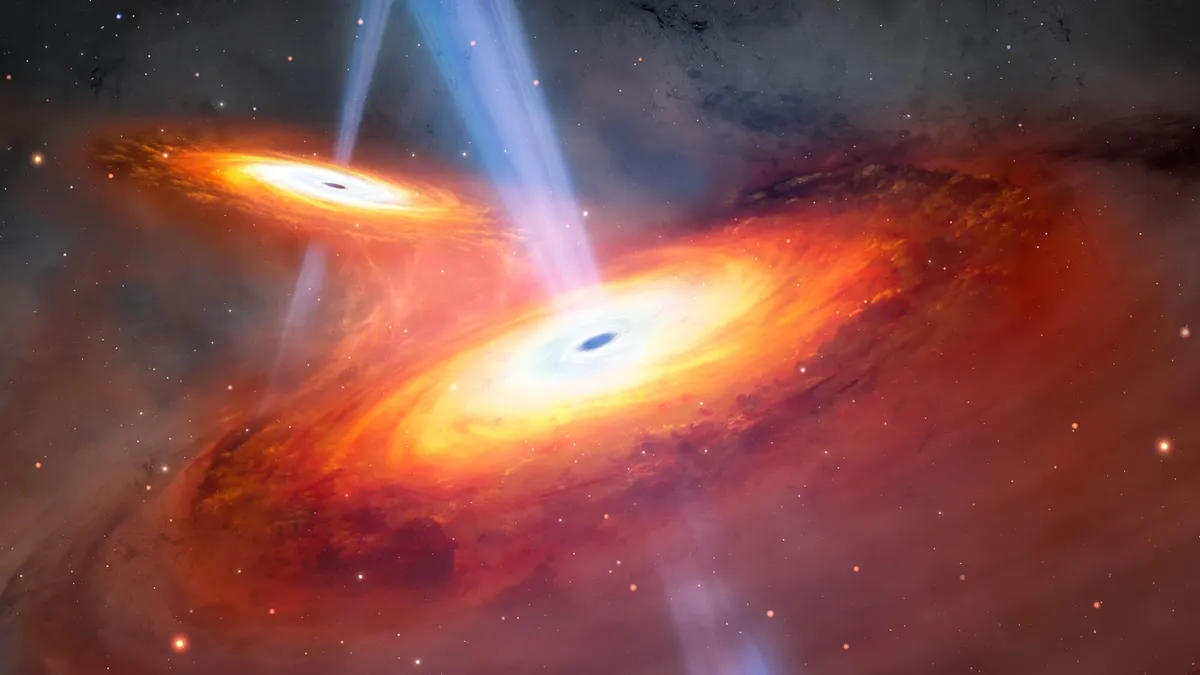
Imagine peering back in time, not just a little, but nearly to the universe's toddler years. That's exactly what astronomers did, confirming a ridiculously rare cosmic tango: two supermassive black holes, each powering a quasar, caught in the act of merging when the universe was less than a billion years old. It's only the second such pair ever spotted from that ancient era.
These aren't your garden-variety black holes. Quasars are basically the universe's loudest, brightest disco balls, fueled by supermassive black holes gorging on everything around them. Think of them as the cosmic equivalent of a food coma, but with light. And when galaxies merge, it's like opening an all-you-can-eat buffet for these behemoths, funneling gas their way and making them light up like a supernova on espresso.
The Smoking Gun
This particular dynamic duo, charmingly named J2037–4537, was first flagged as a potential double act in 2021. But space is tricky. Sometimes, a single quasar can look like two if a foreground galaxy's gravity bends its light — a cosmic optical illusion known as gravitational lensing. Nobody likes a magic trick when you're trying to do science.
We're a new kind of news feed.
Regular news is designed to drain you. We're a non-profit built to restore you. Every story we publish is scored for impact, progress, and hope.
Start Your News DetoxEnter the Atacama Large Millimeter/submillimeter Array (ALMA), a collection of telescopes that basically see in super high-definition. A team led by Minghao Yue from the University of Arizona used ALMA to map the ionized carbon emissions, which glow where cold, star-forming gas hangs out. What they found was a "tidal bridge" — a literal stream of gas stretching between the two quasars, like an umbilical cord made of stardust. That's the unmistakable sign of two galaxies pulling material from each other during a merger. Gravitational lensing doesn't do that. Boom. Mystery solved.
These aren't small fry, either. Both galaxies hosting these light-spewing monsters are colossal, each weighing in at least 10 billion times the mass of our sun and churning out over 500 new stars every single year. Because apparently, even galaxies have overachievers.
The Long Goodbye (and Hello)
Now, don't picture them locked in a tight embrace just yet. The two supermassive black holes are currently thousands of light-years apart, still getting to know each other. Researchers estimate it'll take another 2.1 billion years for them to become a proper, gravitationally bound binary system. Which, if you think about it, is both impressive and slightly terrifying — they're playing the long game.
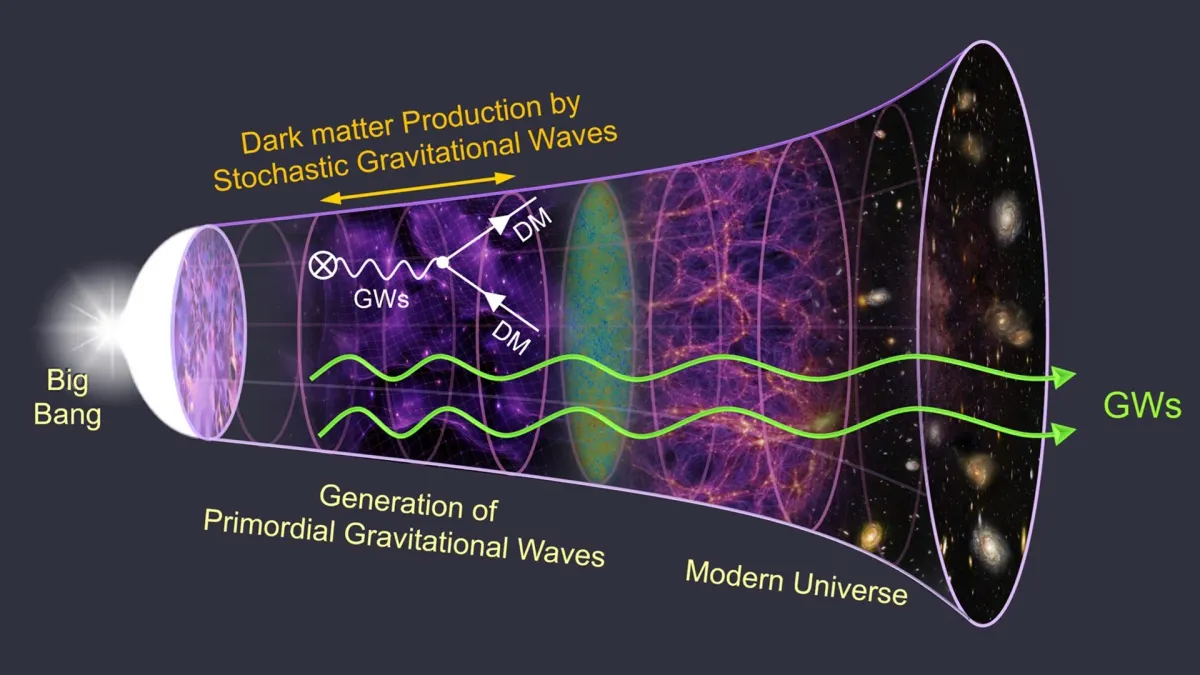
When they finally do merge, around the time the universe is 2 billion years old, it'll send out low-frequency gravitational waves, ripples in spacetime that Pulsar Timing Arrays (PTAs) can detect. This is a big deal, because recent PTA experiments have picked up a stronger background hum of gravitational waves than our current galaxy models predicted. If systems like J2037–4537 turn out to be more common than we thought, they might just be the missing piece in that cosmic symphony, explaining all that extra gravitational noise. Let that satisfying number sink in.