Trying to spot tiny, ghostly particles like neutrinos or dark matter is a bit like trying to photograph a ninja in a dark room. Most particle detectors are huge, intricate affairs, often made of millions of tiny segments, each one blinking when a particle zips through.
Think of Japan's T2K neutrino experiment: two tons of material, two million little cubes, and 60,000 optical fibers. It's an engineering marvel, but trying to scale that up for even bigger mysteries becomes a logistical nightmare. Someone's accountant is definitely getting a headache just thinking about it.
The Light-Field Leap
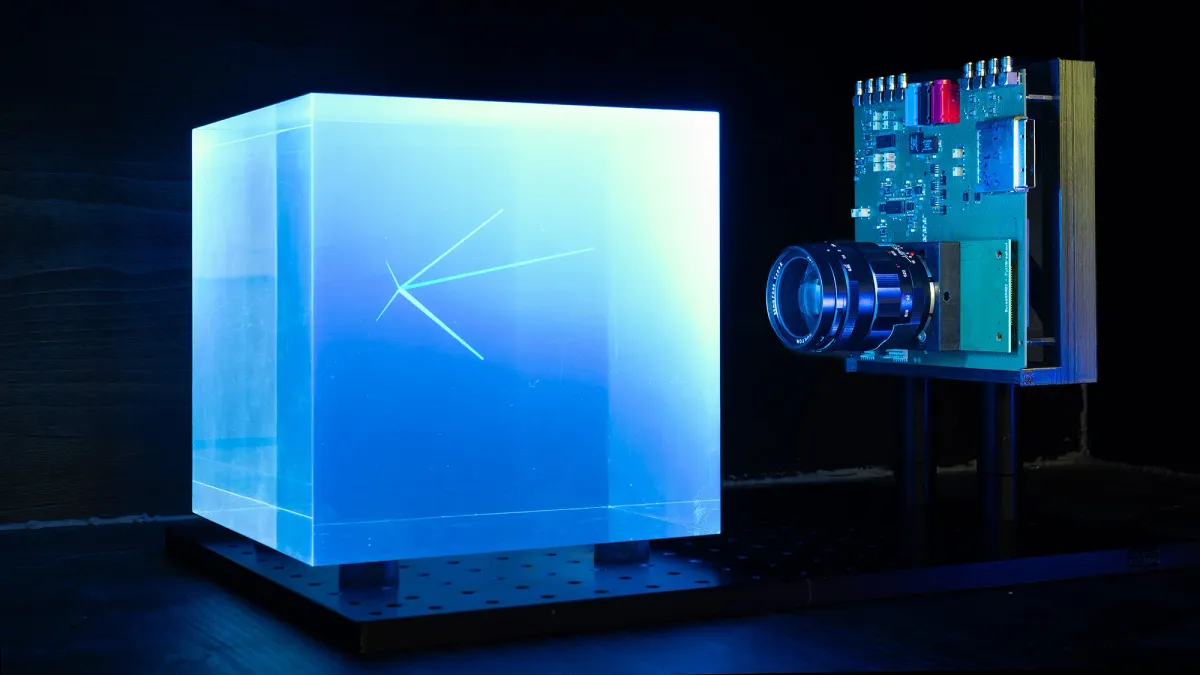
Enter a team from ETH Zurich and EPFL, who decided to throw out the old playbook and borrow a trick from fancy cameras. They’ve developed a prototype detector that can take ultrafast, high-resolution 3D images of particle interactions, all within a large, undivided block of scintillator material. No more millions of tiny bits.
We're a new kind of news feed.
Regular news is designed to drain you. We're a non-profit built to restore you. Every story we publish is scored for impact, progress, and hope.
Start Your News DetoxTheir secret weapon? Plenoptic cameras, also known as light field cameras. These aren't your average point-and-shoots. Instead of just recording light intensity, they also capture the direction of the light. This lets them reconstruct depth information, essentially seeing in 3D. They achieve this with a micro lens array (MLA) — a tiny grid of lenses between the main lens and the sensor.
When you combine this with single-photon avalanche diode (SPAD) sensors (which are ridiculously good at detecting even a handful of photons), you get a system that can track particles in 3D, even with minimal light. It's like giving the camera X-ray vision, but for subatomic particles.
The team’s prototype, called PLATON, uses an MLA designed by Raytrix GmbH and a SwissSPAD2 sensor from EPFL. This SPAD sensor can timestamp individual photons with insane precision, helping filter out background noise. Because apparently, even invisible particles need a good signal-to-noise ratio.
Beyond the Subatomic
After testing their prototype in the lab and matching the results with simulations (because science loves to double-check), the team is already planning upgrades. They’re developing more efficient SPAD sensors and improving the camera design to collect even more light and expand its view. Simulations suggest these tweaks will make the resolution even sharper, which, if you think about it, is both impressive and slightly terrifying.
They even ran simulations for detecting neutrinos in a one-cubic-meter system, using a neural network (yes, like the ones powering large language models) to process the images. The results were promising, suggesting submillimeter performance in volumes larger than one cubic meter. That's like getting a crystal-clear MRI of a particle interaction.
And the best part? The potential uses go far beyond particle physics. The team has already filed three patents for PLATON's application in positron emission tomography (PET) scanners. So, the next time you get a medical scan, you might just be benefiting from technology originally designed to hunt for ghosts of the subatomic world. Particle physics, always finding new ways to make our lives unexpectedly better. Because if there’s one thing we know about fundamental research, it’s that the weirdest discoveries often lead to the most practical — and sometimes life-saving — inventions.