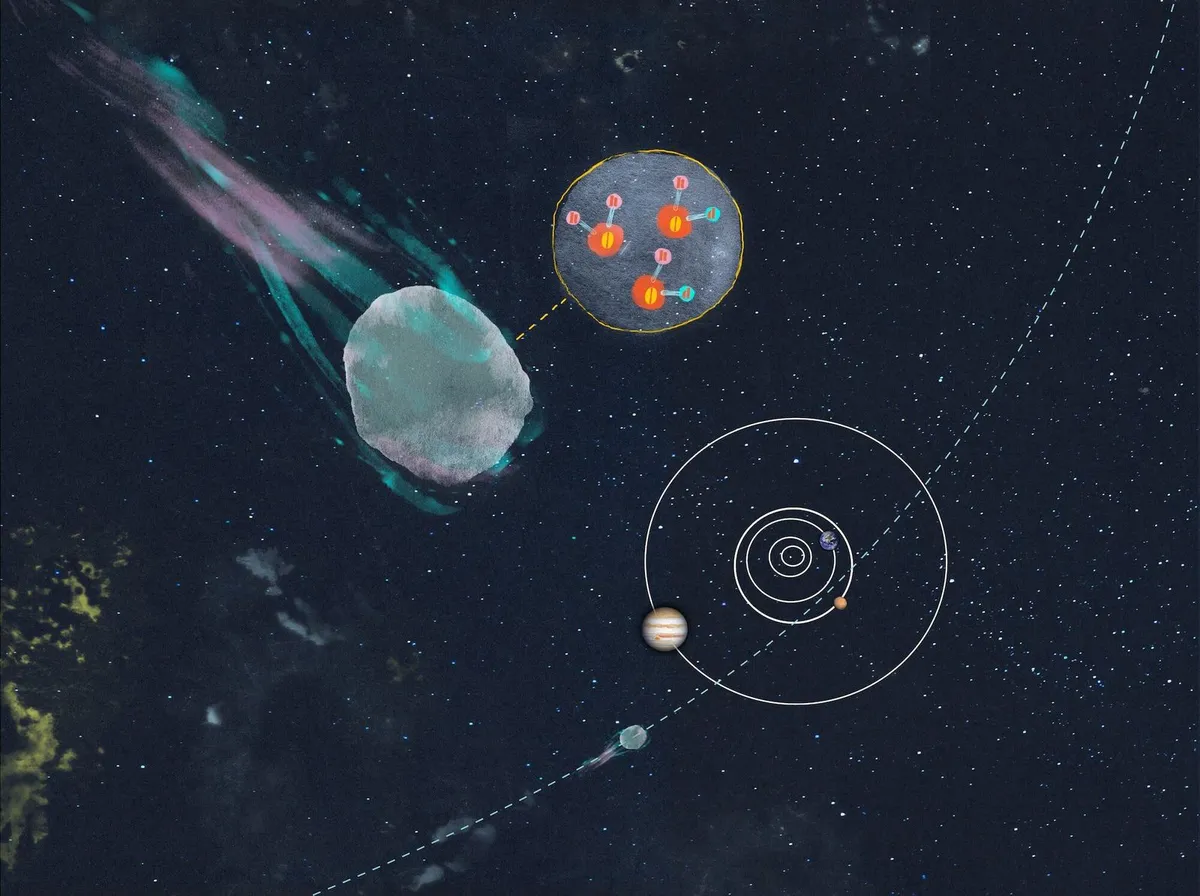
Our latest cosmic tourist, a comet named 3I/ATLAS, is currently waving goodbye as it zips past Jupiter and heads out of our solar system. Scientists have been scrambling to figure out where this icy rock even came from, because its backstory is apparently wild.
Turns out, this comet didn't just wander in from the galactic suburbs. New research suggests 3I/ATLAS grew up in a planetary system so cold and isolated, it practically formed before its star even bothered to switch on. Which, if you think about it, is both impressive and slightly terrifying.
First spotted zipping along at a casual 137,000 miles per hour by a NASA-funded telescope in Chile, 3I/ATLAS immediately raised eyebrows. Its trajectory clearly wasn't sun-centric. Tracing its path backward pointed to an origin near the very center of the Milky Way. This makes it only the third known visitor from another planetary system, joining the ranks of `Oumuamua and Borisov.
We're a new kind of news feed.
Regular news is designed to drain you. We're a non-profit built to restore you. Every story we publish is scored for impact, progress, and hope.
Start Your News DetoxAfter months of celestial snooping, researchers estimate its icy core is somewhere between 1,400 feet and 3.5 miles wide. But the real tell was the bizarre chemistry of its surrounding cloud of gas and dust.
The Heavy Water Mystery
The crucial clue came from the water vapor 3I/ATLAS released as it approached our sun last fall. Data from the Atacama Large Millimeter/submillimeter Array telescope (also in Chile, because apparently that's where all the cool telescopes hang out) revealed something surprising: a lot of "heavy" water.
Now, "heavy water" isn't some sci-fi liquid. All water has one oxygen and two hydrogen atoms. But in heavy water, one or both of those hydrogen atoms have an extra neutron. On Earth, this is rare. But 3I/ATLAS's water had a deuterated-to-standard water ratio roughly 40 times higher than Earth's oceans. And about 30 times higher than a typical comet formed right here in our own solar system.
This extreme ratio points to an origin in an incredibly cold, isolated part of the galaxy. Imagine forming before your star even properly coalesced. While our sun was likely born in a bustling nursery of newborn stars, 3I/ATLAS's star probably formed in a quiet, chilly corner. As Teresa Paneque-Carreño, an astronomer at the University of Michigan and co-author, dryly put it, this proves the conditions that created our solar system aren't universal. Which, yes, sounds obvious, but you still have to prove it.
Darryl Seligman, an astronomer not involved in the study, was suitably impressed, telling Scientific American that making such a measurement is "almost unheard of." It's like measuring the exact mileage on a car from another galaxy.
While scientists still don't know the comet's precise address, these findings throw open a whole new cosmic can of worms. Either our solar system is a total anomaly, or we're still largely clueless about how planets form around other stars. Which, as Seligman noted, are really just two ways of saying the same thing. And if that's not a reason to look up at the night sky and feel delightfully small, what is?