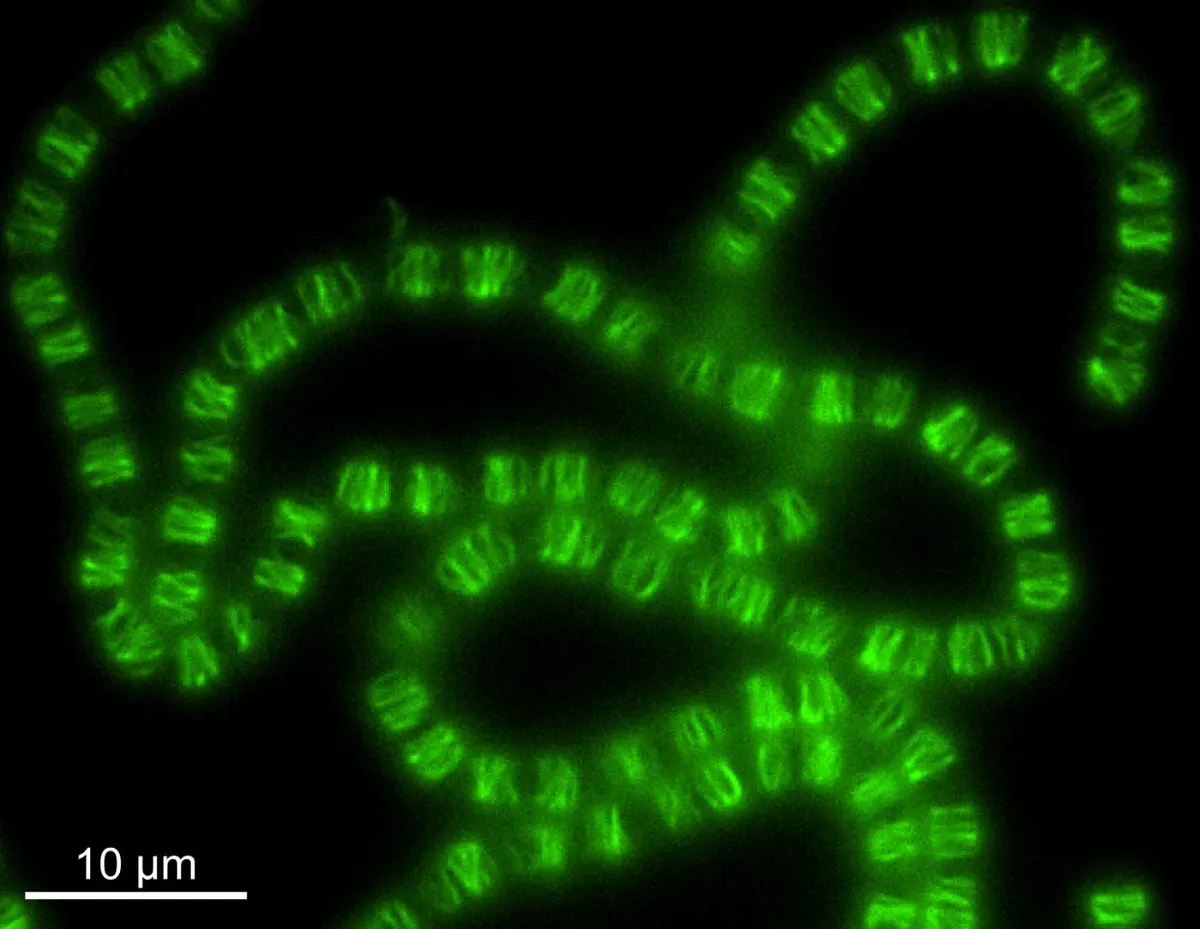
A system in ancient cyanobacteria, once used for organizing DNA, has evolved into a structure that shapes the cell itself. This shows how evolution can turn old biological tools into completely new functions.
Cyanobacteria are photosynthetic bacteria that were vital in creating Earth's oxygen-rich atmosphere. This allowed complex life to develop. Scientists at the Institute of Science and Technology Austria (ISTA) found that a system thought to separate DNA actually helps determine the shape of cyanobacterial cells.
This discovery, published in Science, offers new insights into how protein systems evolve. It also sheds light on how multicellular life began in these important bacteria.
We're a new kind of news feed.
Regular news is designed to drain you. We're a non-profit built to restore you. Every story we publish is scored for impact, progress, and hope.
Start Your News DetoxCyanobacteria: Earth's Oxygen Pioneers
Benjamin Springstein, a postdoc at ISTA, explained that cyanobacteria were pioneers of oxygenic photosynthesis. They caused the Great Oxygenation Event about 2.5 billion years ago. This event filled the atmosphere with oxygen, making aerobic life possible.
Even today, cyanobacteria are crucial for Earth's ecosystems. They contribute a lot to global biomass and are key in carbon and nitrogen cycles. These organisms can adapt to many environments, from hot springs to the Arctic. They also grow on surfaces in cities. Anabaena sp. PCC 7120, or Anabaena, has been studied for over 30 years.
Springstein and his team found that Anabaena and other multicellular cyanobacteria have undergone a big evolutionary change. An old system that once separated DNA now acts like a cytoskeleton, helping control cell shape.
DNA in Bacteria
Like all bacteria, Anabaena reproduces by dividing cells. This needs accurate copying and distribution of DNA so each new cell gets the right genetic material. DNA is packed into chromosomes and often exists in multiple copies. These copies must be passed on reliably during division.
Bacterial DNA comes in two main forms. Chromosomes hold genes essential for survival. Plasmids contain extra genes that are often not needed. Plasmids can move between bacteria, allowing traits to spread quickly and helping bacteria adapt fast.
A New Role for a DNA System
Springstein has studied Anabaena since 2014. He focuses on its evolution and molecular features. During the COVID-19 pandemic, he noticed something unusual while reviewing scientific papers.
He found that Anabaena and some related cyanobacteria have a system called ParMR on their chromosomes. This system is usually found on plasmids and helps separate them. Its unusual location made him think it might have adapted to separate chromosomes instead.

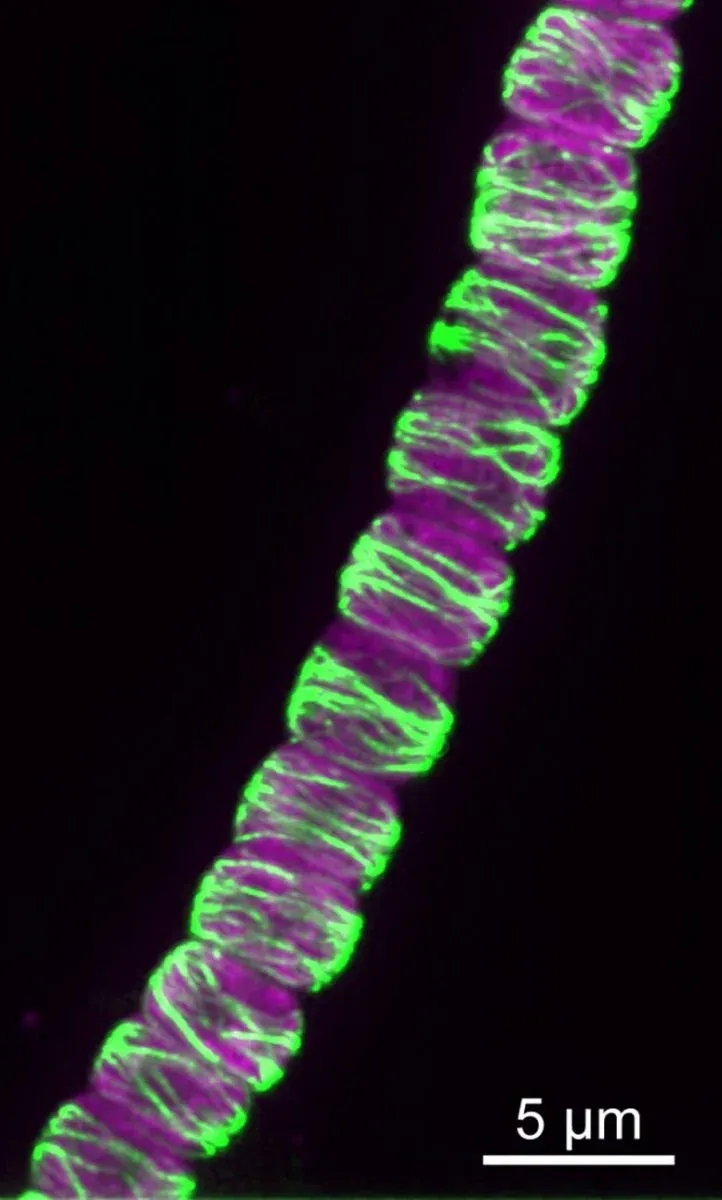
After joining ISTA, Springstein tested his idea. The results showed a different function. One part, ParR, no longer binds to DNA. Instead, it attaches to lipid membranes, especially the inner cell membrane. ParM does not form structures in the cytoplasm to move DNA. Instead, it builds filament networks just under the inner membrane. This creates a protein array that looks like a cell cortex.
Instead of forming spindle-like structures inside the cell to move DNA, the system seems to organize itself at the membrane. It helps with cell structure.
How the System Works
To understand the system better, researchers rebuilt it outside living cells. They saw that the filaments grew and then quickly collapsed. This dynamic instability is also seen in microtubules in more complex cells.
The team worked with ISTA Professor Florian Schur and his student Manjunath Javoor. They used cryo-electron microscopy to look at the filaments' structure in detail. They found that these filaments are bipolar, meaning they can grow and shrink from both ends. This is different from similar systems in other bacteria that form polar filaments.
When the system was removed from living cells, its true role became clear. Cells without the system lost their normal rectangular shape and became round and swollen. This kind of change happens when genes that maintain cell shape are disrupted in other bacteria. This strongly suggests the system's main job is to control cell shape, not to distribute DNA.
Because of its new role and location near the cell membrane, the researchers renamed the system "CorMR."
Evolution of a New Cell Function
Multicellular cyanobacteria evolved from single-celled ancestors. This happened through gradual increases in complexity. Bioinformatic analysis by Daniela Megrian helped explain how the CorMR system developed.
The change likely happened in several steps. First, the system moved from a plasmid to the chromosome. Then, its parts changed in size and structure. Next, it gained the ability to bind to cell membranes. Finally, another protein system took control of it.
These steps transformed an old DNA segregation system into one that shapes the cell. This shows how evolution can repurpose existing biological tools to create entirely new functions.
Deep Dive & References
Repurposing of a DNA segregation machinery into a cytoskeletal system controlling cell shape - Science, 2026