Imagine a laser beam that's usually a scattered mess, suddenly deciding to get its act together and become a super-focused, brain-imaging superstar. That's essentially what MIT scientists just pulled off, turning what was once considered chaotic laser light into a precise "pencil beam" capable of 3D imaging the human blood-brain barrier at speeds that make previous methods look like dial-up internet.
This isn't just a party trick for physicists. This new technique lets researchers watch drugs enter brain cells in real-time. Which, if you're trying to develop treatments for things like Alzheimer's or ALS, is less a "game-changer" and more a "we just skipped a few levels" moment.
When Chaos Gets Its Act Together
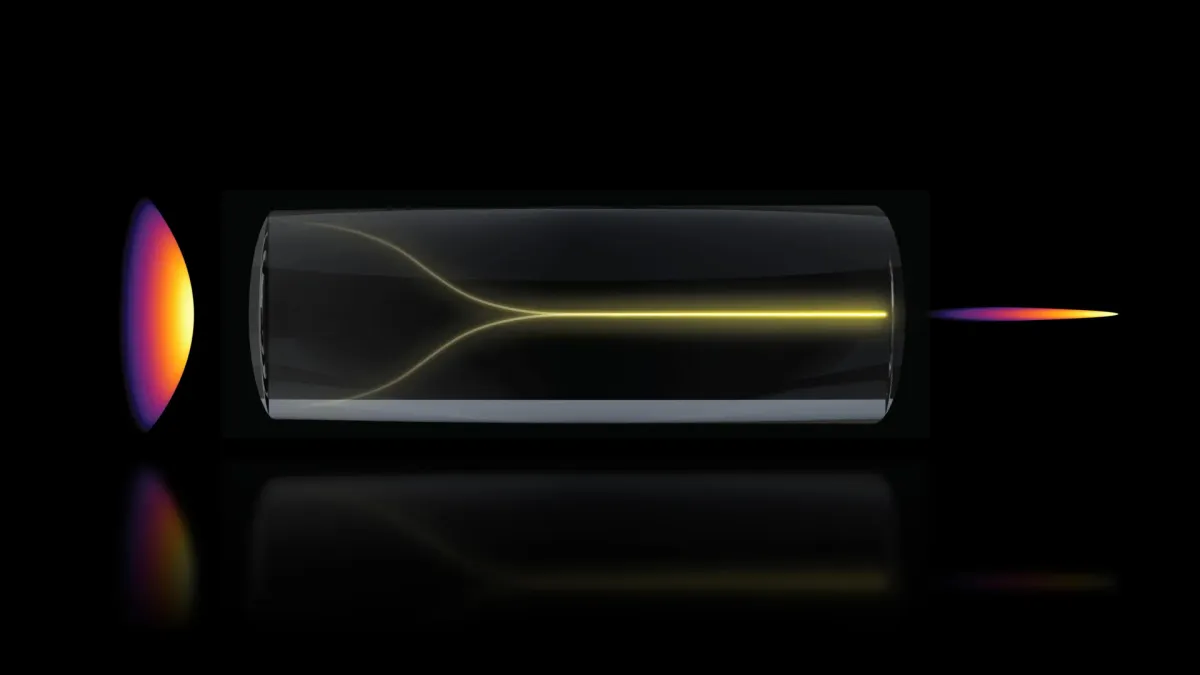
Normally, when you crank up a laser's power in a fiber optic cable, the light just scatters everywhere, like a toddler after too much sugar. But the MIT team pushed past the usual limits. And instead of more chaos, the light pulled a surprise move: it spontaneously organized itself into an incredibly sharp, stable beam.
We're a new kind of news feed.
Regular news is designed to drain you. We're a non-profit built to restore you. Every story we publish is scored for impact, progress, and hope.
Start Your News Detox"This goes against common belief," noted Sixian You, an MIT professor and one of the senior authors. Apparently, even light gets tired of being disorganized and decides to find a new solution, especially when it comes to bioimaging.
The magic here is that this self-organizing beam doesn't need a bunch of complex, expensive tools to shape it. It just... does it. On its own. Because apparently that's where we are now.
So, how does light achieve this level of self-actualization? Two things have to happen: The laser has to enter the fiber perfectly straight (think zero-degree angle), and the power has to be high enough for the light to actually talk to the fiber's glass. At this critical power, the light's natural tendency to go wild is perfectly balanced by its interaction with the fiber, creating that perfectly formed pencil beam.
These are conditions usually avoided because high power can, you know, melt things. But when combined, they create a stable beam without the need for an engineering degree and a small fortune.
Clearer Views, Faster Answers
This new pencil beam cuts through the blur, creating detailed images without the fuzzy halos that plague other methods. The researchers immediately put it to work imaging the human blood-brain barrier – that crucial shield protecting your brain, which unfortunately also blocks a lot of life-saving drugs.
Scientists have been desperate to see how drugs actually cross this barrier and get into brain tissue. Old methods involved painstakingly stitching together many 2D scans to build a 3D picture. This new pencil beam? It delivers rapid, high-precision 3D images, and can even track how cells absorb proteins in real-time without needing fluorescent tags. Which means, for the first time, researchers can watch the drug delivery drama unfold live, at a cellular level.
The system produced these incredibly detailed 3D images about 25 times faster than what was previously possible, with vastly superior quality. Professor You put it best: it overcomes the usual trade-off between image resolution and how deep you can actually see. Let that sink in.
Next up, the team wants to unravel the deeper physics behind this incredibly polite laser and, of course, find even more ways to use it. Imaging neurons, for instance. Because if light can teach itself to be this useful, who knows what else it can accomplish?