NASA's Jet Propulsion Laboratory (JPL) recently tested a new electromagnetic thruster. This technology could power crewed missions to Mars and robotic spacecraft across the solar system.
On February 24, a team successfully fired up a lithium metal vapor thruster. It reached power levels higher than any previous test in the United States.
A Powerful New Thruster
The prototype thruster achieved power levels beyond those of current electric thrusters on NASA spacecraft. The data from this first firing will help with future tests.
We're a new kind of news feed.
Regular news is designed to drain you. We're a non-profit built to restore you. Every story we publish is scored for impact, progress, and hope.
Start Your News DetoxNASA Administrator Jared Isaacman noted that this test shows real progress toward sending astronauts to Mars. He said it's the first time an electric propulsion system in the U.S. has operated at such high power, reaching up to 120 kilowatts.
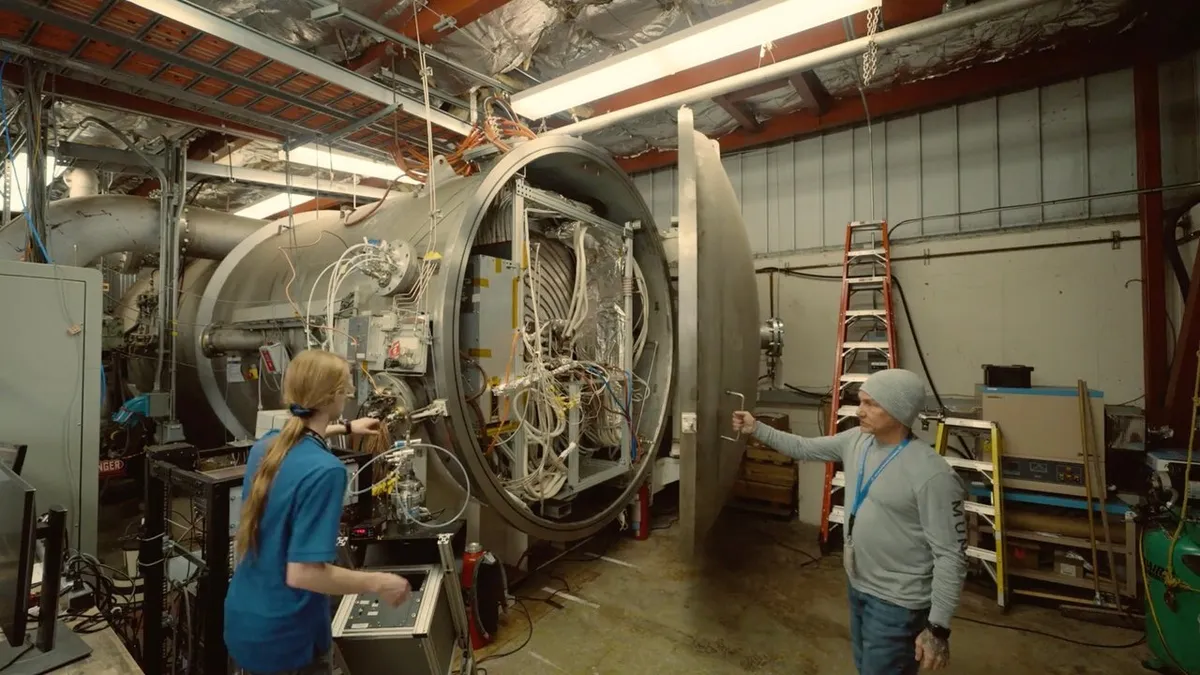
During five ignitions, the thruster's tungsten electrode glowed bright white. It reached over 5,000 degrees Fahrenheit (2,800 degrees Celsius). The tests happened in JPL's Electric Propulsion Lab. This lab has a special vacuum facility for testing electric thrusters that use metal vapor.
Electric propulsion uses up to 90% less fuel than traditional chemical rockets. Current electric thrusters, like those on NASA's Psyche mission, use solar power. They provide a low, continuous thrust that builds up to high speeds over time.
NASA JPL is testing a lithium-fed magnetoplasmadynamic (MPD) thruster. This technology has been studied since the 1960s but has not yet been used in space. The MPD engine uses strong currents and a magnetic field to speed up lithium plasma.
The team reached power levels of up to 120 kilowatts. This is more than 25 times the power of the thrusters on Psyche. Psyche's thrusters accelerate the spacecraft to 124,000 mph in the vacuum of space.
Future Missions to Mars
James Polk, a senior research scientist at JPL, said designing and building these thrusters took years. He noted that hitting their target power levels was a huge moment. It shows they have a good setup to scale up the technology.
Polk watched the test through a small window into the 26-foot-long (8-meter-long) vacuum chamber. Inside, the thruster's nozzle-shaped outer electrode glowed and emitted a red plume. Polk has studied lithium-fed MPD thrusters for decades. He worked on NASA's Dawn mission and Deep Space 1, which was the first electric propulsion demonstration beyond Earth orbit.
The team plans to reach power levels between 500 kilowatts and 1 megawatt per thruster in the coming years. A major challenge will be ensuring the components can handle the high temperatures for many hours. A human mission to Mars might need 2 to 4 megawatts of power. This would require multiple MPD thrusters operating for over 23,000 hours.
Lithium-fed MPD thrusters can operate at high power and use fuel efficiently. They provide much greater thrust than current electric thrusters. If fully developed and paired with a nuclear power source, they could reduce launch mass. This would help support the payloads needed for human missions to Mars.