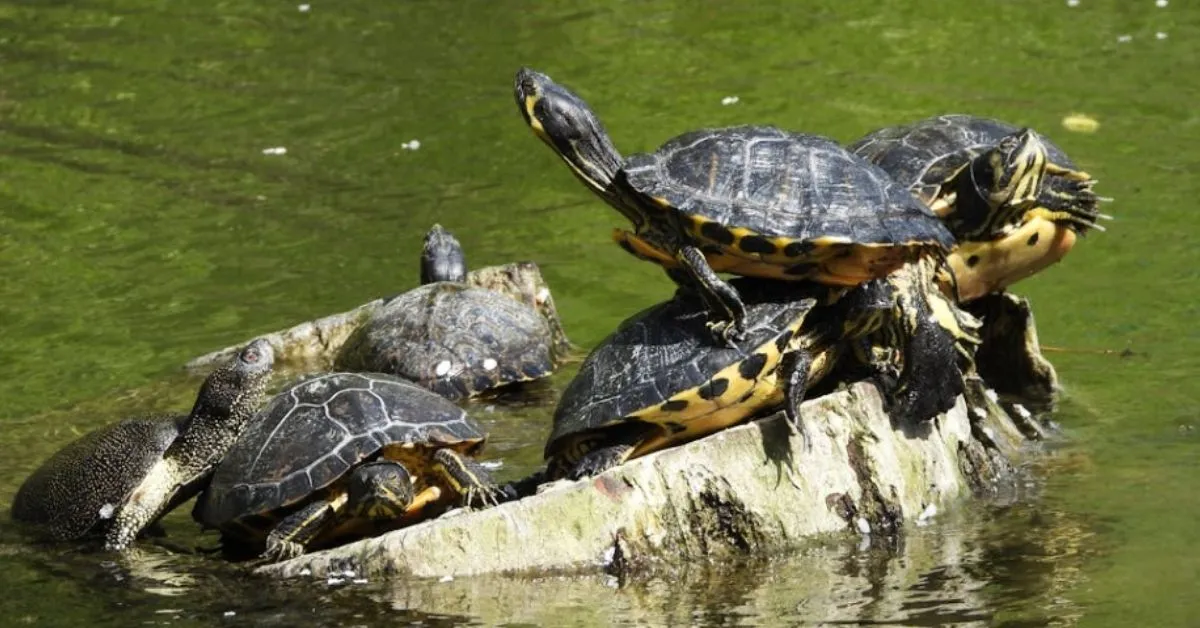
Imagine the Australian Outback. Dry. Dusty. Not exactly prime real estate for a turtle convention. So when students from La Trobe University stumbled upon over 500 freshwater turtles in Imperial Lakes Nature Park, it was less a discovery and more a "Wait, what?" moment.
Ph.D. candidate Wesley Smith, clearly a man who doesn't shock easily, noted that such a turtle turnout in an arid region is, shall we say, unusual. His theories? They hitched a ride during a massive flood, or they've just been hanging out there for thousands of years. Because, apparently, that's where we are now.
The Great Turtle Pile-Up
The researchers identified eastern long-necked, eastern short-neck, and broad-shelled turtles. Master's student Emma Kynaston expected maybe 100. She got five times that. Which, if you think about it, is both impressive and slightly terrifying.
We're a new kind of news feed.
Regular news is designed to drain you. We're a non-profit built to restore you. Every story we publish is scored for impact, progress, and hope.
Start Your News DetoxThese aren't your average couch potatoes, either. Broad-shelled and long-necked turtles are usually the wanderers of the reptile world, not the stay-at-homes. Both species have seen their numbers dwindle thanks to habitat loss and climate change messing with water quality. The eastern long-necked turtle is particularly on thin ice in southern Australia, and the broad-shelled turtle is officially endangered in Victoria. So finding a whole stack of them was, well, a lot.
And by "stack," we mean it. The lakes were on life support, closer to dust than water — a situation that hadn't happened in 130 years. Simon Molesworth, president of Landcare Broken Hill, painted a vivid picture: "There was so little water. They were stacked up as if they were on an elevator." Let that image sink in.
A Splash of Good Fortune
Once the students raised the alarm, Landcare Broken Hill moved faster than a turtle on a hot tin roof, securing emergency funds. They needed water, and they needed it yesterday. An Australian crowdfunding campaign, because apparently Australians love turtles (who knew?), raised over $100,000 AUD (about $72,406 USD).
Molesworth confirmed these funds bought them seven crucial weeks. Seven weeks until, in a twist of Outback fate, late February and early March delivered record-breaking rainfall, refilling the two park lakes. The remaining cash will now help manage water for the next inevitable dry spell. Because, you know, Outback.
Before this discovery, information on turtle populations in dry regions was about as scarce as water in a drought. Now, Smith and his team have a much clearer picture of turtle life in the Darling and Lachlan river systems. Smith plans to return next year for more research, noting that this particular population "seems to be thriving." Sometimes, even in the driest places, good news just floods in.