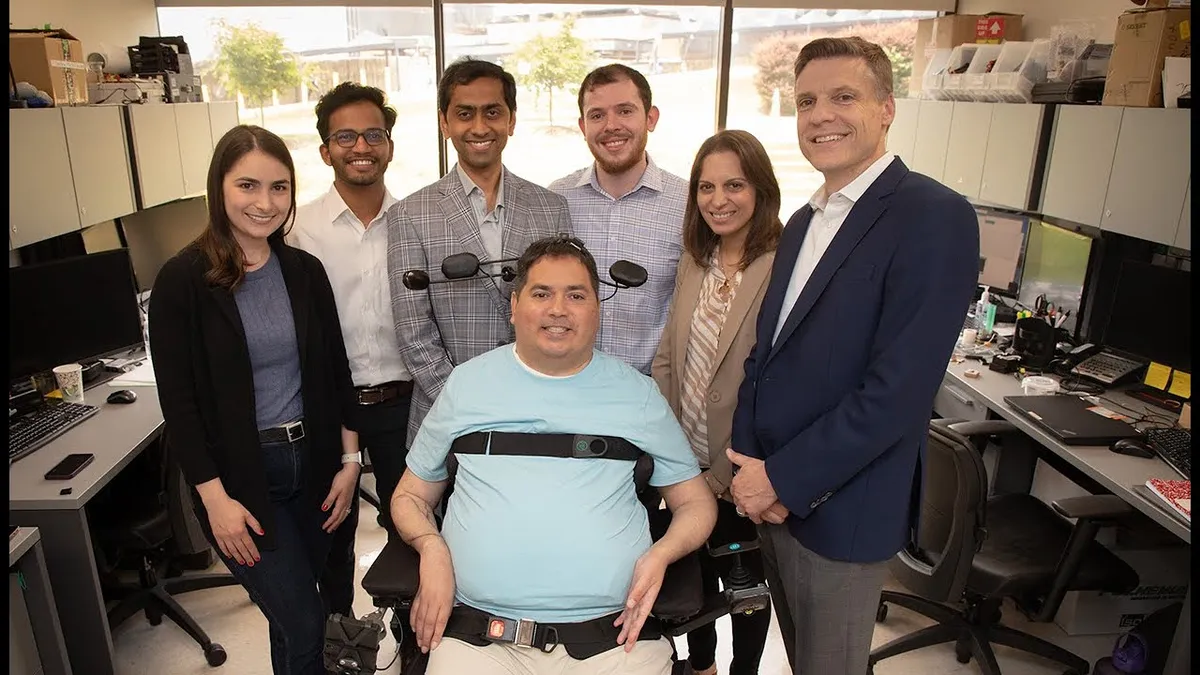
A man paralyzed from the neck down has regained feeling and movement in his hands. This happened thanks to an experimental brain implant. The breakthrough offers new hope for people with spinal cord injuries.
Keith Thomas, 48, was in a diving accident six years ago. Now, he can feel and grasp objects. He can even do this months after the implant system is turned off.
A Double Neural Bypass
Thomas received a "double neural bypass" surgery in 2023. Doctors placed five electrode arrays in his brain. These electrodes measure and send electric currents. They were put in areas of his brain that control movement and sensation.
We're a new kind of news feed.
Regular news is designed to drain you. We're a non-profit built to restore you. Every story we publish is scored for impact, progress, and hope.
Start Your News DetoxThe team also put stimulation patches on his spinal cord and forearm. When Thomas tried to move, the brain electrodes detected the activity. A computer then translated these signals into electrical pulses. These pulses stimulated his muscles, making him move.
At the same time, pressure sensors in a special 3D-printed glove measured touch. These sensors sent signals back to his brain's sensory area. This created the feeling of touch.
The computer algorithm was 85% accurate at interpreting his brain signals. After 35 weeks, his right arm strength increased by 86%. His left arm strength went up by 62%.
"It changed my life dramatically," Thomas said. "I’m able to pet my dog, I’m able to do other things, like sometimes feed myself, wipe my face, wipe my mouth."
Restoring the Sense of Touch
The research team also found a way to bring back the sense of feeling. They used a technique called "cortical mirroring." They recorded Thomas's brain activity when he imagined being touched. Then, they recreated those brain signals using electrical stimulation. This was done in his sensory brain area, spinal cord, and skin.
After about 25 weeks, Thomas could feel touch again in his right wrist. This area was previously numb. He could even pick up hollow eggshells without breaking them 87% of the time, even when blindfolded.
What's remarkable is that these improvements lasted. "We turned everything off completely, for many months, and yet he’s maintained these gains," said Chad Bouton, a neuroscientist involved in the study. "That’s unheard of."
Looking Ahead
This study, published in Nature Medicine, shows a big step forward for brain-computer interface technology. It suggests the technology might have rewired Thomas's nervous system. This process is called neuroplasticity.
Experts are hopeful, but they also note that Thomas is just one patient. It's unclear how these results would apply to others. The procedure is complex, making it hard to pinpoint exactly what caused each effect.
However, the lasting improvements are very encouraging. "In a recent follow up, it was found these gains were still present after more than two years," Bouton noted. The ability for Thomas to do everyday tasks like feeding himself is a significant achievement.
Deep Dive & References
Double neural bypass: Man living with paralysis has feeling, lasting movement restored in arm & hand - Nature Medicine, 2026