
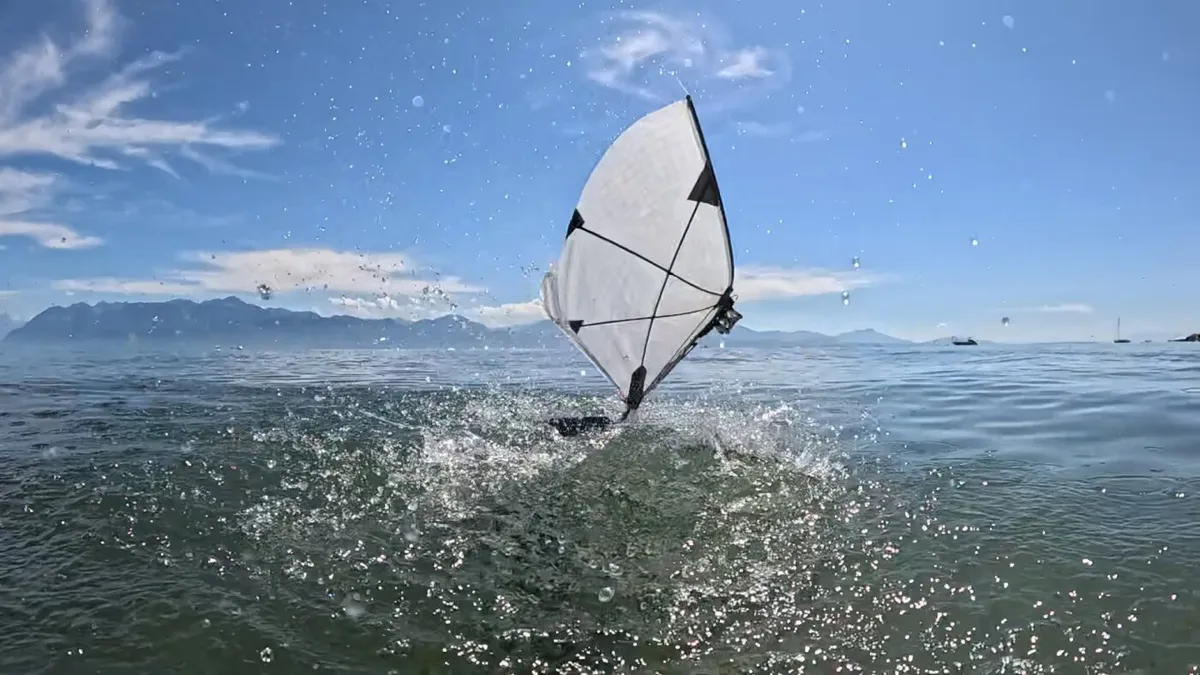
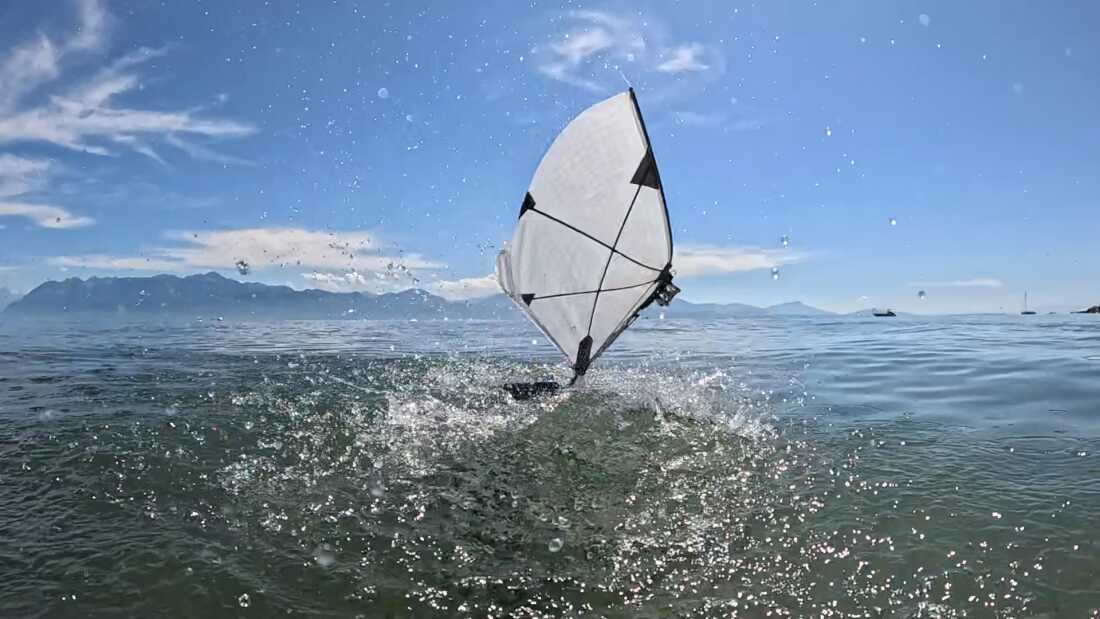
 Scientists tested their aerial-aquatic flying robot in Lake Geneva, proving that it had enough speed and power to lift itself out of the water with its wings alone. **Raphael Zufferey** ****hide caption**** ## **toggle caption** ### Raphael Zufferey Mechanical engineer [Raphael Zufferey's](https://meche.mit.edu/people/faculty/[email protected]) lab at MIT contains a giant tank filled with bright turquoise water, an array of fans that can whip up a powerful wind, and small flying robots perched everywhere you look. It's the robots that are the stars of the show here and they're inspired by diving seabirds like the Atlantic puffin, which uses its wings to both fly and swim. "These puffins solve this really challenging task of moving in air, in water despite the huge difference in density," says Zufferey. He and his colleagues wanted to see if they could build a bird-sized robot that could also move through both mediums and transition between them. It's something no one had ever done before.  Raphael Zufferey, a mechanical engineer at MIT, is one of the leaders of the project to create the new robot. **Ari Daniel/NPR** ****hide caption**** ## **toggle caption** ### Ari Daniel/NPR In a paper published Thursday in the journal [*Science*](https://dx.doi.org/10.1126/science.aeb6744), they describe the engineering of just such an aerial-aquatic robot. It weighs about half a pound and its wingspan measures not quite three feet, tip to tip. "This is a beautiful robot," says [Glenna Clifton](https://www.glennaclifton.com/), an animal movement biologist at the University of Portland in Oregon who collaborates with roboticists but wasn't involved in this research project. She says the robot offers insights into what makes the flight biology of diving birds unique. It also has many potential applications including observing the coastal ocean and monitoring something like a remote coral reef. The robot could fly to the reef — or something else like a pod of whales or an algal bloom — and then sample the water and collect data. Such bio-inspired robots are fertile ground to learn about both nature and engineering. "The biology inspires the robotics," says Clifton, "but then also the robotics are used to understand the biology."  The engineers studied the way puffins dive, swim and fly, and move between air and water. **Raphael Zufferey** ****hide caption**** ## **toggle caption** ### Raphael Zufferey ### **Designing a novel robot** Creating this robot took two years. "Thinking of a wing that could operate in both \[air and water\] somewhat efficiently seems implausible," Zufferey recalls thinking. But he and his colleagues were undeterred. They based the robot's overall body plan on a diving bird, but made a couple of key departures. First, they decided not to include any legs because in robotics, legs are tricky to build, control, and achieve the desired movement in the robot. "Instead, we thought, 'can we go from the water straight to the air simply with the wings themselves?'" says Zufferey. Second, the research team decided against making those wings foldable as they are in many diving birds. That would have been too complex, Zufferey says. "You need to add joints, you need to add motors. So instead we rely on wing flexibility." He holds up the final robot. It's elegant. The central body, which houses the motor and battery is completely open, meaning its electronic guts are visible. "So water floods the whole system here," explains Zufferey. "You have to waterproof, individually, every single component." Such an approach allows the robot to be both light enough to fly easily through the air and also neutrally buoyant, meaning it won't float to the surface or sink to the bottom. It just stays put in the water. 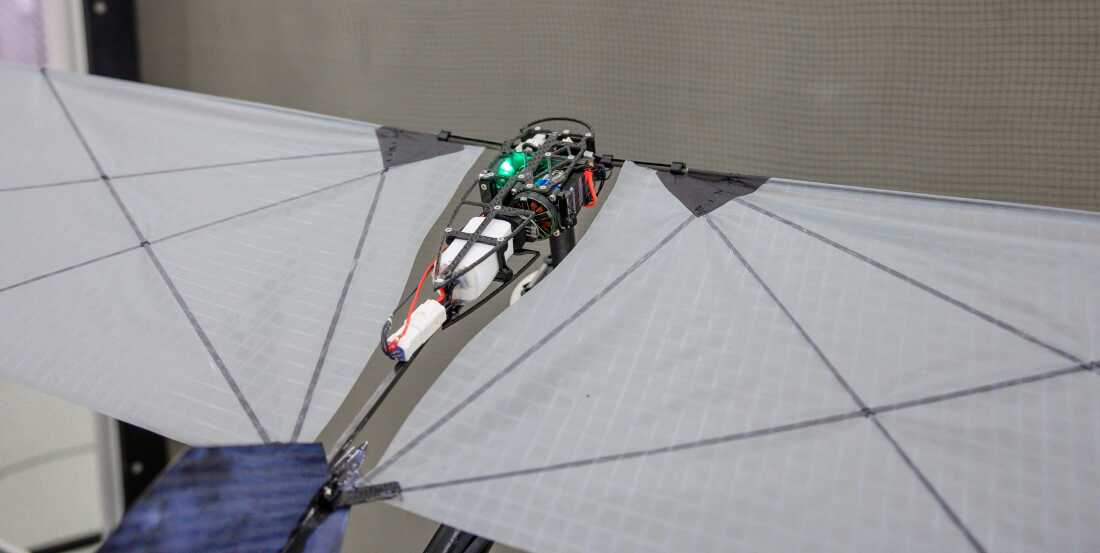 The robot's open body design keeps it neutrally buoyant in water, meaning it won't float to the surface or sink to the bottom. It just stays put in the water. **Raphael Zufferey** ****hide caption**** ## **toggle caption** ### Raphael Zufferey The robot has a tail to help it fly. The wings are made from a translucent nylon fabric reinforced with carbon fiber struts. Zufferey holds the body of the robot while its wings flap up and down crisply and quickly. "You can really feel the forces," he says. The robot flaps five to six times a second to maintain flight. To leave the water and propel itself into the air, however, it must move its wings ten times a second to generate sufficient speed and thrust. Most diving birds can't generate that kind of power with their wings alone, which is why they take off by using their legs to run along the water's surface. (The kingfisher is an exception but it is an especially light bird, says Zufferey.) ### **"A monumental step"** Zufferey calls up a video that he and his colleagues filmed at Lake Geneva in Switzerland. The Alps rise up in the distance and the water's surface is placid. There's the slightest of ripples before the robot bursts out of the water and into the air — all in less than a second. It actually sounds like a bird taking flight. The researchers computed the optimal launch angles and wing size. And they estimate that on a single charge, the robot could fly for not quite four miles or swim for a bit more than a mile, "which is longer than the running and swimming portion of a sprint triathlon," observes Clifton. 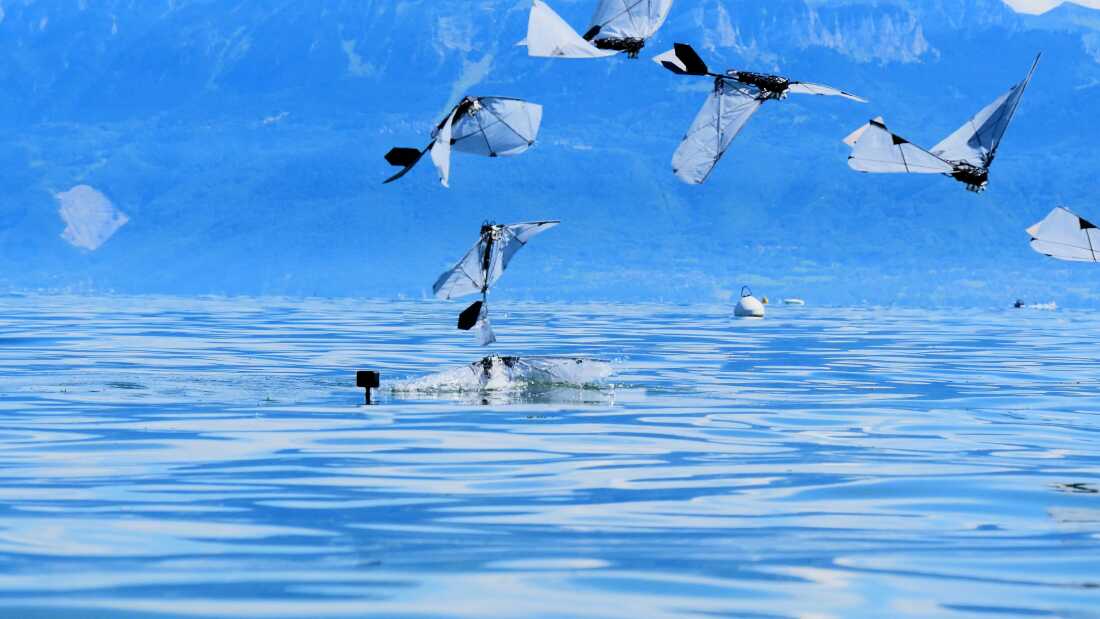 A photo-illustration shows the flight arc of the robot, as it leaves the water and soars into the air. **Raphael Zufferey** ****hide caption**** ## **toggle caption** ### Raphael Zufferey She was impressed by the robot overall. "It is light and powerful and a monumental step in the performance at both swimming, flying, and transitioning between the two," she says. Down the road, Zufferey is excited about using this kind of robot for a range of applications, including monitoring harmful algal blooms, fish stocks, and coastal erosion. He plans to equip the device with a handful of onboard sensors to enable such data gathering. In addition, Zufferey and his team are continuing to refine and improve their aerial-aquatic robots — honed by experimentation but still inspired by the natural world. "You see that it has already been done in biology," he says. "So that gives you hope as a robotics researcher. It tells you that it should be possible."
A new kind of robot swims the seas and soars the skies

Originally reported by NPR Science ↗ · Rewritten for clarity and brevity by Brightcast
Brightcast Impact Score (BIS)
This article describes a significant scientific achievement: the creation of a robot capable of both flying and swimming, inspired by diving seabirds. This represents a notable breakthrough in robotics and engineering, with clear evidence of successful testing. The innovation has high potential for future applications.
Emotional uplift and inspirational potential
Audience impact and shareability
Source credibility and content accuracy
Major proven impact
Start a ripple of hope
Share it and watch how far your hope travels · View analytics →
Wall of Hope
0/20Be the first to share how this story made you feel
How does this make you feel?
Connected Progress

Scientists Create Plastic That Blocks Heat Without Losing Strength
Material science breakthroughs enable new designs, from multi-environment robots to heat-blocking plastics.
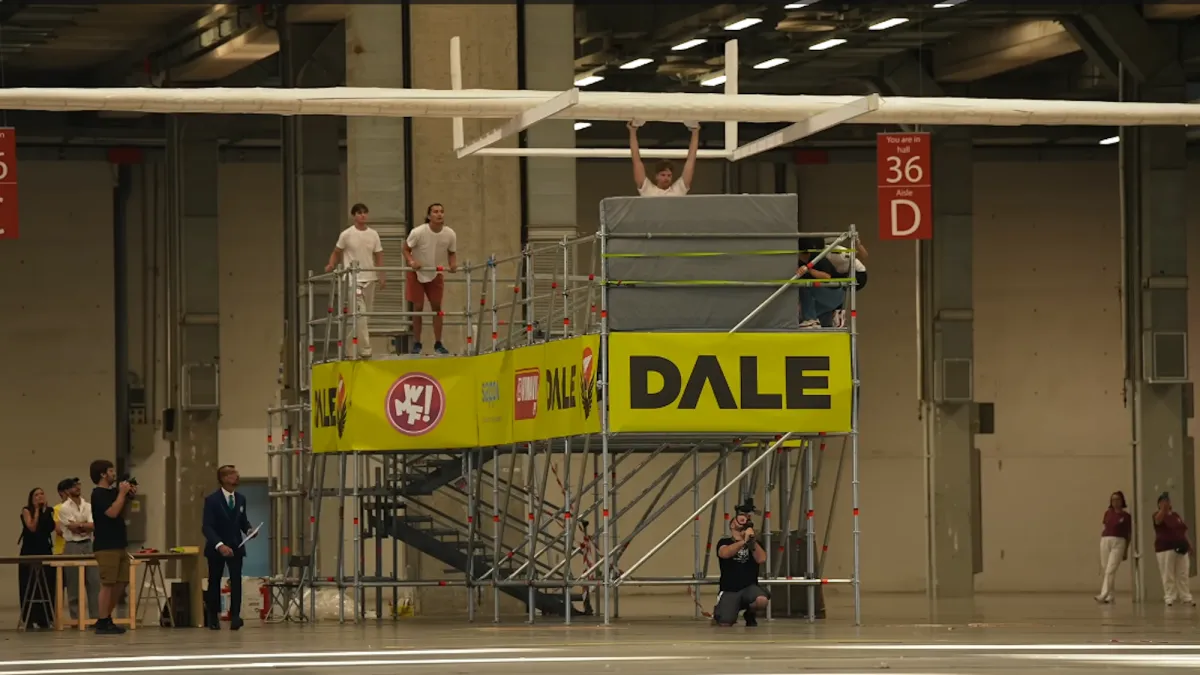
A 65-Foot Paper Airplane Just Flew Into the Record Books
Ingenuity in flight: a robot taking to the sky from water and a massive paper plane breaking records.
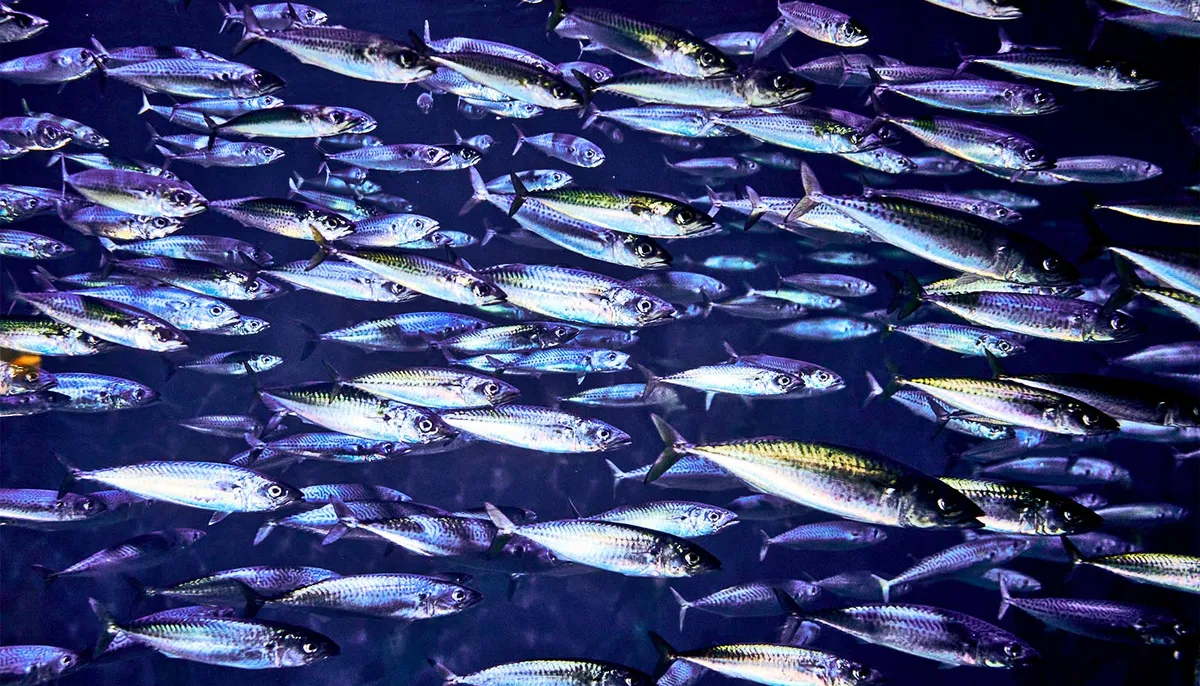
Bird Flocks and Fish Schools Are Just Fancy, Floppy Crystals
Complex natural movements inspire engineers, from robot flight to understanding crystal-like animal formations.
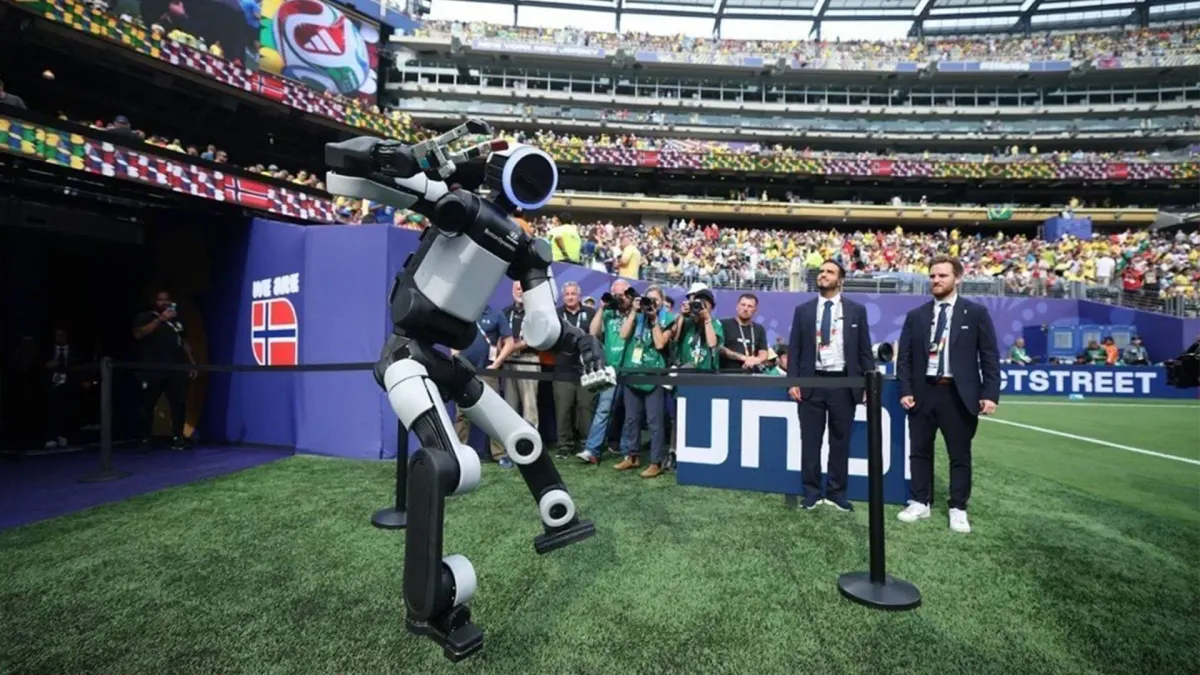
A Robot Just Stole the World Cup Halftime Show. Take That, Shakira.
Robotics push boundaries, from aerial-aquatic drones to humanoid performers captivating global audiences.
Sources: NPR Science
More stories that restore faith in humanity

World’s first transatlantic robotic stroke surgery performed from Florida to Dundee
World's First Transatlantic Robotic Stroke Surgery Performed A robot has collapsed the Atlantic Ocean into a blink, bringing remote stroke treatment closer to reality than ever before. Hours after Professor Iris Grunwald of Dundee performed the w...

Fei-Fei Li wins Queen Elizabeth Prize for Engineering
Fei-Fei Li, founding co-director of the Stanford Institute for Human-Centered AI (HAI) and a pioneering computer scientist, was named a laureate of the Queen Elizabeth Prize for Engineering. The prestigious award, presented by His Majesty King Charle...

Robert Therrien’s World of Everyday Wonder Emerges in a LA Retrospective
Robert Therrien's World of Everyday Wonder Emerges in a LA Retrospective When Robert Therrien passed away in 2019 at 71, he left behind a series of small note cards, each bearing a labeled line drawing. To those closest to him, they felt like leg...

An improved way to detach cells from culture surfaces
Anchorage-dependent cells require physical attachment to a solid surface, such as a culture dish, to survive, grow, and reproduce. In the biomedical industry and others, culturing these cells is crucial, but current techniques used to separate them f...

Researchers Have Identified the Names of Five Million Victims Murdered in the Holocaust
Led by Israel's Yad Vashem, the initiative has been underway since the 1950s. But it recently got a boost from artificial intelligence, which is helping humans search through the records. :focal(3360x2240:3361x2241)/https://tf-cmsv2-smithsonianm...
Student Inventors Create Low-Cost Prosthetics Using 3D Printing
A team of high school students from California has developed a revolutionary approach to creating prosthetic limbs using 3D printing technology. Their designs cost just $50 to produce, compared to traditional prosthetics that can cost thousands of do...