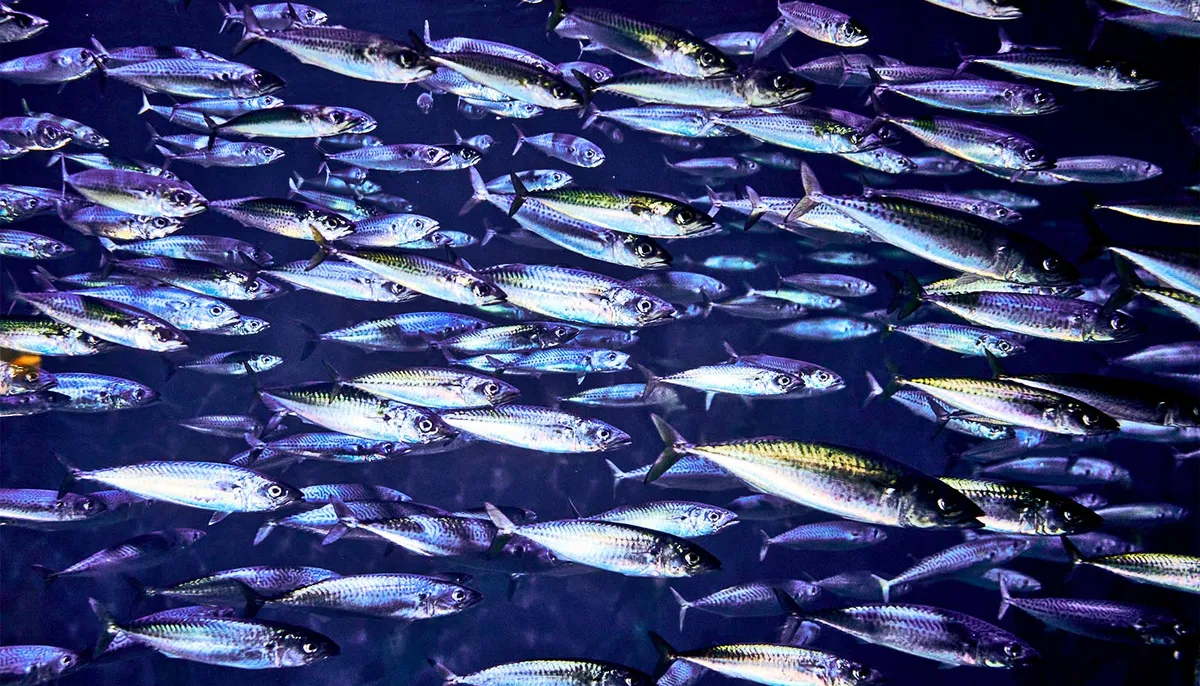
For centuries, the synchronized ballet of a bird flock or a fish school has captivated us. How do they do that without constant fender benders? Turns out, the secret isn't some complex hive mind. It's far weirder: they're basically acting like a soft, squishy crystal.
Yes, a crystal. Not the kind you find in a geode, but a material where individual birds or fish are like "atoms" — each perfectly spaced, held together by invisible, spring-like bonds. Picture it: an elastic, orderly line of individuals, much like the atoms in a soft crystalline substance. Which, if you think about it, is both impressive and slightly terrifying.
Leif Ristroph, who directs NYU’s Applied Mathematics Laboratory, put it rather elegantly: these movements are like the "building blocks of materials." His lab had already figured out how these creatures avoid mid-air or mid-water collisions. But the exact nature of their synchronized shimmy? That remained a mystery. Until now.
We're a new kind of news feed.
Regular news is designed to drain you. We're a non-profit built to restore you. Every story we publish is scored for impact, progress, and hope.
Start Your News DetoxThe Squishy Crystal Model
Enter Christiana Mavroyiakoumou from Oxford and Jiajie Wu, who, along with their team, cooked up a mathematical model. It proposes that these formations behave exactly like "soft crystalline materials." These aren't your grandma's diamonds; soft crystals can shift their properties based on things like temperature or force, making their atomic structure delightfully delicate.
And that's the key. Birds and fish are constantly adjusting their formations in response to air currents, water flows, predators, or that one overly enthusiastic tourist with a selfie stick. Mavroyiakoumou explains that this inherent fragility is actually a superpower. Their positions can easily deform, allowing them to instantly react and maintain those impossibly long, column-like formations. It's less about rigid control and more about flexible, collective jello.
Putting the Theory to the Test
To make sure they weren't just making things up, the researchers dug into past experiments. One particularly inventive setup involved "mechanized flappers" – basically, 3D-printed plastic bird wings flapping in water. This "mock flock" moved at various speeds, effortlessly arranging itself into lines, just as the model predicted. The flappers, it seems, got the memo.
So, next time you see a murmuration of starlings painting the sky, remember: you're not just watching birds. You're witnessing a living, breathing, incredibly flexible crystal. And that's a dinner party fact worth sharing.