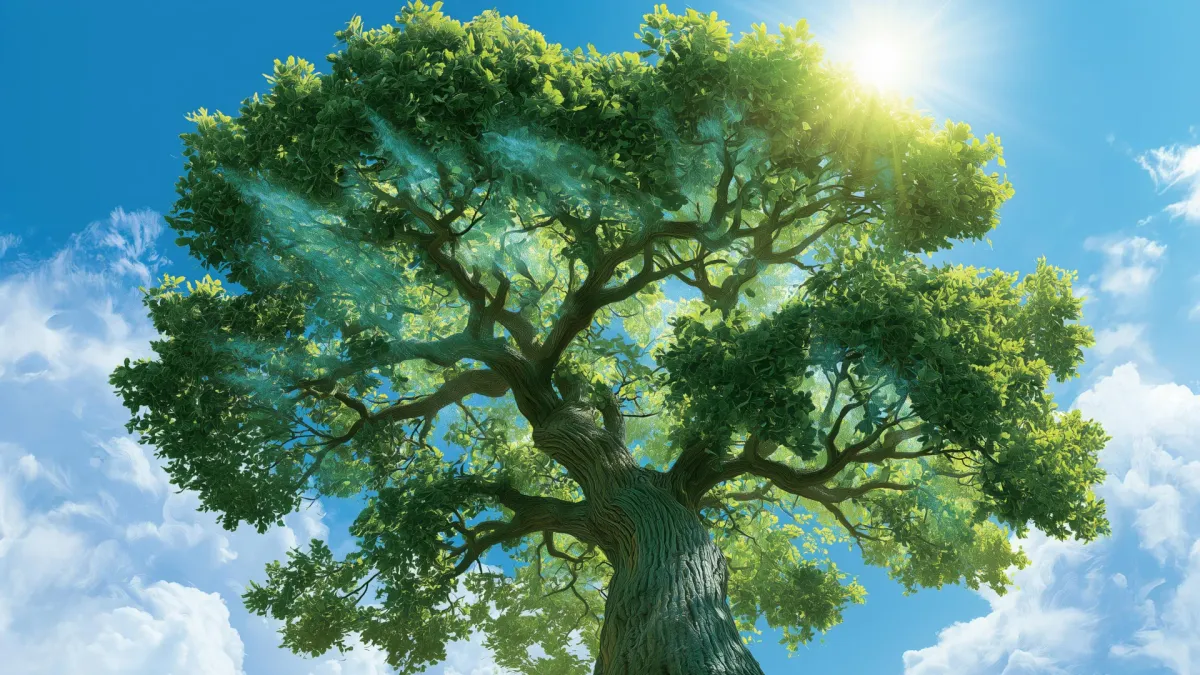
Turns out, a tree can keep chugging carbon dioxide long after it's decided to call it quits on growing for the year. This isn't just a fun fact for your next dinner party; it's a finding that could seriously shake up how we predict Earth's carbon future.
For decades, the scientific community largely assumed that when a tree was photosynthesizing, it was also busy building new wood. More CO2 in the air? More photosynthesis! More photosynthesis? More growth! More growth? More carbon locked away in big, sturdy tree trunks! Simple, elegant, and apparently, not entirely accurate.
A new study in Science Advances just dropped, revealing that oak trees are essentially working overtime. They’re sucking in carbon months after their annual growth spurt is over. Which means the link between photosynthesis (the carbon-grabbing part) and wood production (the long-term storage part) is a lot more complicated than we thought. Think of it as your phone still running apps in the background even when you’re not actively using it. Except, you know, for the planet.
We're a new kind of news feed.
Regular news is designed to drain you. We're a non-profit built to restore you. Every story we publish is scored for impact, progress, and hope.
Start Your News DetoxThe Carbon Conundrum
Forests are our VIPs in the fight against climate change, diligently pulling CO2 from the atmosphere and stashing it away. But if not all that captured carbon turns into hardy wood, where does it go? The researchers found it might be used for things like producing leaves, short-term energy needs, or even enriching the soil around the tree. All good things, but not exactly the long-term carbon vault we were hoping for.
This distinction matters. A lot. Mukund Palat Rao, an ecoclimatologist at Lamont-Doherty Earth Observatory, points out that most climate models operate on the assumption that photosynthesis directly equals growth. This new data suggests that assumption might be a little too optimistic, potentially leading us to overestimate how much carbon forests can actually store as the planet warms.
Growth Spurt vs. Carbon Guzzle
To figure this out, Rao and his team went full detective. They analyzed satellite images showing photosynthesis rates across 137 oak forests in the eastern U.S. and California. They used instruments to measure CO2 levels in tree canopies hourly and even attached sensors to tree trunks to track daily, microscopic changes in size. (Trees expand at night when they drink water and shrink slightly during the day as they release it — over time, that adds up to growth.) They also dug into tree ring records and temperature data stretching back to 1950.
What they found was a clear disconnect. In the eastern U.S., oaks grew from May to July but kept photosynthesizing until October. That's right: 36% of their annual carbon absorption happened after they’d stopped growing. California oaks showed the same pattern, just on a different schedule, with 26% of their carbon uptake happening post-growth.
Why the lag? Rao explains that tree growth is all about internal water pressure. Hot, dry conditions make that pressure drop, effectively hitting the pause button on growth. Photosynthesis, however, is a bit more resilient and can keep humming along, albeit at a slightly lower rate.
So, what happens to all that extra carbon? Some gets saved for next season's growth, some goes into new roots and leaves, and some is used to keep the tree's cells alive through winter. But exactly how much becomes long-term woody biomass versus how much cycles back into the atmosphere sooner is still a big question mark. This means those rosy predictions of ever-larger, carbon-guzzling forests in a warmer, CO2-rich world might need a serious re-evaluation.
To make things even more interesting (and slightly worrying), the team noticed this gap between growth and photosynthesis widened in years with extreme wet and dry weather swings. And guess what climate change is expected to bring more of? Exactly.
Rao and his colleagues are now expanding their research to other tree species and ecosystems. Because, apparently, even trees have their secrets. And those secrets could change everything we thought we knew about their role in our planet's future.