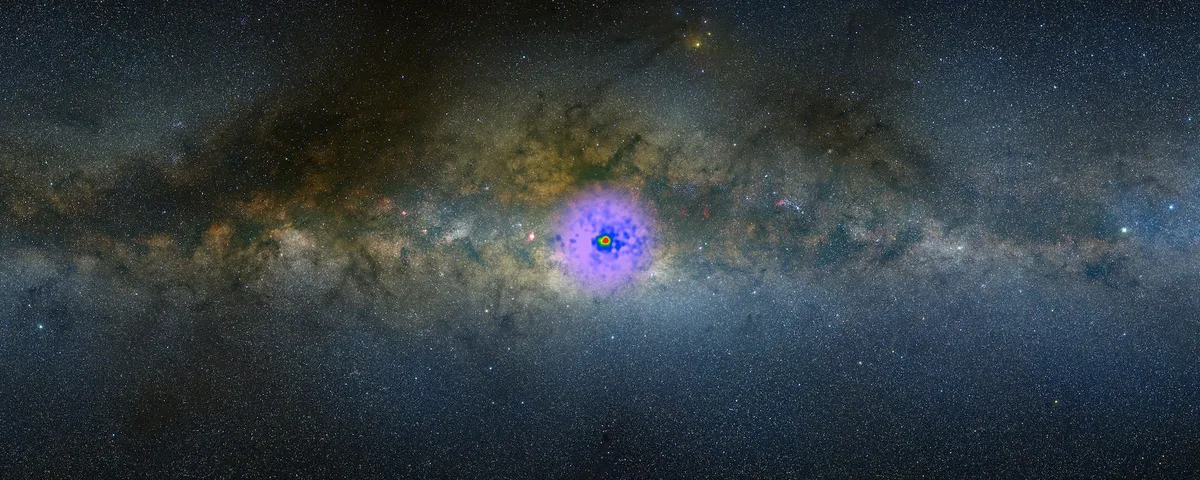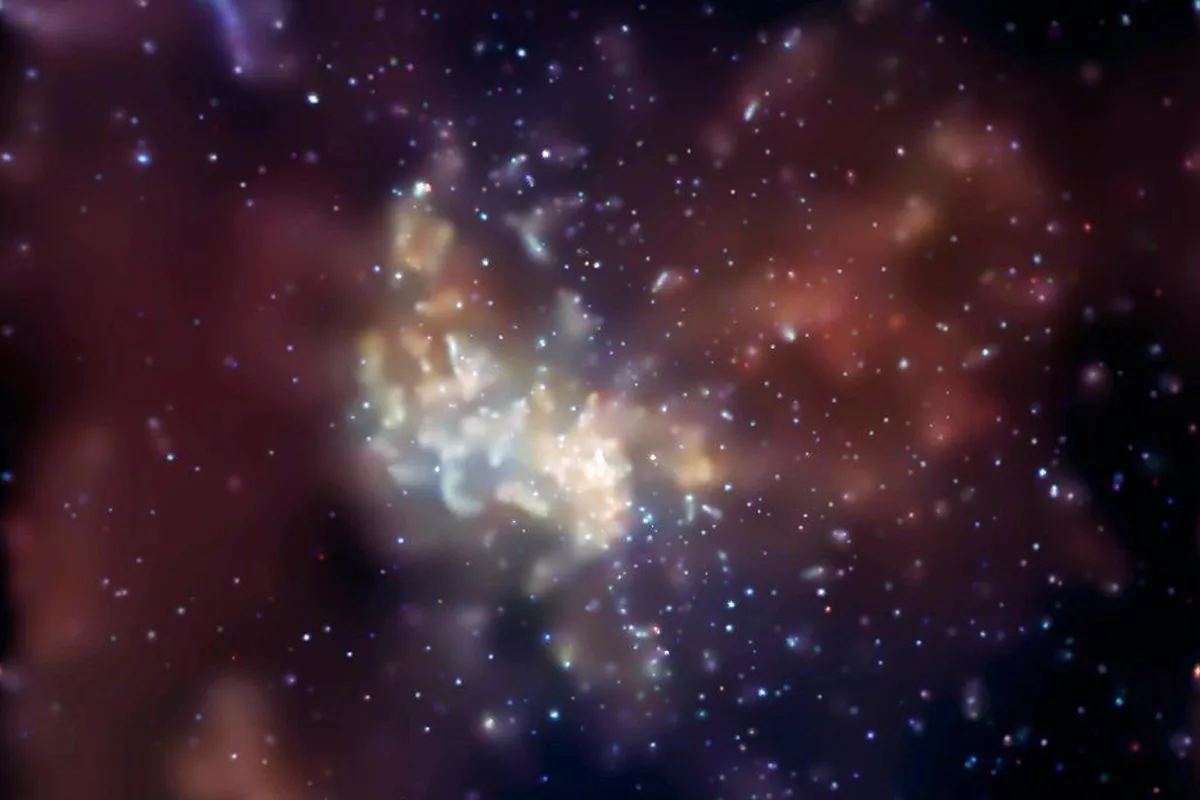
For years, astronomers have been watching a few peculiar, dusty objects near the supermassive black hole at the heart of our Milky Way, Sagittarius A*. The prevailing theory? That Sgr A* was slowly but surely stretching these cosmic dust bunnies into oblivion, like a cosmic taffy puller.
Turns out, Sgr A* might be a little more chill than we gave it credit for. New observations reveal these objects aren't getting spaghettified at all. They're just... chilling in stable orbits.
An international team, led by Dr. Florian Peißker at the University of Cologne, used the ERIS instrument at the Very Large Telescope (VLT) in Chile to get a closer look. What they found was a cosmic surprise, published in Astronomy & Astrophysics: several dusty objects are simply following their own stable paths around Sagittarius A*.
We're a new kind of news feed.
Regular news is designed to drain you. We're a non-profit built to restore you. Every story we publish is scored for impact, progress, and hope.
Start Your News DetoxThe Dust Bunnies Are Doing Just Fine
Take G2, for instance. This famous object was once thought to be a simple cloud of gas and dust, destined for a dramatic gravitational demise. Scientists imagined Sgr A*'s immense gravity would pull it into a long, stringy shape – a process delightfully dubbed 'spaghettification' – before tearing it apart completely.
But ERIS, which peers into the near-infrared, showed G2 holding its shape, staying in a perfectly stable orbit. The new theory? It's likely hiding a star inside. Which, if you think about it, is both impressive and slightly terrifying for the star. This discovery suggests that the galactic center isn't just a demolition derby; it's also a surprisingly stable neighborhood for certain celestial bodies.
And G2 isn't alone. D9, a binary star system discovered by Peißker's team in 2024, is also remarkably intact. Despite the extreme tidal forces near the black hole, these two stars are still orbiting each other. While theory might suggest such intense gravity would force them to merge, ERIS data shows D9 has survived. Objects X3 and X7 are also continuing their stable orbits, proving far more durable than anyone had predicted.
Dr. Peißker finds it fascinating that these objects are moving so stably near a black hole, noting that Sgr A* is proving to be less destructive than previously thought. This makes the center of our galaxy a prime location to study how black holes and stars interact without everything immediately getting torn to shreds.
In fact, Michal Zajaček from Masaryk University in Brno, Czech Republic, explained that the supermassive black hole might even encourage star formation and create these exotic dusty objects, possibly through the merging of binary stars. So, less of a cosmic vacuum cleaner, more of a strange, star-birthing crucible.
Future observations with ERIS and the even more powerful Extremely Large Telescope (ELT), currently under construction, will help astronomers continue to track these resilient objects. Because apparently, even in the universe's most extreme environments, some things just refuse to be torn apart.